Designing a Ticket Booking System
A system design interview guide to selling a fixed, limited inventory of seats under heavy contention — a Ticketmaster-style onsale where a huge crowd arrives at once, everyone wants the same few seats, and you must never sell the same seat twice.
A ticket booking system looks like a simple CRUD app right up until the moment a popular event goes on sale. Then tens of thousands of people hit the same endpoint in the same second, all competing for the same finite pool of seats, and the design problem becomes one of the hardest in distributed systems: enforcing a strict count of inventory under extreme concurrency without ever overselling. You cannot apologize your way out of selling seat 12A to two different people. This guide builds a design that survives the thundering herd at onsale, holds seats safely while a buyer checks out, prevents double-booking with proper concurrency control, sheds load with a waiting room, and confirms payment idempotently — all while choosing consistency over availability for the one thing that must never be wrong: the seat count.
Contents
1. The Core Challenge
Strip the system down and the difficulty is a single sentence: there is a fixed number of seats and, for a hot event, a vastly larger number of people trying to buy them in the same instant. Two facts make this brutal. First, inventory is hard-limited — once the seats are gone they are gone, and the count must be exact. Second, demand arrives as a thundering herd: a sharp, coordinated spike at the onsale moment rather than a smooth stream.
The cardinal sin is overselling — confirming more buyers than there are seats. It is not a glitch you can paper over; it means someone shows up to the venue without a seat. Avoiding it under massive concurrency, when thousands of requests are racing to grab the last few seats at once, is the entire game. A few requirements fall out of this immediately:
- Never oversell. The confirmed count must never exceed the real inventory, no matter how many requests collide.
- Survive the spike. The system has to absorb an onsale burst that may be orders of magnitude above steady-state traffic.
- Be fair and predictable. Users need a coherent experience — a clear place in line, a clear answer about whether they got a seat — rather than random failures.
2. The Reservation / Hold Pattern
The key insight that makes checkout workable is that buying a seat is not instantaneous — the user needs time to enter payment details and confirm. If a seat stayed "available" during that window, two people could both pay for it. So a seat moves through a small lifecycle, and the middle state is a temporary hold.
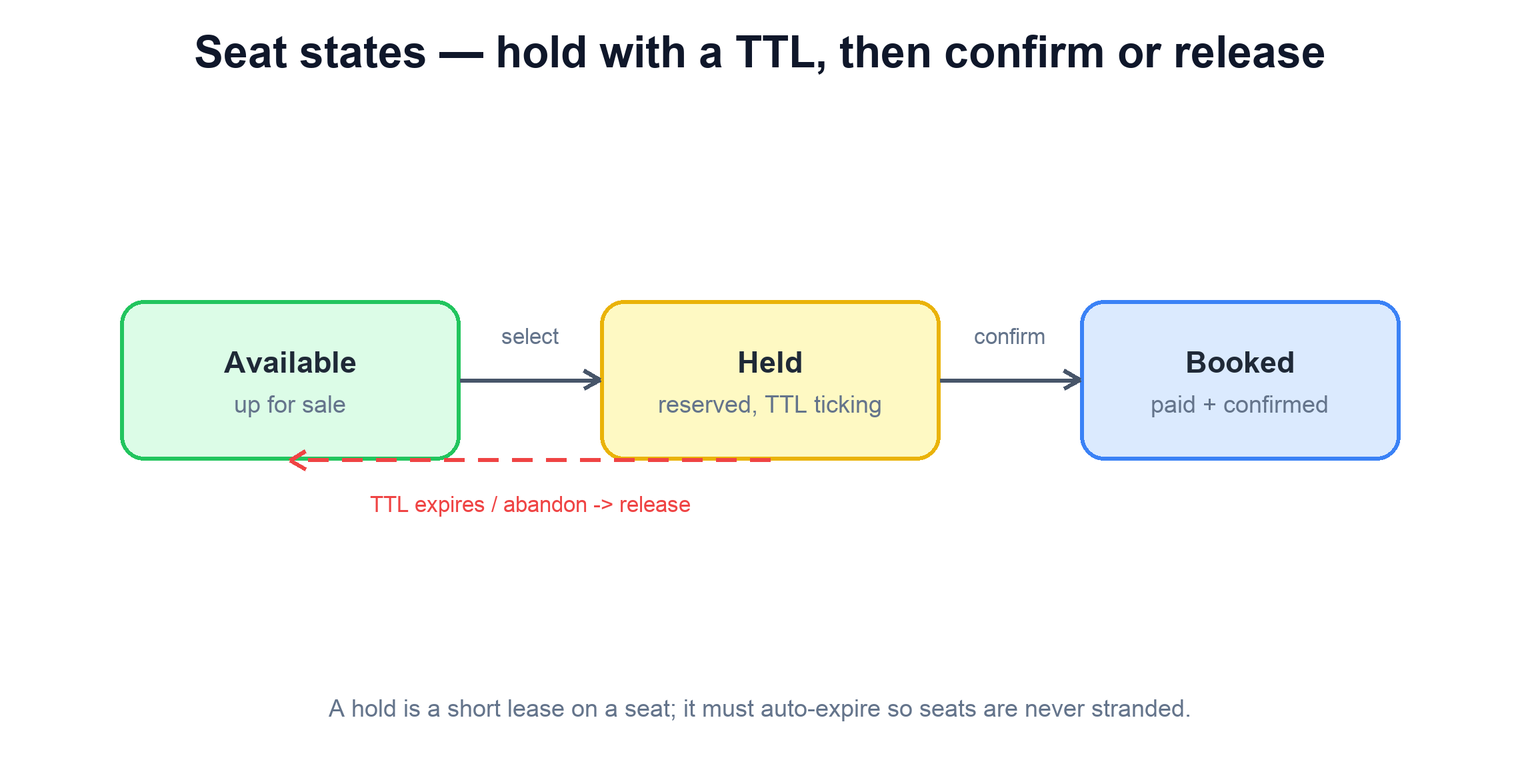
The hold is best understood as a short-lived lease on the seat. When a user picks a seat, the system reserves it for them for a bounded window — say a few minutes — with an attached TTL. During that window no one else can take it. The user then either confirms (the seat becomes booked) or lets the clock run out (the seat is released back to the pool). The states are:
| State | Meaning | Transitions out |
|---|---|---|
| Available | Up for sale, anyone can take it. | → Held, when a user selects it. |
| Held | Reserved for one user, TTL ticking. | → Booked on confirm; → Available on expiry/abandon. |
| Booked | Paid for and confirmed; terminal. | (stays booked) |
function hold_seat(user_id, seat_id):
  if not try_claim(seat_id, holder=user_id, ttl=5min):
    return SEAT_TAKEN                         # someone got it first
  return HELD                                 # reserved; user can now check out

function confirm(user_id, seat_id, payment):
  if not holds(seat_id, by=user_id):
    return HOLD_EXPIRED                       # TTL ran out before checkout
  charge(payment)
  mark_booked(seat_id, user_id)
  return BOOKED
The TTL is what keeps the system honest: it guarantees a seat can never be stranded forever by a user who walked away mid-checkout. Without an expiring hold, abandoned carts would slowly lock up the entire inventory.
3. Preventing Double-Booking
The hold pattern only works if claiming a held seat is atomic. The dangerous moment is when two buyers try to grab the same available seat at the same instant. If the check ("is it free?") and the claim ("take it") are separate steps, both can read "free" and both can take it — a classic race that ends in a double-booking. The fix is to make the read-and-claim a single indivisible operation. There are three standard ways to do it.
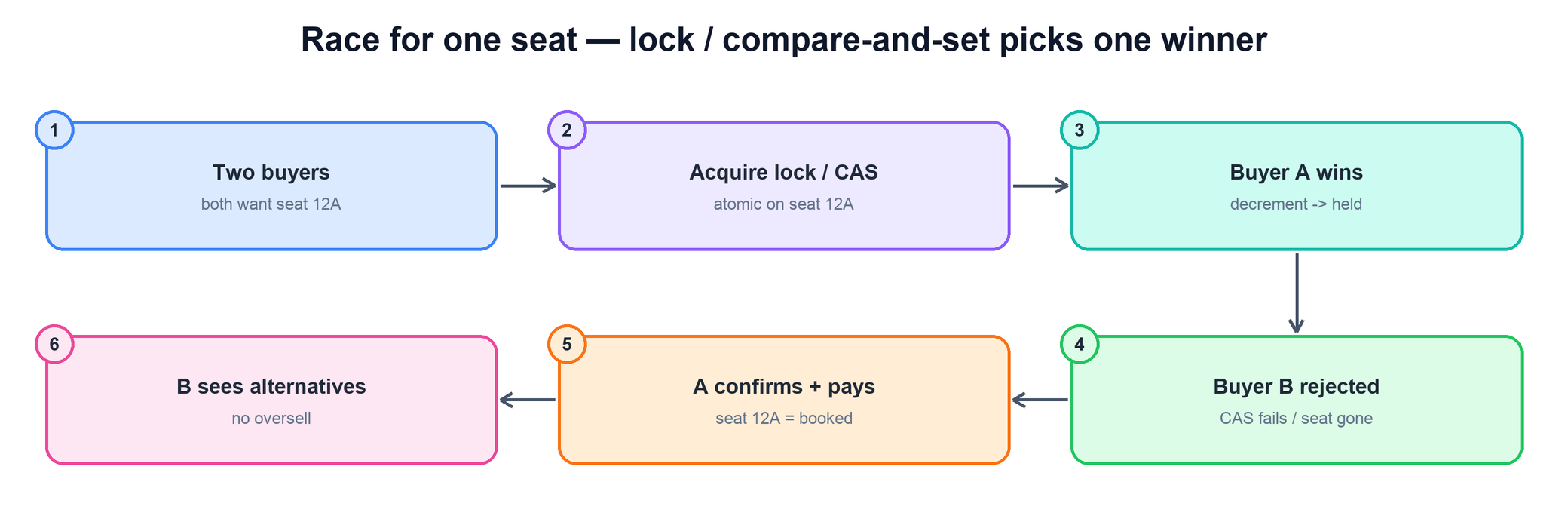
- Database row lock (pessimistic). The buyer's transaction locks the seat's row (a
SELECT ... FOR UPDATE), checks it is available, and updates it to held — all inside one transaction. Any concurrent buyer blocks on the lock and, by the time it proceeds, sees the seat is taken. Simple and correct, but the lock can become a contention bottleneck on a single hot seat. - Optimistic concurrency / compare-and-set. No lock is held. The buyer reads the seat with a version number and attempts an update that only succeeds if the version is unchanged. If another buyer got there first, the version moved, the update affects zero rows, and this buyer is told to retry or pick another seat. Cheap when contention is moderate.
- Atomic decrement of remaining inventory. For general-admission tickets where seats are interchangeable, you do not track individual seats — you keep a single counter of remaining tickets and decrement it atomically, rejecting any decrement that would take it below zero. One atomic operation enforces the cap.
# optimistic: claim only if the seat's version hasn't changed
function try_claim(seat_id, holder):
  seat = db.get(seat_id)
  if seat.status != "available":
    return False
  updated = db.update(
    seat_id, set={status: "held", holder: holder},
    where={version: seat.version})           # compare-and-set
  return updated.rows == 1                    # 0 rows = someone beat us

# general admission: one atomic decrement guards the cap
function take_one(event_id):
  remaining = db.decr_if_positive(event_id)  # atomic; refuses below zero
return remaining is not None4. The Virtual Waiting Room
Atomic claims keep the data correct, but they do nothing to protect the system from being flattened by the onsale spike. If a hundred thousand people hit the booking service in the same second, the database and application tier fall over regardless of how careful the locking is. The answer is to put a virtual waiting room in front of the booking flow and admit users at a controlled rate.
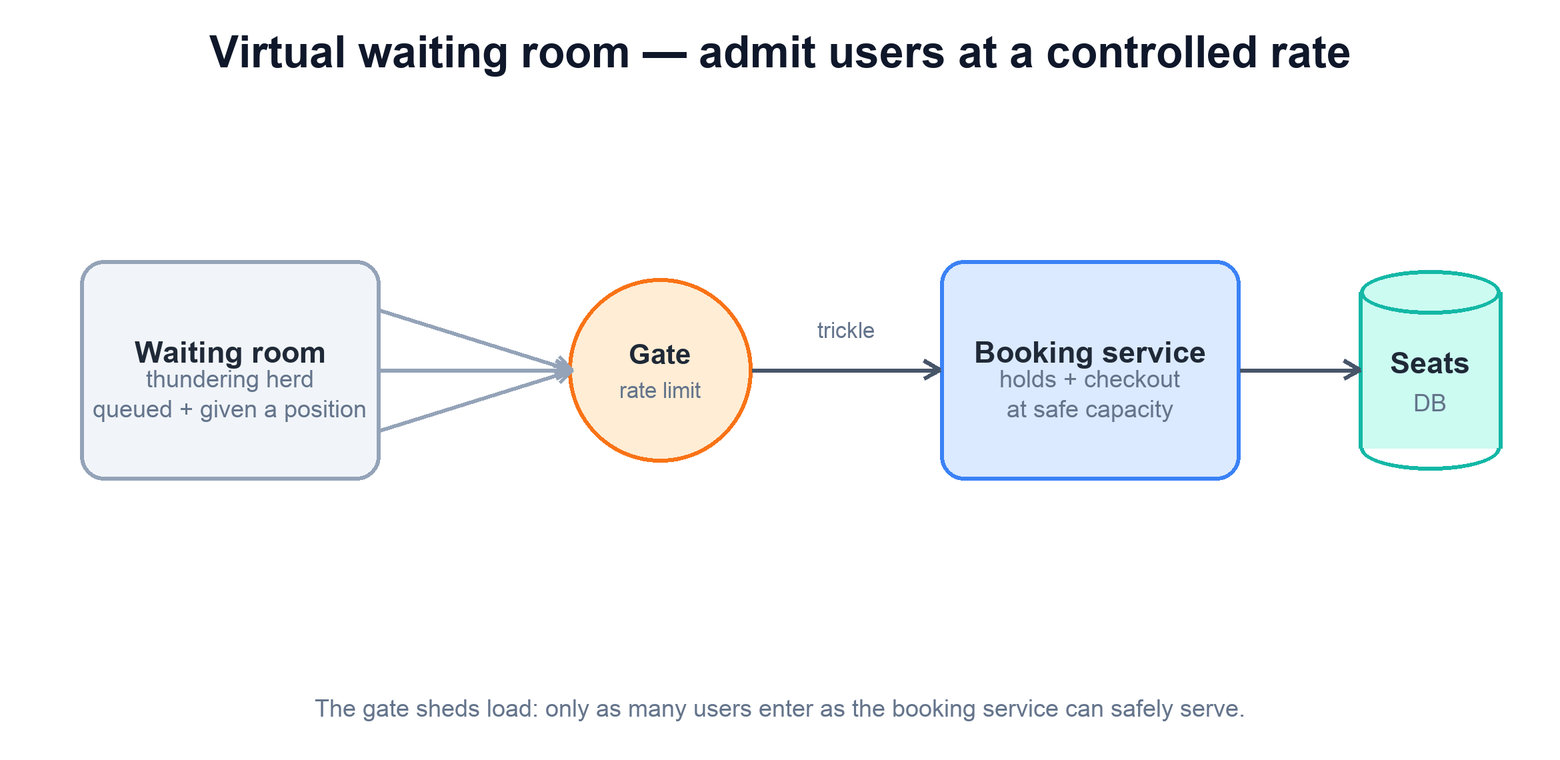
The waiting room turns a chaotic stampede into an orderly line. Everyone who arrives is parked in a queue and given a position; a gate then drips them through into the actual booking service at a rate the service can sustain. This does three things at once:
- Load shedding. The booking service only ever sees as much traffic as it can handle. The spike is absorbed by the queue instead of the database.
- Fairness. Admitting people roughly in arrival order is far better than the random success-and-failure of an unprotected free-for-all.
- Honesty. A user who has no realistic chance can be told their position up front, rather than being failed after they have already invested effort.
function enter_waiting_room(user_id):
  pos = queue.push(user_id)                   # everyone gets a place in line
  return {position: pos}

# the gate admits at a sustainable rate (token bucket)
function admit_loop():
  while True:
    if booking_service.has_capacity():
      user = queue.pop()                      # release one into checkout
      grant_access(user, ttl=10min)
    sleep(admit_interval)
5. Idempotent Payment and Confirm
Once a user is admitted and holding a seat, they pay and confirm. Payment is where retries are most dangerous: networks drop, users double-click, and a confirm request may legitimately arrive more than once. If the system processes the same confirmation twice, it could double-charge the user or tangle the booking. The defense is idempotency.
Each confirm request carries a unique idempotency key. The first time the system sees that key it performs the charge and books the seat and records the outcome against the key. If the same key arrives again — a retry — the system recognizes it, skips the duplicate work, and returns the original result. The buyer is charged once and gets one seat no matter how many times the request is replayed.
function confirm_booking(idempotency_key, user_id, seat_id, payment):
  existing = idempotency.get(idempotency_key)
  if existing:
    return existing.result                    # replay: return prior outcome
  charge_once(payment)                         # the money-moving step
  mark_booked(seat_id, user_id)
  result = {status: "BOOKED", seat: seat_id}
  idempotency.put(idempotency_key, result)     # remember it for retries
return result6. Releasing Expired Holds
Holds exist to give buyers time, but every hold that is not confirmed must eventually return its seat to the pool — otherwise abandoned carts would slowly starve the inventory. The TTL on each hold is the mechanism, and the system needs a reliable way to act on expiry so that a seat held by someone who wandered off becomes buyable again.
There are two common approaches, and robust systems often combine them:
- Lazy expiry. The hold record carries an expiry timestamp. Any later attempt to act on the seat first checks whether the hold has lapsed; if so, it is treated as available. This needs no background job but only reclaims a seat when someone happens to look at it.
- Active sweeping. A background process (or a store with native TTL expiry) periodically finds expired holds and flips those seats back to available. This proactively returns inventory so it does not sit idle while demand is waiting.
# background sweep: reclaim seats whose hold TTL has passed
function sweep_expired_holds():
  for hold in db.holds.where(expires_at < now(), status == "held"):
    db.update(hold.seat_id, set={status: "available", holder: null})
    log.info("released expired hold", seat=hold.seat_id)
Releasing promptly matters most precisely when demand is highest: at onsale, a seat freed a minute after an abandoned checkout is a seat another eager buyer can still grab.
7. Consistency over Availability
Distributed systems force a choice when a network partition happens: do you keep serving requests with possibly-stale data (availability), or do you refuse rather than risk being wrong (consistency)? For ticket inventory the answer is unambiguous — choose consistency. It is far better to tell a user "try again in a moment" than to confirm a seat you cannot actually deliver.
This is the philosophical core of the design. Inventory is the one piece of state that must be strongly consistent, because the cost of an inconsistency is a real person denied a real seat. Concretely, that means the seat count and its atomic claims live in a strongly consistent store, and under failure the system prefers to reject a booking attempt rather than allow two nodes to independently sell the same seat.
- Inventory is strongly consistent. The seat count and claim operations run against a store that guarantees a single, agreed-upon truth, even if that limits raw throughput.
- Reject rather than oversell. When the system cannot be certain a seat is free, it declines the request. A failed booking is recoverable; an oversold seat is not.
- Read-heavy paths can relax. Browsing the seat map or event listings can tolerate slightly stale data and be served from caches — but the moment of claiming a seat cannot.
8. Scale at Onsale
Everything above has to hold up under the single hardest moment: the onsale spike. The traffic pattern is extreme and short — a massive burst, then a rapid taper as seats sell out — so the system is tuned to absorb and flatten that burst rather than to scale infinitely.
- Queue absorbs the burst. The virtual waiting room is the primary spike defense, converting a stampede into a steady, sustainable trickle into the booking service.
- Cache the read path. Seat maps, event details, and availability summaries are served from caches so the strongly consistent store is reserved for the actual claim operations.
- Keep claims fast and atomic. Whether via row locks, compare-and-set, or atomic decrement, each claim is a single quick operation, minimizing how long any hot seat is contended.
- Isolate the hot event. A single blockbuster onsale can be partitioned onto dedicated capacity so it does not degrade booking for every other event on the platform.
The unifying idea is to protect the one scarce, consistency-critical resource — the inventory store — by keeping everything else (queuing, browsing, payment processing) off its back. The queue flattens the spike, caches absorb the reads, and the consistent core does only the irreducible work of claiming seats exactly once.
9. Summary
A ticket booking system is a distributed counting problem: sell an exact, limited inventory under a thundering herd without ever overselling. Its design is a set of reinforcing decisions:
| Concern | Mechanism |
|---|---|
| What makes this hard? | Fixed inventory plus a thundering herd at onsale; overselling is unacceptable. |
| How do users hold a seat while checking out? | A reservation with a TTL: available → held → booked, or released on expiry. |
| How do we prevent double-booking? | Atomic claims: DB row locks, optimistic compare-and-set, or atomic inventory decrement. |
| How do we survive the onsale spike? | A virtual waiting room that queues users and admits them at a controlled rate. |
| How do we avoid double-charging? | Idempotent payment and confirm keyed by an idempotency key. |
| How do abandoned holds get freed? | TTL-based release via lazy expiry checks plus a background sweep. |
| What do we do under failure? | Choose consistency over availability — reject rather than oversell. |
| How do we handle onsale scale? | Queue absorbs the burst, caches serve reads, the consistent core only claims seats. |