Thinking, Fast and Slow — High-Level Learnings
A practical, high-level summary of the ideas in Thinking, Fast and Slow by Daniel Kahneman — how the two systems of the mind think, where intuition quietly misleads us, and what to do about it.
The book is a lifetime of research distilled into one argument: much of what we call “thinking” is not deliberate reasoning at all but a fast, automatic machinery that runs beneath awareness and is usually right — until it is confidently, systematically wrong. Kahneman gives that machinery a name, shows the recurring ways it errs, and connects those errors to how we judge, choose, and remember. What follows is a summary of the core ideas in my own words, meant as a study aid; the full book is worth reading for the experiments and the data behind every claim.
Contents
1. Two systems
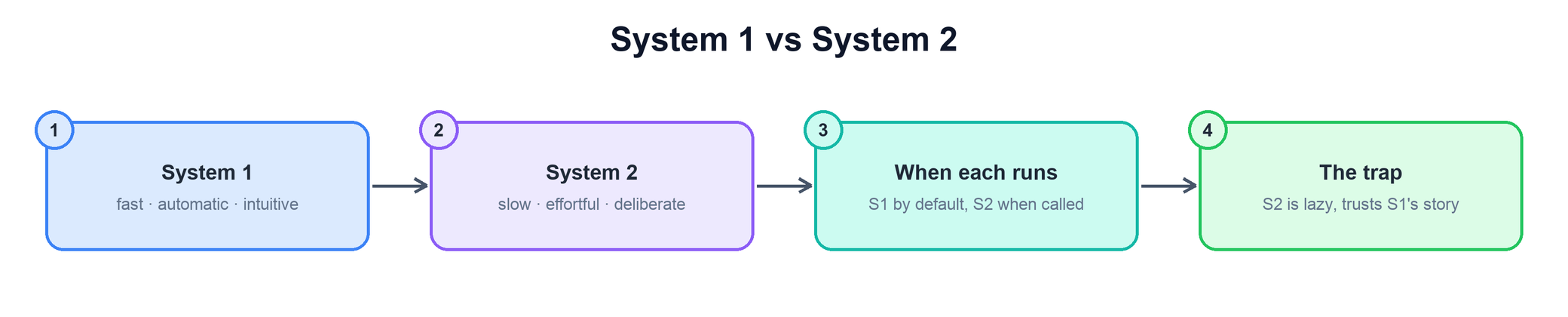
The book’s organizing device is a pair of characters Kahneman calls System 1 and System 2. System 1 is fast, automatic, and effortless — it recognizes a face, reads a word, senses hostility in a voice, completes “bread and…” It is always on, it runs on associations and emotion, and it generates impressions and intuitions with no sense of voluntary control. System 2 is the slow, effortful, deliberate self — the one that multiplies 17 × 24, fills in a tax form, or checks the validity of an argument. It is where we feel our conscious reasoning lives.
The twist is that System 2, despite believing itself to be in charge, is fundamentally lazy. Effortful thinking is metabolically expensive, so System 2 mostly endorses whatever System 1 hands it. Most of the time this division of labor works beautifully. The errors happen at the seams: System 1 produces a confident, coherent answer to the wrong question, and System 2 — not paying close attention — simply signs off.
| Dimension | System 1 (fast) | System 2 (slow) |
|---|---|---|
| Speed | Instant, automatic. | Deliberate, sequential. |
| Effort | Effortless; no sense of work. | Effortful; drains attention and energy. |
| Control | Involuntary; can’t be switched off. | Voluntary; must be engaged on purpose. |
| Typical use | Faces, threats, familiar words, gut feel. | Math, comparison, following rules, self-checks. |
| Failure mode | Jumps to a confident but biased answer. | Too lazy to intervene; rubber-stamps System 1. |
2. How System 1 gets us in trouble
System 1’s job is to build a coherent story from whatever is in front of it, and it is remarkably good at that — too good. Kahneman coins the phrase WYSIATI: “what you see is all there is.” System 1 does not account for information it does not have; it builds the best possible story from the evidence at hand and does not flag how thin that evidence might be. Confidence comes from the coherence of the story, not from the amount or quality of the data behind it. This is why we can hold strong opinions on the flimsiest of facts.
Several related tendencies make things worse:
- Cognitive ease. When something is easy to process — clearly printed, repeated, rhymed, familiar — it feels true, good, and safe. Fluency is mistaken for truth. Making a message easy to read literally makes people more likely to believe it.
- Priming. Exposure to a word, idea, or number quietly shifts later behavior and judgment without our awareness. We think our choices are free-standing when they are nudged by whatever was recently in mind.
- Substitution. When faced with a hard question (“How happy am I with my life?”), System 1 quietly swaps in an easier one it can answer (“What’s my mood right now?”) and answers that instead — without noticing the switch. Most cognitive biases are, at root, this kind of unnoticed substitution.
3. Heuristics & biases
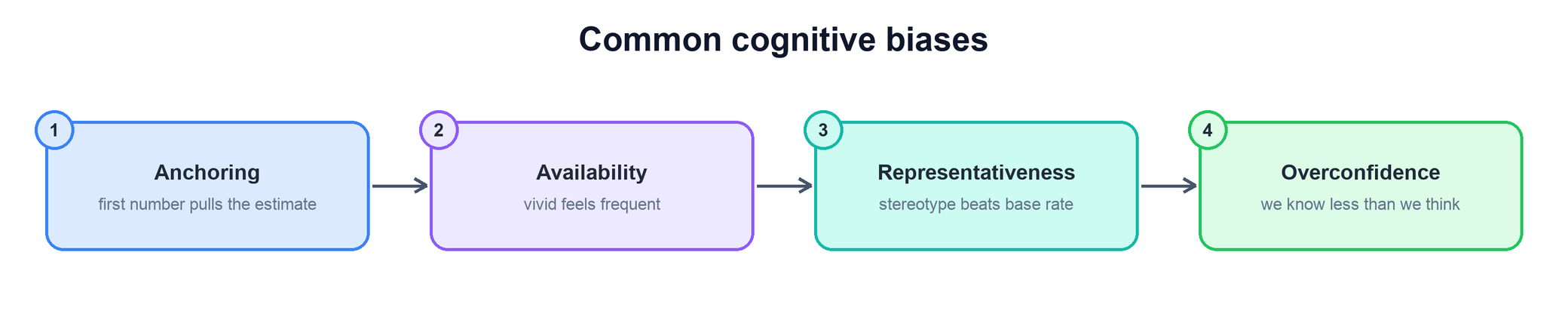
Heuristics are the mental shortcuts System 1 uses to answer hard questions quickly. They are usually helpful, which is exactly why the errors they produce are so hard to see — the same shortcut that works ninety times fails predictably on the tenth. Kahneman’s catalog of these biases is the heart of the book.
| Bias | What it is | Example |
|---|---|---|
| Anchoring | An arbitrary starting number drags the final estimate toward it, even when it’s clearly irrelevant. | See a $1,200 sticker first and $900 feels cheap; a random wheel spin shifts people’s numeric guesses. |
| Availability | We judge how likely something is by how easily examples come to mind — vividness beats frequency. | After a news story about a plane crash we overrate the risk of flying versus driving. |
| Representativeness | We judge probability by similarity to a stereotype and ignore the base rate of how common it actually is. | “Quiet, reads a lot” feels like a librarian, though there are vastly more salespeople than librarians. |
| Halo effect | One salient good (or bad) trait colors our whole impression, making judgments falsely consistent. | A confident, polished speaker is assumed to also be competent and honest. |
| Regression to the mean | Extreme outcomes tend to be followed by more average ones for statistical reasons — but we invent causes. | A team punished after a terrible quarter “improves” next quarter; the punishment likely did nothing. |
Regression to the mean deserves a second look because it fools even experts: since luck contributes to any extreme result, the next result is likely closer to average regardless of what we do in between. That’s why praise seems to hurt performance and criticism seems to help — a statistical illusion we routinely mistake for cause and effect.
4. Overconfidence
If WYSIATI means we build confident stories from thin evidence, overconfidence is the predictable result at scale. We suffer from an illusion of understanding: the past looks far more explainable than it really was, so we believe the future is more predictable than it is. Coupled to this is the illusion of validity — the strong subjective feeling that our judgments are sound, which persists even after the judgments are shown to be no better than chance.
Two mechanisms keep the illusions alive:
- Hindsight bias. Once we know how something turned out, we misremember having expected it (“I knew it all along”). This quietly erases the uncertainty that actually existed at decision time, so we never learn how unpredictable the world really is — and we judge past decisions by their outcomes rather than by whether they were sound.
- The planning fallacy. We estimate projects from a best-case, inside view — imagining the specific plan going smoothly — and systematically ignore how similar projects have actually gone. This is why nearly everything runs late and over budget: the estimate is a story, not a forecast.
The antidote Kahneman prescribes is the outside view, or reference-class forecasting. Instead of asking “how long will this project take?” ask “how long did the class of projects like this one actually take?” The base rate of similar efforts is a far better predictor than any detailed inside-view plan. Deliberately anchoring on that outside distribution — and adjusting only cautiously — is one of the few reliable corrections for overconfidence.
5. Prospect theory & choices
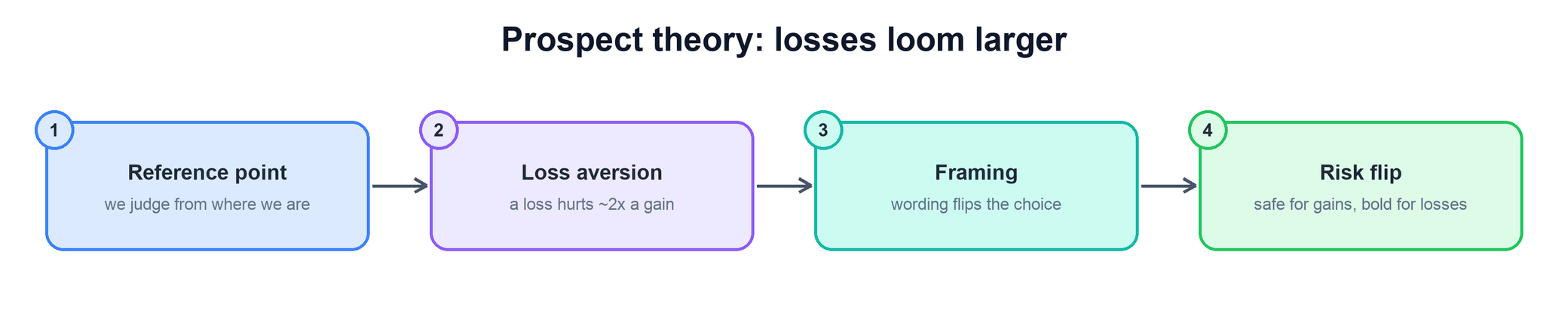
Classical economics assumes we weigh outcomes rationally against final states of wealth. Kahneman and Tversky’s prospect theory shows we don’t. We evaluate outcomes not as absolute levels but as gains and losses relative to a reference point — usually the status quo. And the value function is bent: the pain of a loss is roughly twice the pleasure of an equivalent gain. This is loss aversion, and it quietly governs an enormous share of our choices.
Several consequences follow:
- Reference points matter more than absolutes. The same salary feels like a win or a loss depending on last year’s number or a peer’s. Change the reference and you change the experience without changing the money.
- Framing effects. Logically identical choices produce different decisions depending on wording. “90% survival” and “10% mortality” describe the same fact, yet people choose differently — because the frame sets the reference.
- The endowment effect. Once we own something, giving it up registers as a loss, so we demand far more to sell it than we’d have paid to buy it. Ownership inflates value.
- The risk flip. Because losses loom larger, we are risk-averse when facing gains (we’ll take a sure smaller win over a gamble for more) but risk-seeking when facing losses (we’ll gamble to avoid a certain loss). This is why people hold losing stocks too long and sell winners too early.
6. The two selves
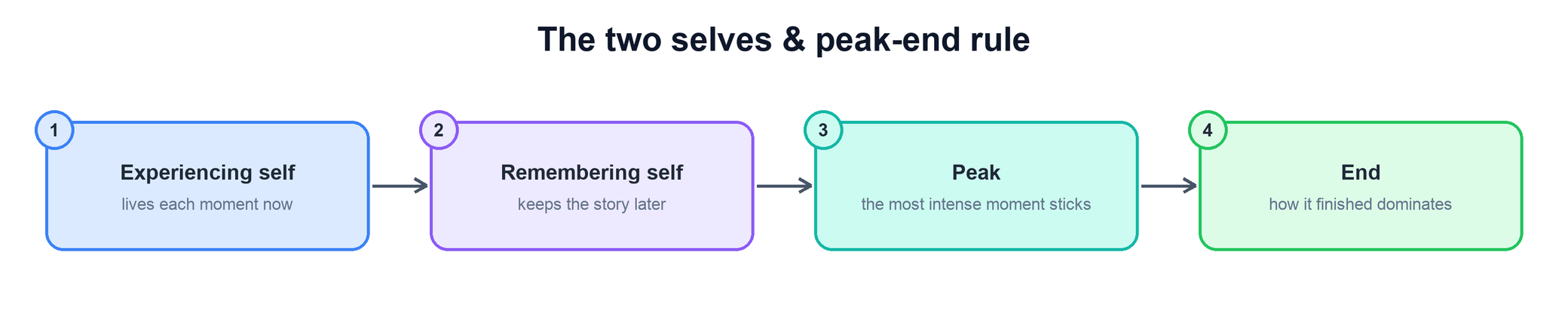
The final turn of the book is about wellbeing, and it introduces a different pair: the experiencing self and the remembering self. The experiencing self is the one that actually lives each moment — the you that feels the pain or pleasure right now, moment to moment. The remembering self is the one that keeps score afterward, tells the story, and makes decisions about the future. They frequently disagree, and it is the remembering self that wins — we choose based on remembered experience, not lived experience.
Memory follows two quirks that badly misrepresent the actual experience:
- The peak-end rule. We remember an experience by an average of how it felt at its most intense moment (the peak) and how it felt at the end — not by its overall average. A painful procedure that ends mildly is remembered as better than a shorter one that ends at its worst.
- Duration neglect. How long an experience lasted has almost no effect on how we remember it. A two-week and a one-week vacation of equal quality leave nearly the same memory, even though the experiencing self lived twice as much of the good one.
The unsettling implication is that we routinely make choices to please the remembering self — optimizing for the story — at the expense of the experiencing self that actually has to live through the time.
7. Applying it at work
The ideas map directly onto engineering leadership, where fast intuition and high-stakes judgment collide constantly:
- Fight the planning fallacy. Estimate from the outside view — how long did comparable projects actually take? — and add explicit buffers. Treat a detailed inside-view plan as a best case, not a forecast.
- Use checklists and pre-mortems. Both are deliberate ways to slow System 1 down. A pre-mortem (“imagine this launch failed — why?”) licenses dissent and surfaces risks that WYSIATI would otherwise hide.
- Watch for anchoring. The first number on the table — a rough estimate, an opening salary figure, a proposed headcount — will drag every later number toward it. Set anchors deliberately and question inherited ones.
- Design good “ends.” Because of the peak-end rule, how a retro, a launch, or a tough project ends shapes how the whole thing is remembered. Close deliberately: acknowledge the peak, end on something constructive.
- Structure decisions to engage System 2. Write down assumptions, separate facts from stories, get independent estimates before people anchor on each other, and judge past decisions by whether they were sound at the time — not by their outcome (defeating hindsight bias).
8. Summary
| Idea | The one-line takeaway |
|---|---|
| Two systems | Fast, automatic System 1 usually rules; slow System 2 is lazy and rubber-stamps it. |
| WYSIATI | We build confident stories from the evidence at hand and ignore what we can’t see. |
| Heuristics & biases | Handy shortcuts — anchoring, availability, base-rate neglect — fail in predictable ways. |
| Overconfidence | The past looks explainable, so we overpredict the future; fix it with the outside view. |
| Prospect theory | We judge from a reference point and feel losses about twice as much as gains. |
| The two selves | Memory is written by peak and end, not average or duration — and it drives our choices. |