Leading a Cross-functional Migration
Moving dozens of teams onto a new platform or architecture — phased, backward-compatible, reversible, and coordinated across regions and timezones all the way to zero.
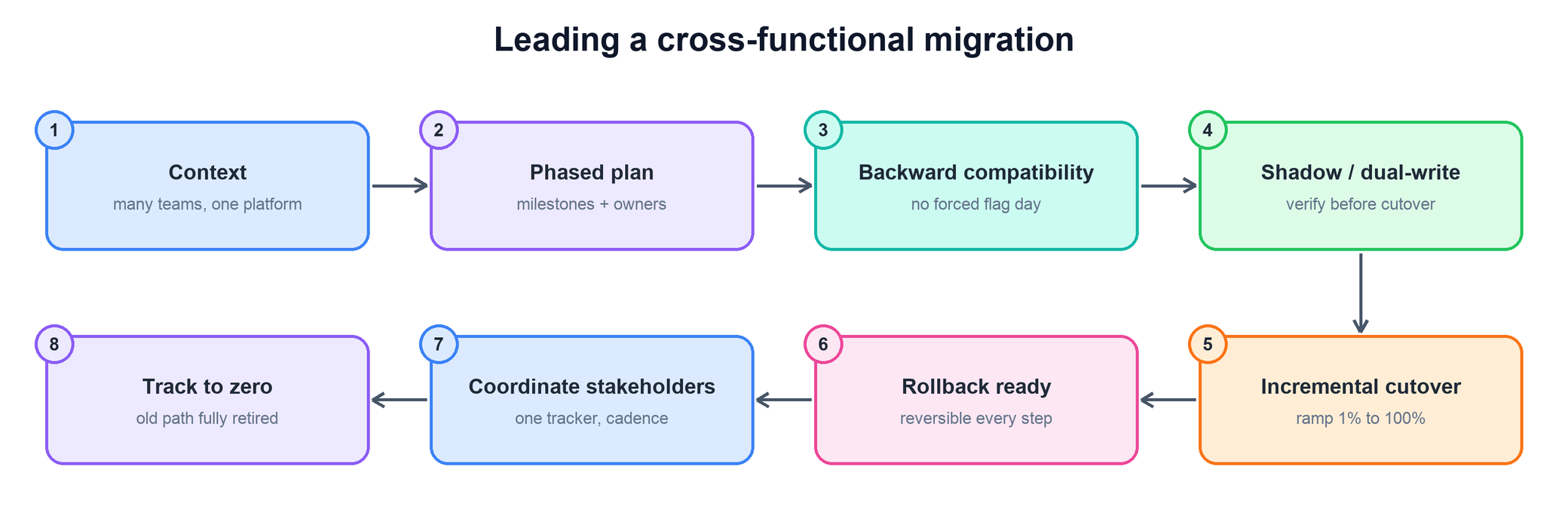
This question tests whether you can execute a large, risky migration that touches many teams without a big-bang outage and without losing the plot halfway through. Cloud moves, storage-engine swaps, and architecture migrations are where a lot of senior candidates reveal they’ve only ever done greenfield. The interviewer wants to see two intertwined skills: the technical de-risking — a phased plan, backward compatibility so there’s no forced flag day, shadow or dual-write to verify before cutover, incremental ramp with rollback at every step — and the program coordination to drive dozens of stakeholders, often split across timezones and with no reporting line to you, all the way to zero on the old system. The hard part of a platform-wide migration is rarely the code; it is getting many teams, each with its own roadmap, to actually do the work and finish it. The answer follows the CARL shape.
What this question is really testing
Can you de-risk a large migration into safe, reversible increments, coordinate many teams — often across regions and timezones, with no authority over them — over a long horizon, and actually finish — including the brutal last 10% and the decommission — rather than leaving two systems running forever? The senior signal is treating adoption as a system you engineer: making per-team status legible so no team can quietly stall, reducing the per-team cost of migrating until the new path is easier than the old, and defining done as the old system deprecated and deleted, not merely the new one available.
How to answer- Phase the plan. Break the migration into milestones with owners and exit criteria — foundation, dual-run, ramp, decommission — so it’s a sequence of small verifiable steps, not one terrifying cutover.
- Preserve backward compatibility. Build the new path behind the same interface so consumers don’t have to change on your schedule. No forced flag day — teams migrate when ready, within a deadline.
- Shadow, then dual-write, to verify. Run the new system in shadow against production traffic and compare outputs, or dual-write to both stores and diff them, so you prove correctness on real load before anything depends on the new path.
- Cut over incrementally with rollback. Ramp traffic 1% → 10% → 50% → 100% behind a flag, with a fast rollback at every step and clear health metrics gating each increase. Reversibility is what makes the migration safe to run during business hours.
- Map dependencies and reduce per-team effort. Sequence the rollout off a dependency graph — foundational libraries first, then high-volume consumers, then the long tail — and invest your own team’s effort in a landing zone (codemods, migration scripts, a golden-path guide) so each team’s work is hours, not weeks. The cheaper you make migrating, the less you have to push.
- Coordinate across timezones, async-first. When teams are split across regions, run written decisions of record, a regular written status post, and rotating office-hours instead of one meeting that’s midnight for a third of the teams — so no decision is trapped in one region’s working hours and any team can self-serve answers.
- Coordinate stakeholders and track to zero. One tracker/scorecard with per-team state and a live percentage to 100%, a named DRI per workstream, and an exec sponsor whose borrowed authority moves teams you don’t manage. And finish it — drive the long tail off the old system and decommission it, because a migration that stalls at 90% leaves you paying for two systems and owning double the on-call.
- Risk decomposed into phases with exit criteria, not a heroic cutover.
- Backward compatibility and dual-run so correctness is proven before dependence.
- Incremental ramp with rollback and health gates — reversibility as a first principle.
- Coordination machinery — scorecard, DRIs, sponsor, landing-zone tooling — for many teams over a long horizon.
- An async, written default so the program isn’t bottlenecked on any one region or timezone.
- The discipline to finish — the last 10% and the decommission, tracked to zero.
A worked example (CARL)
Context. Our ads events storage sat on an aging storage engine that was hitting scaling and cost limits, and we needed to migrate to a new tiered backend. The catch: more than 20 downstream teams read from this store — spread across three regions with an eight-to-twelve-hour spread, none reporting to me — several with strict freshness SLAs, and a billing pipeline where any data loss or duplication was unacceptable. A big-bang cutover was off the table — a bad migration here would be a company-level incident — and I owned the outcome with no authority over the people who had to do the work.
Actions. I designed it as a phased, reversible program rather than a project with a launch date. Phase one was foundation and compatibility: my team put the new backend behind the exact same read and write interface the 20 teams already used, so no consumer had to change code to benefit — that removed the “forced flag day” that kills these efforts. I also built the dependency map up front, ranking teams by traffic and migrating the shared libraries several teams depended on first, so downstream teams weren’t blocked when their turn came. Phase two was verification without dependence: we dual-wrote every event to both the old and new stores and ran a continuous diff job comparing them, so we caught correctness bugs against real production traffic while the old store was still the source of truth and nothing was at risk. We ran dual-write for weeks until the diff rate was effectively zero, including through peak load and a few gnarly edge cases the diff surfaced that we’d never have found in a test environment. Phase three was incremental cutover of reads: I moved read traffic behind a flag and ramped 1% → 10% → 50% → 100%, with each step gated on freshness and error-rate health metrics and a one-command rollback if anything regressed — and we did roll back once at 10% when a latency spike appeared, fixed it, and re-ramped. For the billing pipeline specifically, I kept it on the old store until every other consumer was cut over and stable, because its risk tolerance was lowest. The coordination was as much of the work as the engineering. The single highest-leverage move was a landing zone: a codemod and a golden-path guide that turned each team’s cutover from a multi-week task into a day or two, so most teams migrated with no direct help from us. On top of that I ran a scorecard — one row per team showing status and the live percentage of traffic still on the old store, visible to every team and the exec sponsor, because a public number is leverage a private ask never has — a named DRI per workstream, and a coordination model built for the timezone spread: a weekly written status post as the decision of record, an FAQ that grew every time someone hit a snag, and rotating office-hours in two timezone-friendly slots instead of one meeting that was midnight for a third of the teams. My sponsor set a company-visible target date and a dated freeze so the old path grew progressively costlier than the new one. The last 10% was the hardest — a few low-priority teams that kept deprioritizing — so I embedded engineers to concierge-migrate the genuinely blocked ones and used a short, factual escalation through the sponsor for the rest, converting “someday” into “this sprint.”
Results. We migrated all 20+ teams across the three regions with zero data-loss incidents and no consumer-facing SEV, decommissioned the old storage engine within the target half, and cut storage cost for the tier by roughly 35% once the old system was fully retired. The codemod alone accounted for most teams migrating with no direct help from mine, which is the only reason a group my size could drive that many teams at all. Because we never had a forced flag day and could roll back at every step, the whole migration ran during normal business hours.
Learnings. The two moves that made it safe were backward compatibility (no consumer had to move on my clock) and dual-write-plus-diff (correctness proven on real traffic before anyone depended on it). The move that made it finish was the landing zone: every hour spent making migration cheaper bought more adoption than any hour spent pushing teams to spend their own. And the migration wasn’t “done” at 90% — the discipline to drive the long tail to zero and actually decommission the old system is what turned it from a science project into realized cost savings.
Common follow-ups
How do you handle the last teams that keep deprioritizing the migration?
How to answer- Concierge the migration. Do the work for them so it’s a review, not a project on their backlog.
- Set a hard decommission date. A dated shutoff of the old system converts “later” into a real deadline.
- Make the cost of the old path visible. Show leadership the double on-call and dollar cost of keeping it alive.
- Escalate the true holdouts. If a team won’t move despite an easy path, that’s a priority call for shared leadership.
How do you verify data correctness during the migration?
How to answer- Dual-write and diff. Write to both systems and continuously compare outputs on real traffic before cutover.
- Shadow reads. Serve from the old path but replay against the new one and compare, so users are never at risk during validation.
- Gate ramp on the diff rate. Don’t increase traffic until the discrepancy rate is at or near zero, including at peak.
- Reconcile the edge cases. Investigate every diff — the last few percent are usually the real bugs.
Mid-migration you find the new system has a flaw. Do you roll back or push through?
How to answer- Roll back if users are at risk. Reversibility exists precisely for this — use it without ego.
- Assess blast radius and reversibility. A two-way-door flaw you fix forward; a one-way-door risk you stop.
- Fix, re-verify, re-ramp. Return to dual-write/diff to confirm the fix before resuming the ramp.
- Communicate the pause. Tell stakeholders why you paused — a controlled hold builds more trust than a hidden push-through.
How do you run this when the teams are split across timezones?
How to answer- Async-first, written by default. Every decision lands in a doc or a status post so no region is excluded for being asleep, and any team can self-serve answers in its own working hours.
- A scorecard, not a standup. A live per-team dashboard replaces the status meeting — anyone in any timezone reads progress without a sync, and you spend sync time only on blockers.
- Rotate the sync burden fairly. Office-hours in two timezone-friendly slots instead of one meeting that’s midnight for a third of the teams.
- Make the default do the work. New services born on the new path and a landing zone that self-serves mean teams unblock themselves rather than waiting on a handoff across the clock.
How do you drive this across dozens of teams you don’t manage?
How to answer- Make migrating cheap first. Invest your own team’s effort in codemods, scripts, and a golden path so each team’s work collapses to hours — the strongest lever there is.
- Make status legible. A public per-team scorecard with a percentage to 100% changes behavior a private ask never can.
- Borrow authority from a sponsor. A shared goal and an exec who has publicly backed the date give you the leverage your org chart doesn’t.
- Shift the incentive. Make the new path the default and the old path progressively costlier — deprecation warnings, then a dated freeze, then removal.
- GSD — pull the migration program, its phased milestones, the dependency sequencing, and the per-team scorecard with DRIs driven to zero.
- Scuba / Unidash / ODS — pull the dual-write diff rate, ramp health metrics, the traffic-on-old-system curve from 100% to zero, and the cost reduction after decommission.
- Design-review notes — pull the migration design: compatibility layer, dual-write plan, and rollback strategy.
- Workplace posts / announcements — pull the weekly written status updates, the stakeholder syncs, the deprecation notices, and the sponsor’s public backing of the date.
- Phabricator — pull the compatibility shim, dual-write, cutover-flag, and landing-zone codemod diffs that made the migration reversible and cheap to adopt.
- Internal wiki / SEV records — pull the golden-path guide and any before/after SEVs that quantify the reliability win.