Radical Candor — High-Level Learnings
A practical, high-level summary of the ideas in Radical Candor: Be a Kick-Ass Boss Without Losing Your Humanity by Kim Scott — how to build trusting relationships by caring about people and telling them the truth at the same time.
The single hardest thing about managing people is telling them what they need to hear without either wrecking the relationship or dodging the truth entirely. Kim Scott’s central argument is that these are not opposites you must trade off — the best bosses do both at once. They form real human relationships and they say the difficult thing directly. What follows is a summary of the core models in my own words, meant as a study aid — the book itself is far richer, full of stories, scripts, and hard-won detail behind each idea.
Contents
1. The core idea
Radical Candor is what you get when you Care Personally and Challenge Directly at the same time. It is guidance — praise or criticism — given with both of those things present. You show the person you genuinely give a damn about them as a human being, and, precisely because you care, you are willing to tell them the hard truth about their work.
The two moves reinforce each other. Caring without challenge is hollow — it lets people fail quietly. Challenge without care lands as an attack — it makes people defensive and destroys trust. Only when both are present does feedback actually help someone grow, because they can hear that you are on their side even while you are pushing them.
2. The two dimensions & four quadrants
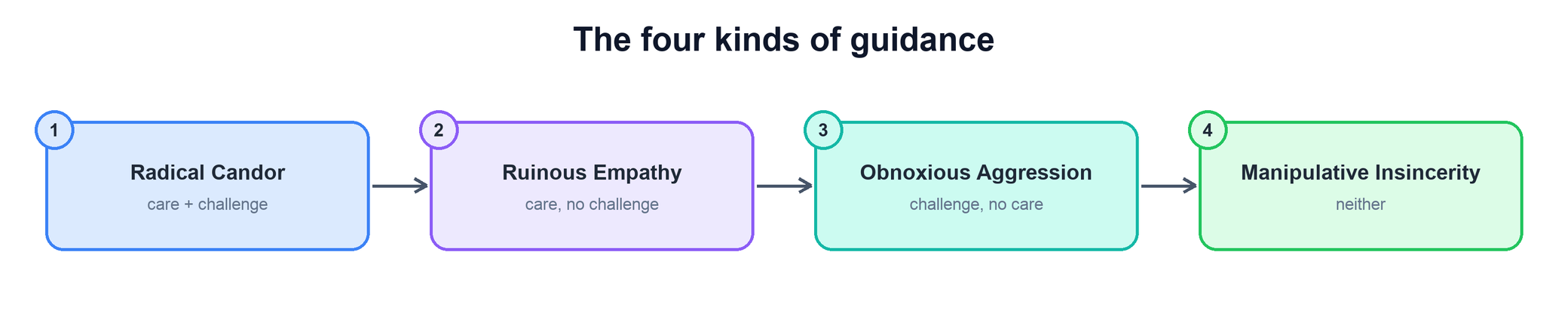
The framework is a 2×2. The vertical axis is Care Personally — how much you show that you care about the whole person, not just their output. The horizontal axis is Challenge Directly — how willing you are to say the difficult thing. Crossing the two produces four kinds of guidance.
| Quadrant | Care Personally | Challenge Directly | What it is — and why it fails |
|---|---|---|---|
| Radical Candor | Yes | Yes | You care about the person and you tell them the truth. The goal state — the only quadrant that actually helps people improve. |
| Ruinous Empathy | Yes | No | You care, but you hold back the hard truth to spare feelings. The most common failure — it feels kind in the moment but leaves people uninformed, unable to fix problems until it is too late. |
| Obnoxious Aggression | No | Yes | You challenge hard but without showing you care — belittling, front-stabbing criticism. It fails because people get defensive and stop trusting you, so even correct feedback is rejected. |
| Manipulative Insincerity | No | No | Neither caring nor challenging — back-stabbing, political, saying whatever is convenient. The worst quadrant: no honesty and no relationship, so nothing improves. |
A crucial point: when you catch yourself slipping out of Radical Candor, the answer is not to move sideways into aggression. Most people fail into Ruinous Empathy, so the fix is almost always to challenge more directly while keeping the care intact.
3. It’s measured at the listener’s ear
Radical Candor is not a license to say whatever you want and call it honesty. It is judged by how it lands, not how it was intended. If you meant to be caring and direct but the other person heard an attack, then for that person, in that moment, it was not Radical Candor — it was closer to Obnoxious Aggression.
The practical consequence is that you must adjust to the person. The same words delivered to two people can land in two different quadrants depending on their history, their culture, their current stress, and how much they trust you. So you watch the reaction, and if it did not land as intended, you course-correct — you do not insist that you were technically being candid. Feedback is a gift only if the recipient can receive it.
4. Guidance: praise and criticism
Guidance flows in both directions and comes in two forms — praise and criticism — and both are worth doing well. A few durable rules:
- Praise in public, criticize in private. Public praise amplifies the recognition and models what good looks like for everyone; private criticism protects dignity and keeps the person from getting defensive.
- Be specific. Vague praise (“great job!”) is nearly worthless because the person cannot repeat what they did right. Specific praise tells them exactly which behavior to do more of.
- HIP delivery. Good guidance is Humble (you might be wrong, so ask), Helpful (aimed at helping, not venting), Immediate (given close to the event, not saved up), and delivered In Person wherever possible — humble, helpful, immediate, in person.
- Criticize the work, not the person. Talk about what was done and its impact, not about who they are as a human. “This section confused the reader” keeps the door open; “you’re a sloppy writer” slams it shut.
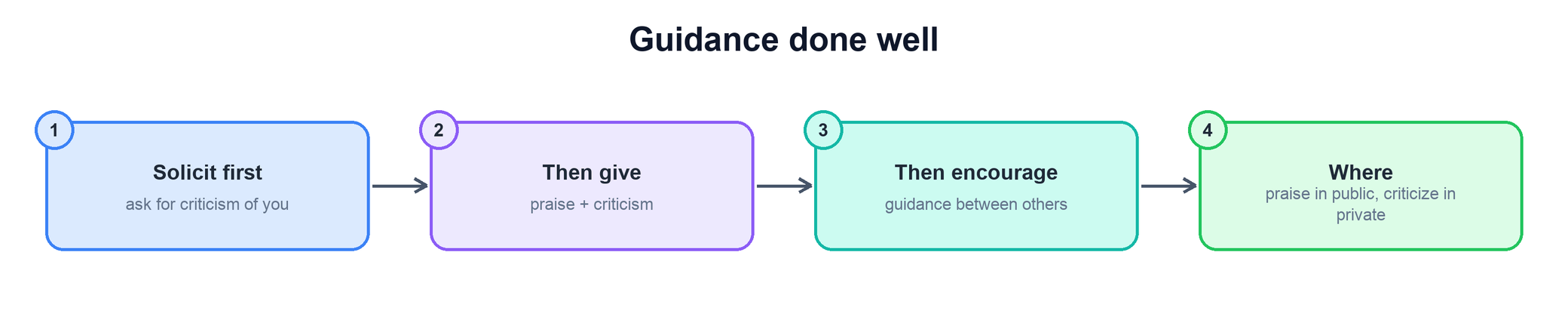
There is also an order of operations for building a culture of candor: solicit guidance first, then give it, then encourage it between others.
- Solicit — ask for criticism of yourself first. Requesting feedback on your own work (and rewarding candor rather than punishing it) proves it is safe and earns you the standing to give it.
- Give — offer praise and criticism generously once you have shown you can take it.
- Encourage — foster candid guidance between your team members, not just up and down through you, so honesty becomes the norm rather than a manager ritual.
5. Get Stuff Done — the GSD wheel
Radical Candor is not only about feedback; it is the foundation for actually shipping results together. The GSD wheel (Get Stuff Done) is the collaborative cycle a team turns to move from raw ideas to results and back to better ideas. The temptation is to jump straight to execution; the wheel argues that skipping the early steps produces worse results and less commitment.
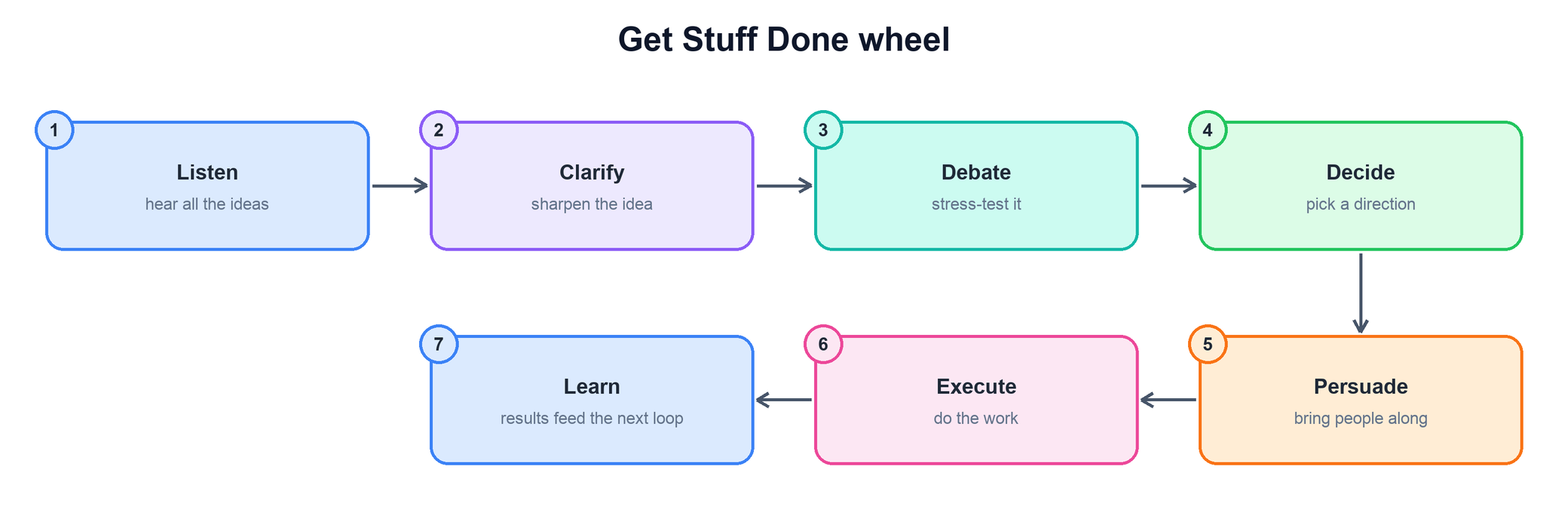
- Listen — create the space and safety for everyone’s ideas to surface, including quiet voices.
- Clarify — help sharpen a rough idea so it is understandable and can be evaluated.
- Debate — stress-test the idea vigorously, arguing about ideas rather than people.
- Decide — push the decision to the person closest to the facts, and actually make the call.
- Persuade — bring the people who must act along, addressing emotion and credibility, not just logic.
- Execute — do the work; the boss’s job is to minimize the collaboration tax on the people doing it.
- Learn — take the results, stay open to being wrong, and feed the lesson back into the next turn of the wheel.
6. Growth: rock stars vs superstars
Great people are great in two different ways, and confusing them is a management error. Some people are on a gradual, stable growth trajectory — the author calls them rock stars because they are the solid rock the team is built on. Others are on a steep growth trajectory — the superstars, who are hungry for new challenges and change. Neither is better; both are excellent. The mistake is managing everyone against a single ladder, as if the only valid direction is up-and-out.
| Rock stars | Superstars | |
|---|---|---|
| Trajectory | Gradual, stable | Steep, fast-rising |
| Role on team | The stabilizing force; deep expertise; institutional memory | The driving force; wants the next big thing |
| What they want | Mastery and stability in the current role; recognition, not upheaval | New challenges, stretch, and room to grow fast |
| How to manage them | Value and recognize them; do not push change or promotion they don’t want | Keep stretching them; give new problems before they get bored and leave |
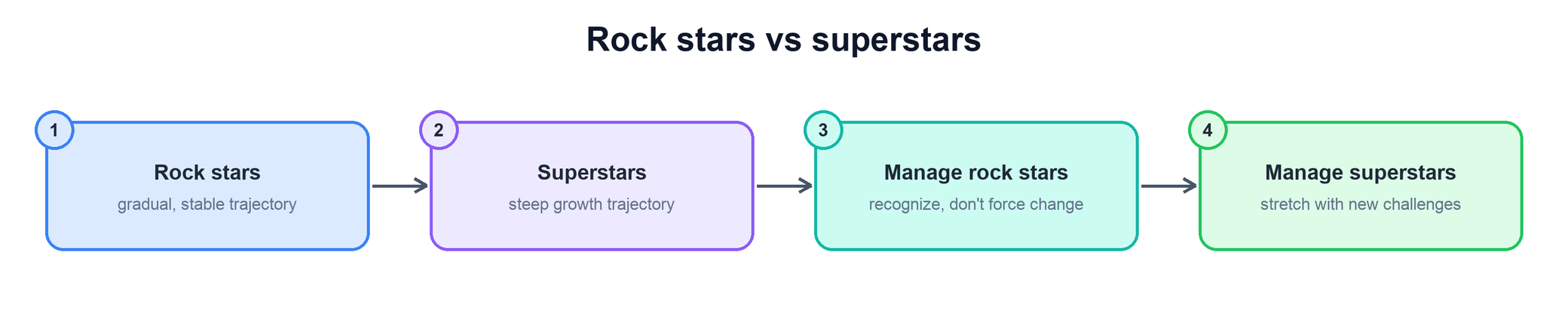
The same person can also shift between modes over time — a superstar phase in one role, a rock star phase in another — so the label describes a moment, not a permanent identity.
7. Applying it at work
The model maps directly onto the recurring conversations of engineering leadership:
- 1:1s — use the standing time to Care Personally (understand the human and their trajectory) and to give small, immediate guidance rather than saving it for review season.
- Code review feedback — criticize the work not the person, be specific about the impact, stay humble (“did you consider…?”), and praise strong solutions publicly in the review.
- Career conversations — ask whether someone is in a rock star or superstar phase and manage to that trajectory, instead of assuming everyone wants the next promotion.
- Calibrations — ground ratings in specific observed work rather than personality, and value stabilizing rock stars, not just fast-rising superstars.
- Avoiding Ruinous Empathy in perf conversations — the kind-seeming instinct to soften a hard message is the most common trap; care and challenge, so the person actually knows where they stand while there is still time to act.
8. Summary
| Idea | The one-line takeaway |
|---|---|
| The core idea | Care Personally and Challenge Directly, at the same time. |
| Four quadrants | Miss either axis and you fall into Ruinous Empathy, Obnoxious Aggression, or Manipulative Insincerity. |
| Listener’s ear | Candor is judged by how it lands, not how it was meant — adjust to the person. |
| Guidance | Praise in public, criticize in private; be HIP; criticize the work, not the person. |
| Solicit first | Ask for criticism of yourself before giving it, then encourage it between others. |
| GSD wheel | Listen, clarify, debate, decide, persuade, execute, learn — don’t skip to execute. |
| Rock stars vs superstars | Manage each person to their own trajectory, not a single ladder. |