Mindset — High-Level Learnings
A practical, high-level summary of the ideas in Mindset: The New Psychology of Success by Carol S. Dweck — how a single belief about whether ability is fixed or can grow quietly shapes learning, resilience, relationships, and leadership.
Underneath a lot of what we call talent, motivation, or grit sits one quiet belief: do you think your abilities are basically fixed, or do you think they can be developed? Dweck’s decades of research argue that this belief — your mindset — is not just a mood but a lens that shapes how you read challenge, effort, failure, and other people’s success. The good news is that a mindset is learned, which means it can be changed. What follows is a summary of the core ideas in my own words, meant as a study aid; the full book is worth reading for the studies and stories behind each point.
Contents
1. The core idea
A mindset is simply a belief about the nature of ability — whether qualities like intelligence, talent, and character are carved in stone at birth or can be cultivated over a lifetime. It sounds abstract, but the belief is doing enormous work in the background. It decides whether a hard problem reads as a threat or an invitation, whether effort feels shameful or worthwhile, and whether a setback means “I’m not cut out for this” or “I haven’t figured this out yet.”
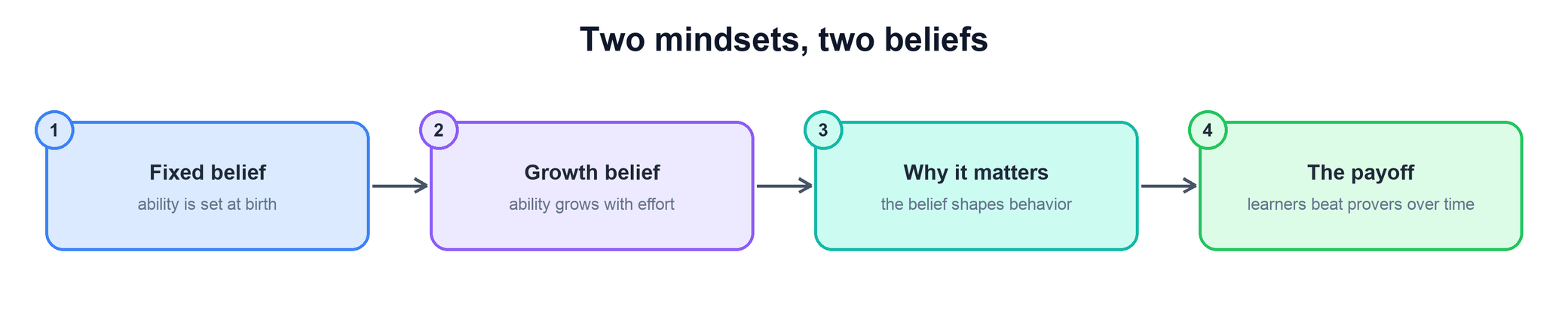
The key move in the book is to notice that this belief is a choice of interpretation, not a fixed fact about you. The same red-inked review, the same failed launch, the same tough interview can be read through either lens — and which lens you use changes what you do next far more than the raw talent you walked in with.
2. The two mindsets
Dweck contrasts two ways of holding ability. In a fixed mindset, intelligence and talent are static: you have a certain amount, and life becomes an ongoing exam to prove you have enough. In a growth mindset, abilities are a starting point that grows through effort, strategy, and help from others: life becomes a chance to improve. The two mindsets don’t just feel different — they produce opposite reactions to the exact same situations.
| When facing… | Fixed mindset (“prove it”) | Growth mindset (“improve it”) |
|---|---|---|
| Challenges | Avoids them — a hard task risks exposing a limit. | Embraces them — a hard task is where growth happens. |
| Effort | Sees effort as a bad sign — “if I were talented I wouldn’t have to try.” | Sees effort as the path — the way ability actually gets built. |
| Obstacles & setbacks | Gives up or gets defensive — a setback is a verdict. | Persists and adjusts — a setback is information to act on. |
| Criticism | Ignores or resents it — feedback feels like an attack on identity. | Learns from it — feedback is free data about how to get better. |
| Others’ success | Feels threatened — their win implies your deficiency. | Feels inspired — their win is proof it can be done, and a lesson to steal. |
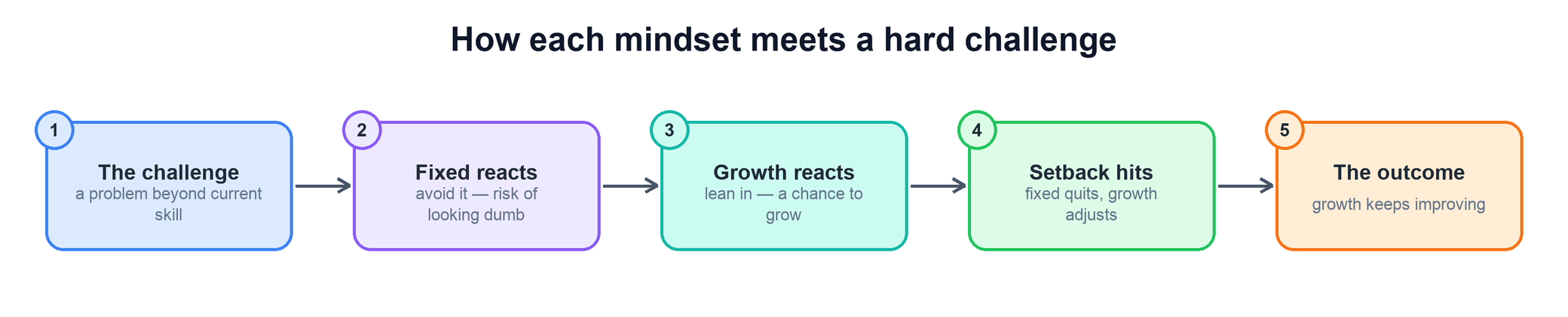
Nobody is purely one or the other. We each carry a mixture, and specific situations — a domain we secretly doubt ourselves in, a moment of public evaluation — can flip us into the fixed lens without our noticing.
3. The power of “yet”
One of the book’s most portable ideas is a single word. Failing at something in a fixed frame produces a terminal statement: “I’m not good at this.” Adding yet converts that verdict into a position on a path: “I’m not good at this yet.” The facts are identical; the future is completely different. “Not yet” keeps you in the game, points at effort and strategy as the next move, and treats the current gap as temporary.
This is more than a pep-talk trick — it lines up with how brains actually work. The research on neuroplasticity shows the brain is not fixed hardware: neurons form new connections and strengthen existing ones when we struggle with hard material and practice deliberately. In other words, the effort itself is what physically builds the ability. Understanding that struggle is the mechanism of learning, not evidence of its absence, is what makes “yet” believable rather than just cheerful.
4. Praise the process, not the person
Dweck’s studies on praise are the sharpest practical finding in the book. Children (and adults) given the same task can be praised two ways after they succeed: for their innate talent (“you’re so smart”) or for their process (“you worked hard and tried good strategies”). The results run opposite to intuition.
Praising intelligence backfires. Once someone believes their success proves they are “smart,” they become invested in protecting that label — so they start avoiding harder tasks that might puncture it, they crumble when they hit something difficult, and some even lie about their scores rather than admit a struggle. Praising the process does the reverse: it teaches that effort and strategy are what produced the result, so people seek out harder challenges, stay resilient through difficulty, and keep improving. The lesson is not to stop praising, but to praise the things a person can control and repeat — effort, choices, focus, strategy, persistence — rather than a fixed trait they can only either have or lack.
5. False growth mindset
Because “growth mindset” became popular, it also became easy to fake — to yourself as much as to others. Dweck warns about a false growth mindset: claiming the label while behaving in fixed ways. Watching for the common traps keeps the idea honest.
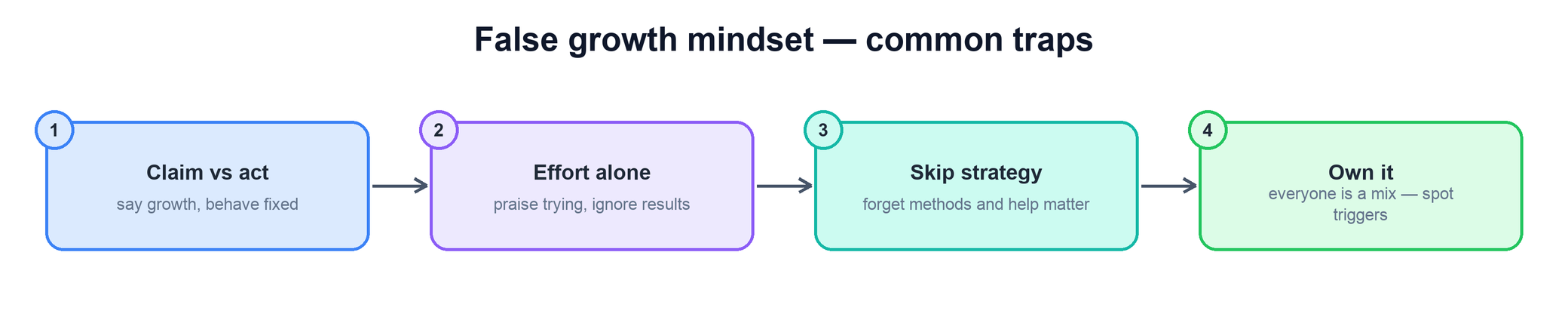
- Claiming it while acting fixed. It’s comfortable to declare “I have a growth mindset” and then, under evaluation, still avoid challenges, dodge feedback, and feel threatened by others’ wins. The claim is not the practice.
- Reducing it to effort and pep talks. Growth mindset is not just “try harder” or a motivational poster. Praising effort that isn’t working, with no change in approach, teaches people to grind uselessly rather than to learn.
- Ignoring strategy and help. Effort is necessary but not sufficient. When effort stalls, the growth move is to try new strategies and to ask for help — not to simply repeat the same failing attempt with more determination.
- Pretending you’re always in it. Nobody lives in a pure growth mindset. Denying your fixed-mindset triggers is itself a fixed move; the honest path is to notice when you get defensive or avoidant and name it.
6. Mindset in leadership & organizations
Mindsets scale up from individuals to whole cultures. Dweck contrasts a culture of genius with a culture of growth. In a culture of genius, the organization worships innate brilliance, sorts people into the gifted and the not, and treats talent as the scarce thing to be hired and displayed. In a culture of growth, the organization believes capability is developed, so it invests in learning, collaboration, and improvement.
Fixed-mindset leaders tend to make predictable, damaging moves. Because their own status depends on looking like the smartest person in the room, they can come to fear talented people around them, take credit, and surround themselves with agreement. Because admitting a mistake threatens the “genius” image, they hide failure rather than surface and learn from it — which is exactly how small problems become large ones. Growth-minded leaders do the opposite: they treat their own development as ongoing, hire and grow people who can surpass them, and make it safe to name failures early. The organizational result is not soft — teams in a growth culture trust each other more, take smarter risks, and simply learn faster.
7. How to change your mindset
The most encouraging claim in the book is that mindset is changeable, and Dweck gives a concrete, repeatable process. You don’t erase the fixed mindset — it shows up as a “voice” in the tense moments — you learn to hear it and answer it.
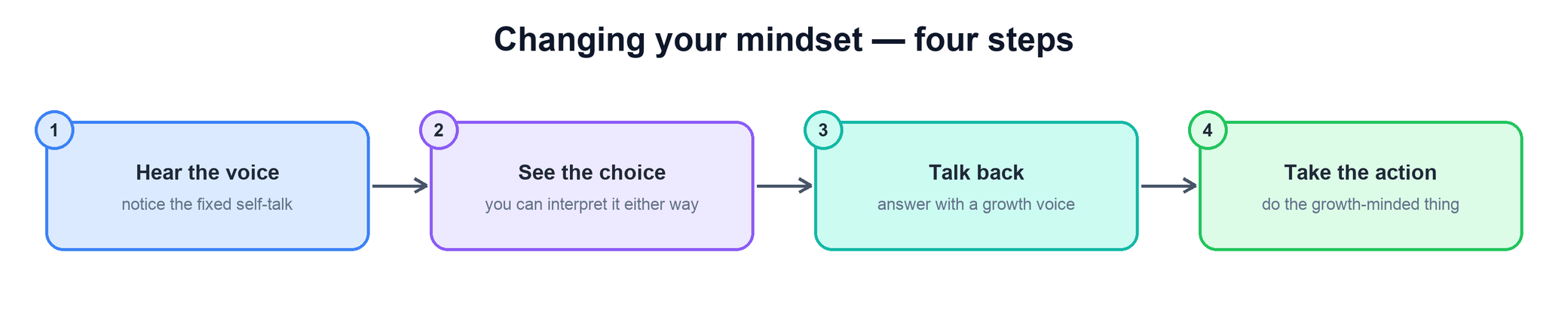
- Hear your fixed-mindset voice. Learn to notice the self-talk it produces — “what if you fail and look stupid,” “if you had real talent this would be easy,” “it’s not your fault, the deck was stacked.” You can’t answer a voice you don’t hear.
- Recognize you have a choice. That voice is offering an interpretation, not stating a fact. How you read this challenge or setback is up to you, and there is always a growth reading available.
- Talk back with a growth-mindset voice. Answer it directly: “I’m not sure I can do it yet — but I can learn with effort and a better approach,” “most successful people struggled here first,” “if I don’t try, I fail by default.”
- Take the growth-mindset action. The voice only changes through behavior — take on the challenge, learn from the setback, seek the feedback, try the new strategy. Repeated action is what rewires the default.
8. Applying it at work
The ideas map cleanly onto the recurring decisions of engineering leadership. A few examples:
- Feedback — frame and deliver critique as data for improvement, tied to effort and strategy, not a verdict on someone’s fixed ability; make asking for and giving feedback normal, not threatening.
- Hiring for learners — weight curiosity, how candidates talk about past failures, and how they learn over raw pedigree; a strong learner outgrows a static “genius” on a real team.
- Blameless learning culture — run incidents and postmortems to surface failure early and fix the system; punishing mistakes just teaches people to hide them, the classic fixed-mindset failure mode.
- Promotions — reward trajectory, skill growth, and how people lift others, not just a fixed reputation for brilliance; celebrate the process that produced the results.
- Giving hard problems as growth — assign stretch work deliberately as a development tool, with support and permission to struggle, rather than reserving the hard problems for a chosen few.
9. Summary
The whole book turns on one belief and its consequences: treat ability as fixed and you spend your energy proving it; treat ability as growable and you spend your energy building it — and over time the builders pull ahead.
| Idea | The one-line takeaway |
|---|---|
| The core idea | Your belief about whether ability is fixed or growable quietly shapes everything. |
| The two mindsets | Fixed proves; growth improves — same events, opposite reactions. |
| The power of “yet” | “Not yet” turns a verdict into a path; struggle is how the brain grows. |
| Praise the process | Praise effort and strategy; praising raw talent backfires. |
| False growth mindset | Don’t just claim it or reduce it to effort — strategy and help matter too. |
| Leadership & orgs | Culture of growth beats culture of genius; safe-to-fail teams learn faster. |
| Changing your mindset | Hear the fixed voice, see the choice, talk back, take the growth action. |