07 · Cross-functional Partnerships
How to answer the cross-functional questions in a senior engineering-leadership loop: the framework to structure each answer, what the interviewer is really listening for, and where inside Meta to pull the evidence that backs your story.
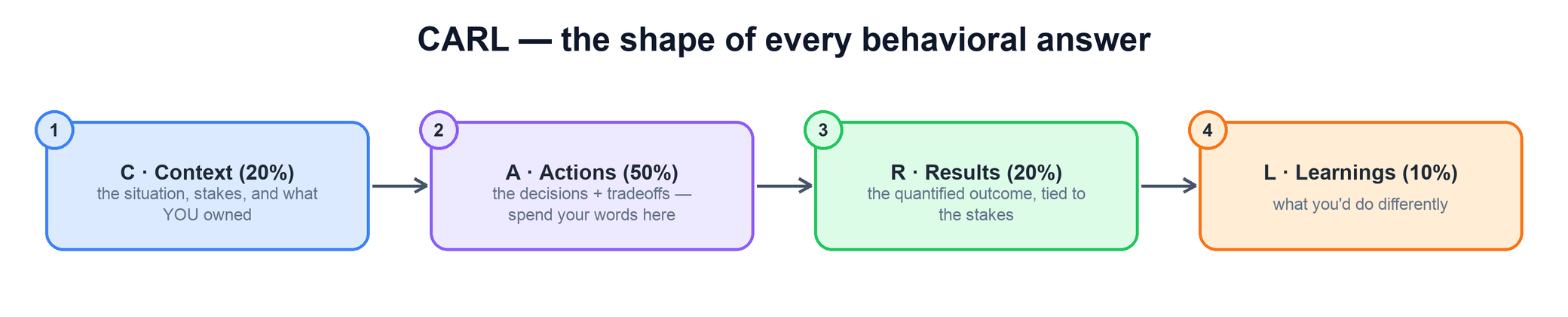
This area tests one thing: can you deliver through teams you don't own. Almost nothing that matters at scale ships inside a single org — it ships across Product, Design, other engineering teams, and specialist functions who all have their own goals and their own manager. Interviewers are not grading whether you are agreeable; they are grading whether you can align on a shared outcome, influence without authority, and make dependencies visible before they become surprises. Every answer below is built on the CARL shape — Context, Actions, Results, Learnings — with most of your words spent on the alignment and influence moves only you could have made.
Questions on this page
- How to answer this area — the framework
- Building partnerships with Product and Design
- The most complex cross-functional project you led
- Influencing a decision without authority
- A conflict with a peer team or a PM
- A dependency slipped and put your deadline at risk
- Aligning teams with conflicting priorities
- More questions you might get
- How do you partner with SRE, Security, Legal, or Data Science specifically?
- How do you say no to a partner team without damaging the relationship?
- How do you communicate the same update to engineers vs executives?
- How do you build trust with a new partner team quickly?
- How do you handle a partner who over-commits and under-delivers?
- Tell me about a partnership that failed — what did you learn?
- How do you manage a dependency on an external vendor or partner?
How to answer this area — the cross-functional partnership framework
Every cross-functional question can be answered with the same six-step spine. The underlying skill it probes is influence without authority: you cannot order a partner team to do anything, so you have to align them on a goal, earn their trust, and make the work legible to everyone at once. Walk the spine in order and you will hit the signals interviewers look for without sounding like you just went along with whatever people wanted.
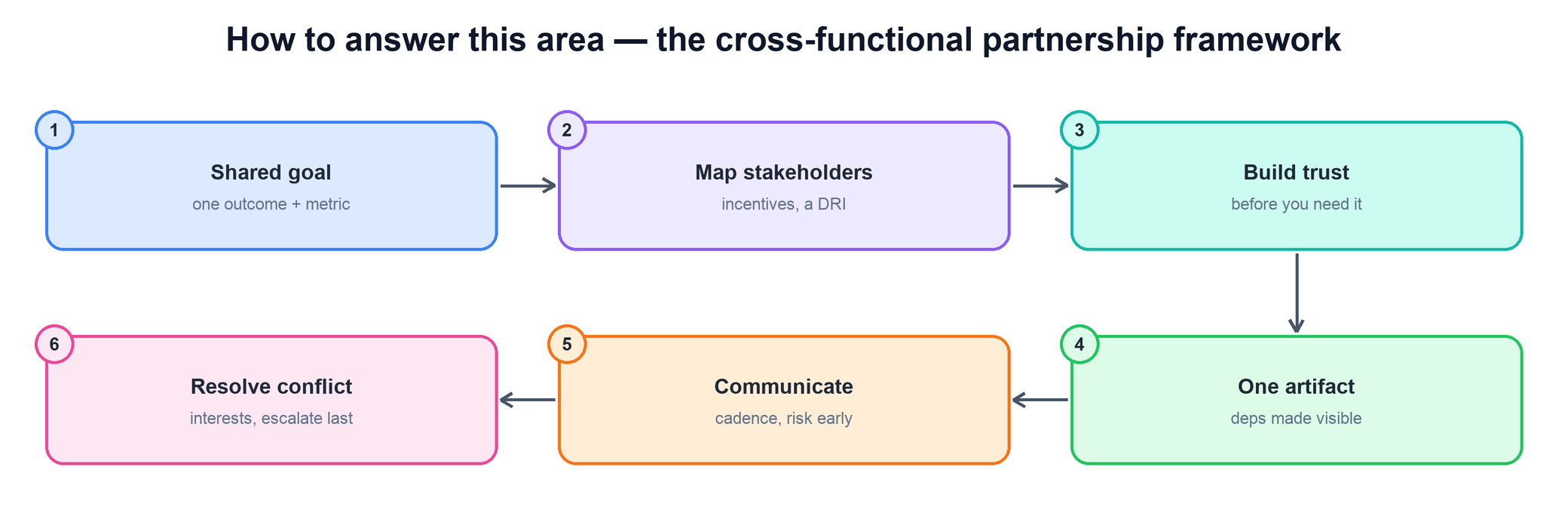
- Start from a shared goal. Name the one outcome and the single success metric that every team owns together. If each team is optimizing a different number, you have no partnership — you have a collision.
- Map the stakeholders. List who is involved, what each of them is actually incentivized to deliver, and put a named DRI on each piece so ownership is never ambiguous.
- Build trust before you need it. Understand each partner's world and pressures — their roadmap, their constraints, their manager's goals — so that when you ask for something the relationship is already there.
- Work off one shared artifact. A single plan or doc that makes each team's part and every dependency visible, so no one is surprised and no one can quietly assume someone else has it.
- Communicate on a cadence. Surface risk early rather than at the deadline, and tailor the message to each audience — a different framing up to leadership than across to peer engineers.
- Resolve conflict on interests, not positions. Dig for what each side actually needs, find the option that serves both, and escalate only as a last resort — and when you do, escalate with options, not just a complaint.
- A single shared outcome and metric, not a list of separate team goals.
- Genuine understanding of partners' incentives — you can state what they were optimizing.
- Influence earned through trust and data, not through your manager or your title.
- Dependencies made visible early, so slips were surprises to nobody.
- "I" for the alignment moves you made, "we" for how the teams delivered.
- GSD — pull from the cross-team project for the shared milestones, the DRIs, and the dependencies you tracked across orgs.
- Shared OKRs / goals — pull the one metric multiple teams committed to, to prove the goal was genuinely shared.
- Design docs & the internal wiki — pull the one artifact that made each team's part and the dependencies visible.
- Scuba / ODS / Unidash — pull the shared outcome metric that shows the partnership actually moved the number.
- Calendar — pull the recurring cross-functional sync to show communication ran on a real cadence.
How do you build effective partnerships with Product and Design?
This is the principle-plus-proof question: they want your operating model for working with your two closest non-engineering partners, and one story that shows you actually run it that way.
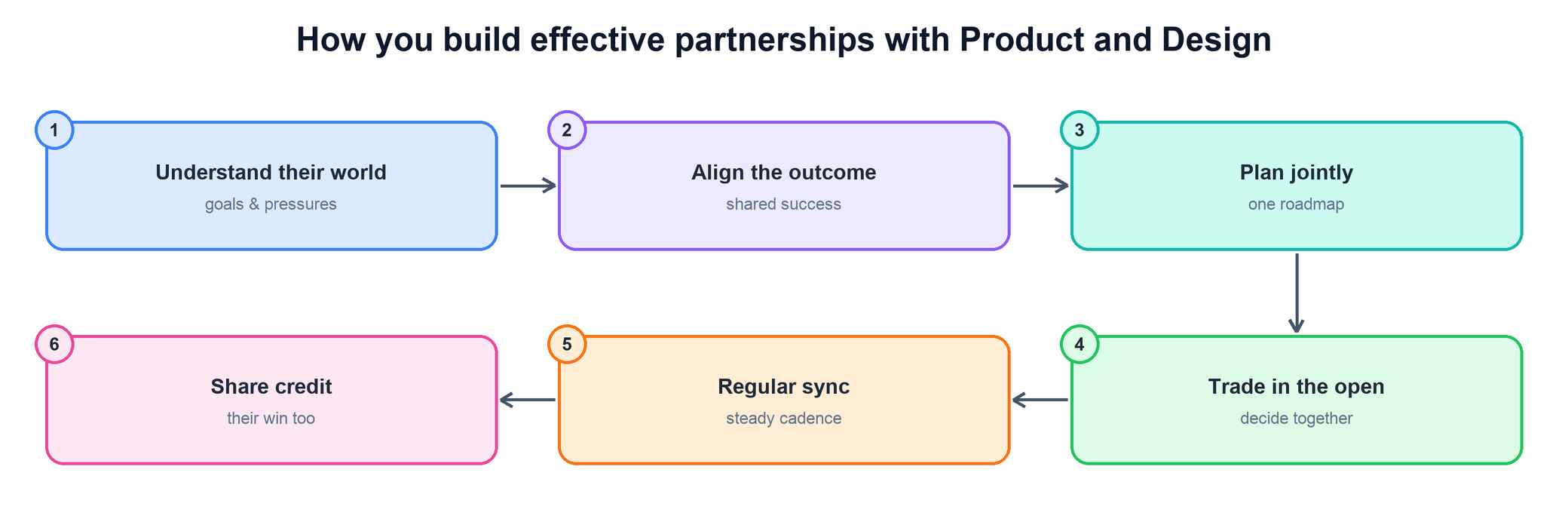
- Open with the principle: Product owns the "why" and the "what," Design owns the experience, Engineering owns the "how" and the "when" — effective partnership means each of you is trusted inside your lane and no one is fighting over the wheel.
- Understand their world first. Learn what pressures Product and Design are under — the launch date, the exec they answer to, the user research driving them — so you can help them win rather than just push back.
- Align on the outcome, then plan jointly off one roadmap so engineering realities and product priorities are reconciled once, up front, not renegotiated every sprint.
- Make tradeoffs together in the open: when the ideal design is too expensive, put the cost and the options on the table and decide as a group, so the cut is a shared decision, not an engineering veto.
- Keep a regular sync as the forum for surfacing risk, and share the credit loudly when it ships — that is what makes the partner want to work with you again.
- Respect for the distinct crafts — you don't treat PM/Design as ticket sources or order-takers.
- You can articulate a partner's goals and pressures, not just your own.
- Tradeoffs made jointly and transparently, not imposed by engineering.
- A durable, two-way relationship — credit shared, trust reinvested.
- GSD — pull from the joint project to show the shared roadmap and milestones you planned with Product.
- Design docs & the internal wiki — pull the spec or PRD you shaped together to anchor how tradeoffs were made in the open.
- Calendar — pull the recurring PM/Design/Eng sync to prove the partnership had a steady cadence.
- Workplace posts — pull the launch post where you shared credit across the partner teams.
Tell me about the most complex cross-functional project you led. How did you keep it on track?
The flagship question for this area. They want the hardest thing you have driven across boundaries — multiple teams you didn't own, with genuinely conflicting incentives — and the mechanics you used to hold it together.
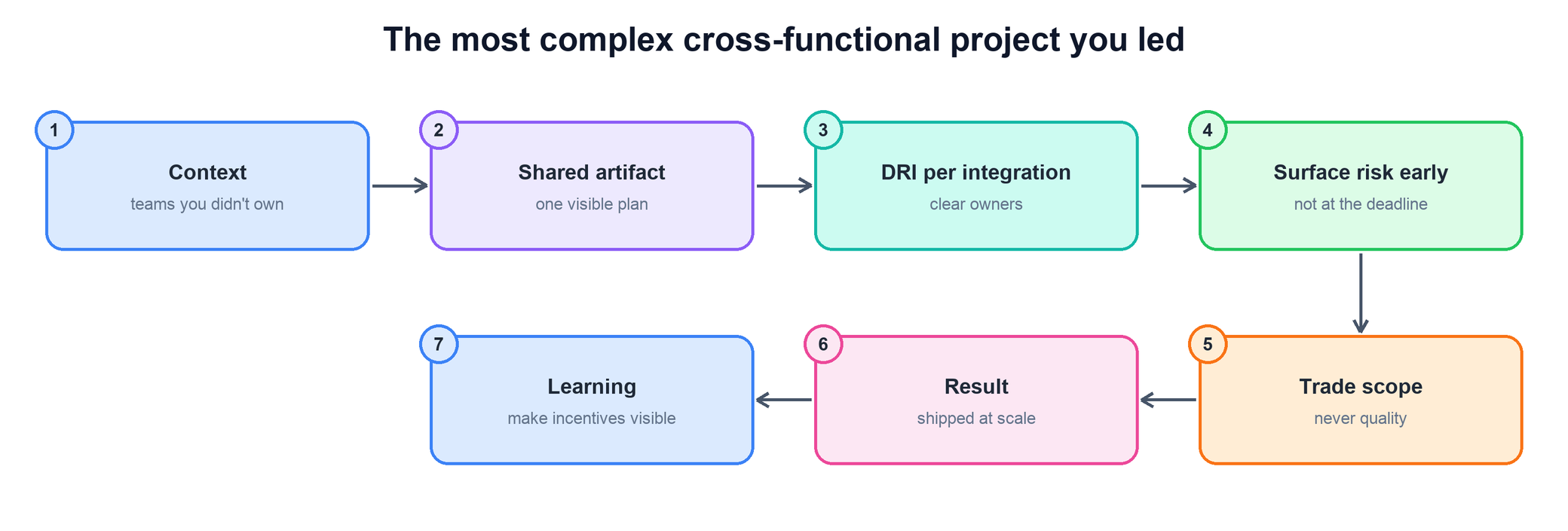
- Set the context in two sentences: several teams you did not own, with conflicting incentives — one optimizing for velocity, another for reliability, another for a different launch — and the one outcome they all had to reach.
- Describe the one shared artifact — an integrated plan, a joint design, a single dependency map — that made each team's piece and every hand-off visible in one place.
- Put a named DRI on each integration point, so the seams between teams (usually where these projects fail) had a clear owner rather than falling in the gap.
- Surface risk early, not at the deadline. Explain the mechanism — the sync, the status, the tracker — that turned a slip into a two-weeks-early conversation instead of a launch-day fire.
- When something had to give, you traded scope, never quality. Close with the result — shipped at scale — and the learning: your real job was making each team's incentives visible to the others.
- Real complexity: teams outside your authority with incentives that genuinely pulled apart.
- A concrete mechanism for visibility — not "I stayed on top of it."
- Ownership placed on the integration seams, where these projects usually break.
- Risk surfaced early and scope, not quality, used as the release valve.
- GSD — pull from the cross-team project for the milestone history, the DRIs, and the dependency slips you caught early.
- Design docs & the internal wiki — pull the integrated plan or joint design that served as the one shared artifact.
- Scuba / ODS / Unidash — pull the shared outcome metric that proves it shipped and held at scale.
- Meeting / review notes — pull from the sync records where you surfaced and re-planned around risk.
Tell me about a time you influenced a decision without authority.
The purest test of the area: you had no power to mandate the outcome, and you got it anyway. They are listening for how you moved people who did not report to you.
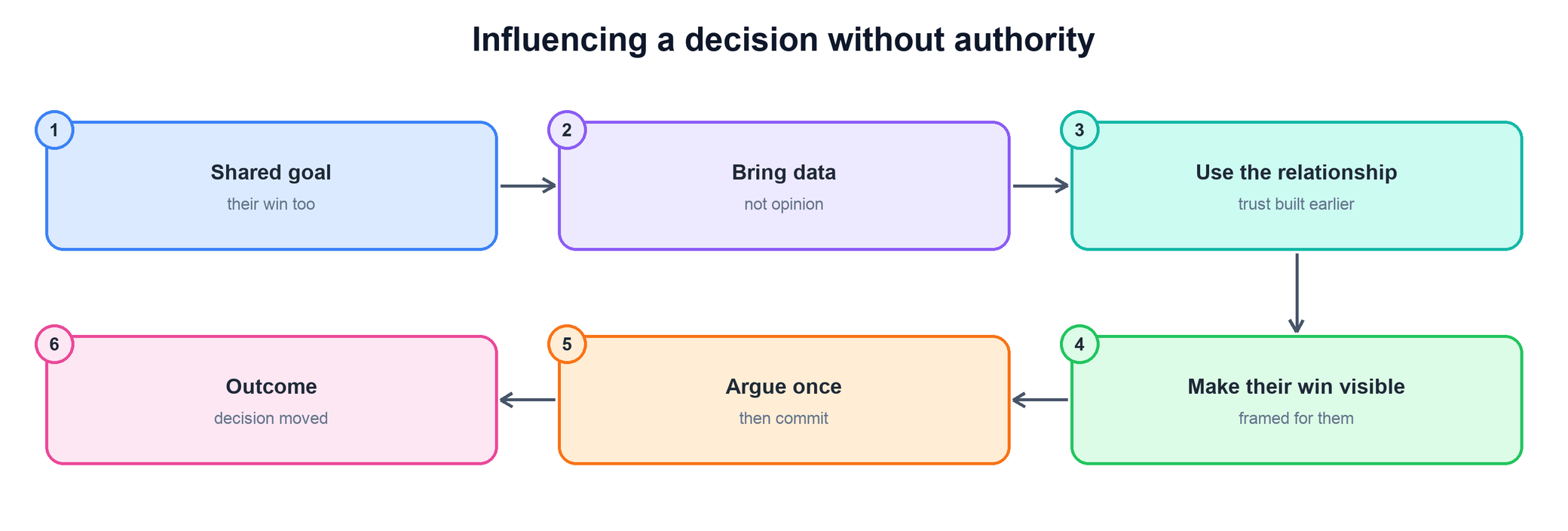
- Lead with the shared goal. Frame your proposal as their win too — the decision that also advances the metric or launch they care about — not as a favor to your team.
- Bring data, not opinion. A prototype, a benchmark, a cost model, or user numbers move people you can't order around; a strong assertion does not.
- Spend the relationship you built. Influence draws down trust banked earlier — make it clear this worked because you had already invested in the partner before you needed anything.
- Make their win visible. Frame the outcome in their language and metrics, and make sure their leadership sees the value, so saying yes is easy and good for them.
- Argue once, clearly, then commit. If they still choose differently, disagree-and-commit rather than relitigating — that is what keeps you credible for the next decision. Close with the outcome.
- Persuasion through shared goals and evidence — not "I escalated to my manager."
- The relationship was already in place before the ask.
- The proposal framed as the partner's win, in their terms.
- Genuine disagree-and-commit if the call went another way, with no grudge.
- Design docs & the internal wiki — pull the proposal or RFC where you laid out the data that moved the decision.
- Scuba / ODS / Unidash — pull the numbers or prototype results you brought instead of opinion.
- Workplace posts / groups — pull the thread where the alignment happened in the open across teams.
- Meeting / review notes — pull from the record of the decision meeting to anchor the outcome you influenced.
Tell me about a conflict with a peer team or a PM, and how you resolved it.
They want to see that you can be in genuine disagreement with a partner and come out the other side with the problem solved and the relationship intact.
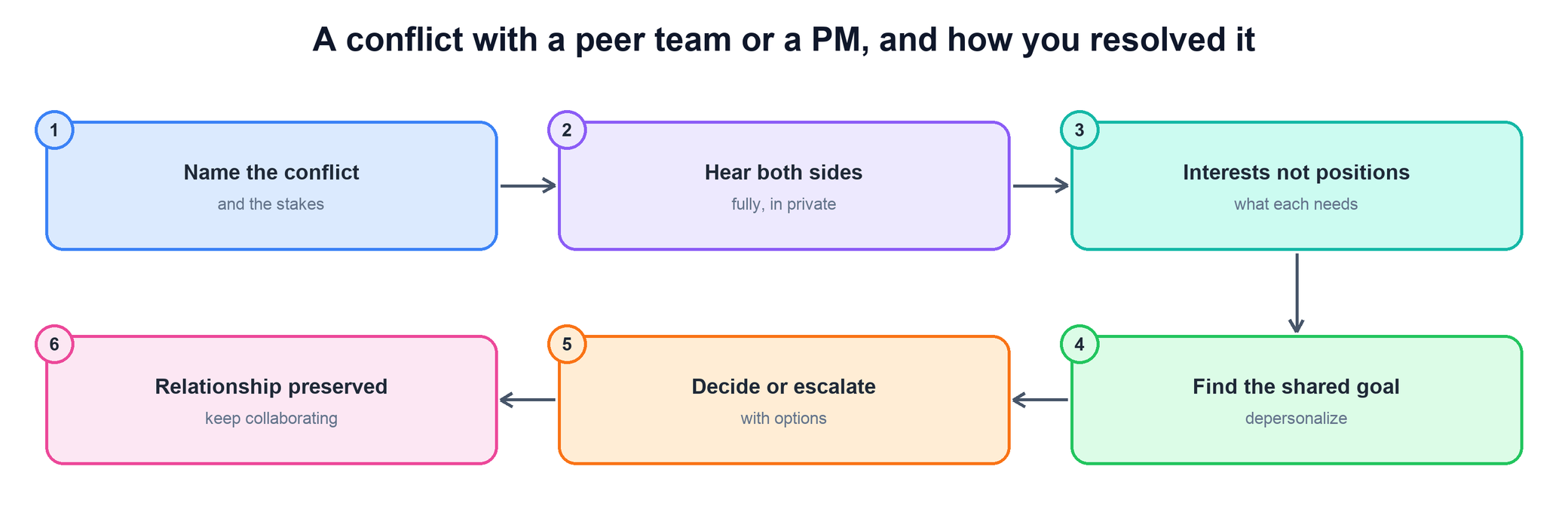
- Name the conflict and the stakes honestly — a real disagreement with something riding on it, not a trivial difference you are dressing up.
- Hear both sides fully, ideally in private first, so the other party feels understood before anyone is defending a position in a room.
- Separate interests from positions. The stated position ("we won't move the API") usually hides an interest ("we can't absorb another migration this half") — solve for the interest.
- Return to the shared goal to depersonalize it: it stops being you-vs-them and becomes both-of-us-vs-the-problem.
- Decide, or escalate with options. If you can resolve it, do; if not, escalate jointly with two or three framed options and a recommendation — never a naked complaint. Close with the relationship preserved and the collaboration continuing.
- You engaged the conflict directly instead of avoiding or steamrolling it.
- Interests separated from positions — the real "why" underneath the stated ask.
- Escalation, if any, done jointly and with options, as a last resort.
- The relationship survives — you'd happily work with them again.
- Meeting / review notes — pull from the record where the disagreement and the resolution were worked through.
- Design docs & the internal wiki — pull the doc where the competing positions and the agreed option were written down.
- Workplace posts / groups — pull the thread that shows how the two sides realigned after the conflict.
- Shared OKRs / goals — pull the shared goal you returned to in order to depersonalize the disagreement.
A cross-team dependency slipped and put your deadline at risk — what did you do?
A composure-and-mechanics question. They want to see how you handle the most common cross-functional failure — someone else's slip landing on your critical path — without either panicking or blaming.
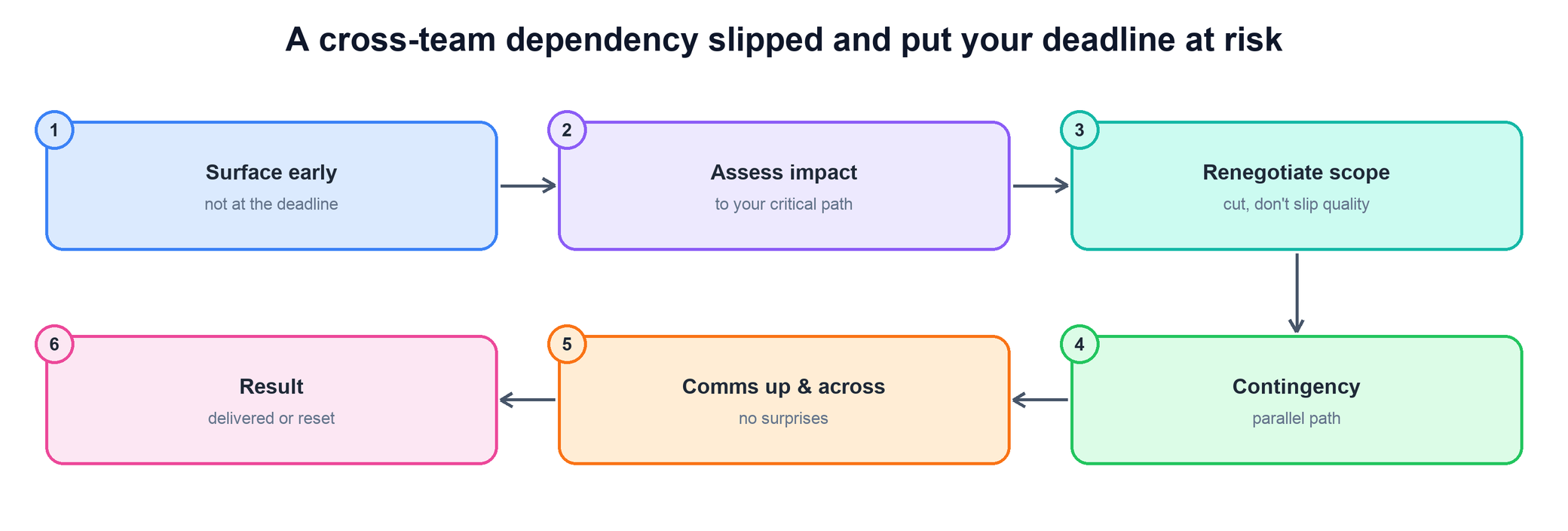
- Surface it early — the key move. You knew about the slip weeks out (because you were tracking the dependency), not on the day it was due.
- Assess the impact precisely: is this on your critical path, or is there float? Quantify the days at risk before you react.
- Renegotiate scope, not quality. Work with the partner and stakeholders to cut or defer scope so the date holds without shipping something broken.
- Build a contingency — a parallel path, a stub, a temporary in-house workaround — so you are not single-threaded on the slipping team's recovery.
- Communicate up and across so leadership and every affected team hear the risk and the plan from you first. Close with the result: delivered on a renegotiated plan, or a deliberate, transparent reset.
- Early detection through active dependency tracking, not a deadline-day surprise.
- A clear-eyed impact assessment before a reaction.
- Scope traded to protect quality, plus a real contingency path.
- Proactive, blame-free communication — no surprises for anyone.
- GSD — pull from the project for the tracked dependency, the slip date, and the re-planned milestones.
- Meeting / review notes — pull from the sync where you raised the risk and agreed the contingency.
- Workplace posts / groups — pull the update where you communicated the risk and plan up and across.
- Scuba / ODS / Unidash — pull the outcome metric showing the delivery held (or the reset was clean).
How do you align teams with conflicting priorities or incentives?
The strategic version of the area: not one project but the recurring problem of getting teams whose goals genuinely pull apart to move in the same direction.
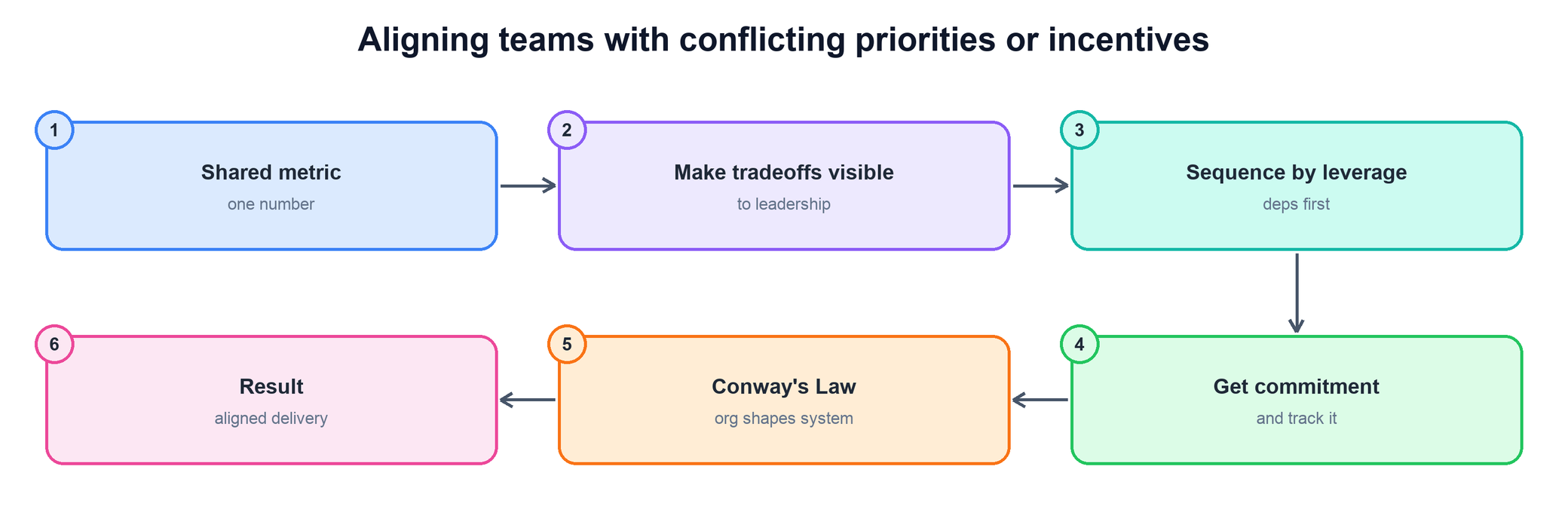
- Find the shared metric. Above every team's local goal there is almost always one company or product number they all ladder up to — anchor the alignment on that single number.
- Make the tradeoffs visible to the shared leadership. When priorities genuinely conflict, you don't resolve it by force; you put the tradeoff clearly in front of the leader who owns both teams and let the priority call be made once, explicitly.
- Sequence by leverage and dependency. Order the work so the highest-leverage and most-blocking pieces go first — often you can dissolve a "conflict" just by proving whose work truly has to precede whose.
- Get explicit commitment and track it. Turn verbal agreement into named owners, dates, and a tracker — alignment that isn't written down and watched decays within a week.
- Nod to Conway's Law: the org chart shapes the system, so persistent friction between two teams often signals a boundary in the architecture — sometimes the real fix is structural, not interpersonal. Close with the aligned-delivery result.
- Alignment anchored on a genuinely shared metric, above local goals.
- Conflict resolved by making tradeoffs explicit to the right decision-maker, not by force.
- Commitment made concrete — owners, dates, tracking — not a hallway handshake.
- Systems thinking: awareness that org structure and architecture shape each other.
- Shared OKRs / goals — pull the one number the conflicting teams laddered up to.
- GSD — pull from the projects for the sequenced plan, the owners, and the commitments you tracked.
- Meeting / review notes — pull from the leadership review where the priority tradeoff was made explicit.
- Scuba / ODS / Unidash — pull the shared metric that shows the aligned delivery actually moved it.
More questions you might get — Cross-functional Partnerships
All of these reduce to the same spine: agree on a shared outcome, understand the other side's incentives, make dependencies visible, and influence through trust and data rather than authority. Have a story ready for each.
How do you partner with SRE, Security, Legal, or Data Science specifically?
How to answer- Engage them early. Bring specialist partners in at design time, not as a final gate — a Security or Legal review sprung at the end is where launches die.
- Learn their bar. Understand what "good" means to them — SRE's reliability bar, Security's threat model, Legal's risk tolerance — and design to it rather than negotiating it down later.
- Give them the context, not just the ask. Specialists make better calls with the full picture; treat them as advisors on the outcome, not approvers on a form.
- Build the relationship off-cycle. Know your SRE and Security partners before the incident or the launch, so the first interaction isn't under pressure.
How do you say no to a partner team without damaging the relationship?
How to answer- Say no to the request, yes to the goal. Anchor on their underlying need and offer an alternative path to it, rather than a flat refusal.
- Show the tradeoff, don't just assert it. Make the cost visible — what would have to be dropped to say yes — so the no is a shared conclusion, not a decree.
- Be early and direct. A fast, clear no is kinder than a slow maybe that wastes their planning; ambiguity damages trust more than the answer does.
- Leave the door open. Name the conditions under which the answer changes, so they know it's a "not now," not a "never," and you're still a partner.
How do you communicate the same update to engineers vs executives?
How to answer- Lead with the answer for execs. Outcome, risk, and the decision or help you need, up top — they want the "so what," not the mechanism.
- Give engineers the "how." The technical detail, the tradeoffs, and the failure modes — the audience that has to build it needs the reasoning, not just the headline.
- Keep one source of truth. The two views are different framings of the same facts — never let the exec summary and the eng detail drift into different stories.
- Match the ask to the audience. From execs you need decisions and air cover; from engineers you need feasibility and execution — be explicit about which you're seeking.
How do you build trust with a new partner team quickly?
How to answer- Listen before you propose. Spend the first conversations learning their goals, pressures, and history — understanding earns more trust than a fast plan does.
- Deliver a small thing first. A quick, reliable win — an unblock, a fix, a promise kept — proves you're dependable faster than any amount of talk.
- Be transparent about constraints. Share your own pressures and limits openly; teams trust partners who are honest about what they can't do.
- Do exactly what you said. Reliability compounds — matching your actions to your words a few times is the whole foundation of trust.
How do you handle a partner who over-commits and under-delivers?
How to answer- Separate pattern from person. Assume good intent first; the issue is usually optimism or overload, not bad faith — address it without souring the relationship.
- Make commitments concrete. Replace vague "we'll get to it" with named owners, dates, and interim checkpoints, so slippage shows up early instead of at the deadline.
- Build a buffer around them. Once the pattern is clear, plan contingencies and parallel paths so your critical path no longer depends on their optimistic estimate.
- Escalate the pattern, not the incident. If it persists, raise it calmly with their manager as a recurring risk to the shared goal, with the data to back it.
Tell me about a partnership that failed — what did you learn?
How to answer- Own your half. Name what you would do differently — a misread incentive, an assumption you never checked, trust you didn't invest — without blaming the other side.
- Diagnose the root cause. Most failed partnerships trace to misaligned goals or invisible dependencies; say which one it was and how you'd surface it earlier now.
- Show the correction in flight. Describe what you tried once you saw it going wrong, not just the post-mortem — you noticed and acted, even if it wasn't enough.
- Bank a concrete rule. Close with the habit you adopted — align the metric first, or map dependencies up front — so this class of failure can't repeat.
How do you manage a dependency on an external vendor or partner?
How to answer- Contract the interface and the SLA. Pin the API contract, the guarantees, and the support terms explicitly — with an external party you can't rely on hallway alignment.
- Insulate with an abstraction. Put an adapter between your system and theirs so a vendor change or outage has a contained blast radius and a swap stays feasible.
- Plan for their failure. Assume the vendor will have an outage or miss a date; build fallbacks, timeouts, and degradation so their reliability isn't silently yours.
- Keep an exit and a lever. Avoid total lock-in and maintain the relationship and the commercial leverage to get issues fixed when they matter.