01 · Project / Roadmap Leadership
How to answer the roadmap-leadership questions in a senior engineering-leadership loop: the framework to structure each answer, what the interviewer is really listening for, and where inside Meta to pull the evidence that backs your story.
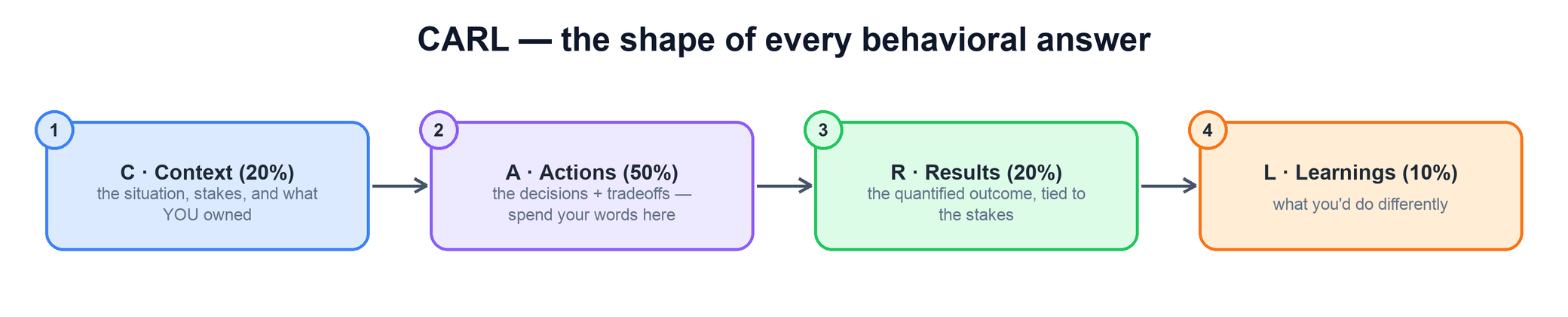
This area tests one thing: can you set a direction worth following, prioritize ruthlessly, and land it across teams. Interviewers are not grading whether you shipped something — they assume you did. They are grading judgment: did you anchor on an outcome, choose the few bets that mattered, say no to the rest, and prove the result moved a number. Every answer below is built on the CARL shape — Context, Actions, Results, Learnings — with most of your words spent on the decisions and tradeoffs.
Questions on this page
- How to answer this area — the framework
- Define a technical roadmap and drive it to completion
- Prioritize when everything is 'urgent' — and saying no
- Lead a complex cross-functional project
- Align stakeholders who disagree on direction
- A roadmap or project that slipped
- More questions you might get
- How do you decide what makes it onto the roadmap — and what gets killed?
- Tell me about a time you changed direction mid-roadmap. What triggered it?
- How do you balance long-term platform investment against short-term delivery pressure?
- Tell me about a bet that didn't pay off. How did you decide to stop?
- How do you set and communicate OKRs that your team actually believes in?
- Describe a time leadership's priorities conflicted with what your team needed. What did you do?
- How do you keep a multi-quarter roadmap from becoming stale?
How to answer this area — the roadmap-leadership framework
Every roadmap question can be answered with the same five-step spine. Walk it in order and you will hit the signals interviewers look for without rambling.
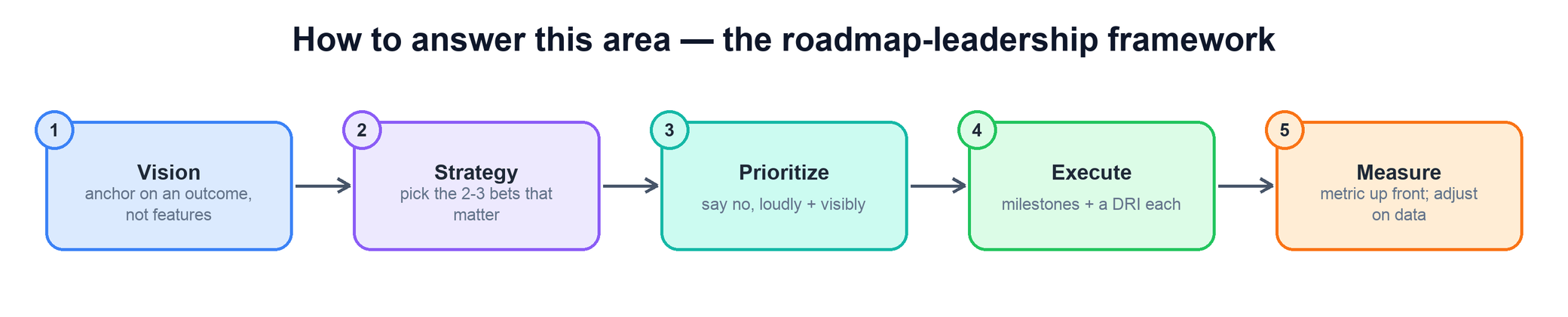
- Vision — anchor on outcomes. Tie the roadmap to a business or user outcome, not a feature list. "Cut build-to-deploy time so the team ships faster," not "build a CI tool."
- Strategy — pick the few bets. Name the two or three bets that matter and the data behind them. Sequence by leverage and dependency.
- Prioritize — say no, loudly. Show what you cut and how you defended it. The willingness to deprioritize is the strongest seniority signal in this area.
- Execute — milestones and owners. Break the roadmap into milestones, assign a DRI per workstream, and surface dependencies and risks early.
- Measure — close the loop. Define the success metric before the work starts; review against it; kill or double down on the data.
- Outcome-driven thinking, not a feature checklist.
- A real, costly tradeoff — the thing you chose not to do.
- Ownership clarity: who drove what, and how you measured success.
- "I" for the decisions you made, "we" for how the team executed.
- GSD — the roadmap itself: projects, milestones, OKRs, and the portfolio status reports that show progress over time.
- Workplace — the post where you announced the direction and the buy-in thread underneath it.
- Planning docs (Google Docs / Quip) — the half or year plan, and the explicit list of bets you cut.
- Scuba / ODS / Unidash — the time-series metric that proves the outcome actually moved.
- Internal wiki — search your team or system's roadmap page and prior planning-review notes.
Tell me about a time you defined a technical roadmap and drove it to completion.
The flagship question for this area. They want a roadmap you owned end to end — defined from an outcome, narrowed to a few bets, and driven to a measurable result.
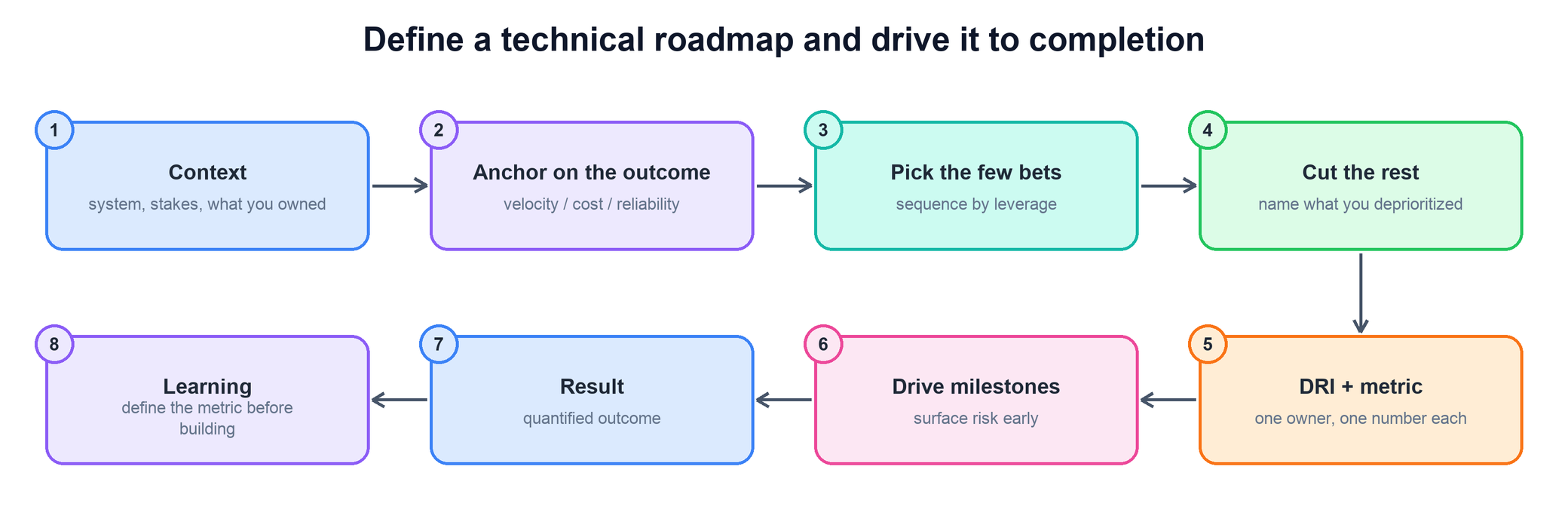
- Open with the context and stakes in two sentences: the system, its scale, and what you personally owned.
- State the outcome the roadmap was built to move — velocity, cost, reliability — before you mention any project.
- Name the two or three bets you chose and why, then the things you deliberately deprioritized.
- Give each workstream a DRI and a metric defined up front; describe how you reviewed against the metric, not activity.
- Land a quantified result tied back to the opening stakes, and close with one genuine learning.
- The roadmap is framed as an outcome, not a list of deliverables.
- Evidence you sequenced by leverage and cut low-value work.
- A metric defined before building — not reverse-engineered after.
- Clear personal ownership of the direction, shared credit for execution.
- GSD — the project tree, milestone dates, and status reports that document the roadmap and its progress.
- Scuba / ODS / Unidash — the before/after numbers for the outcome you claim moved.
- Planning docs — the original roadmap doc, so you can quote the bets and the cuts accurately.
- Workplace — the launch or milestone posts, useful for dates and impact framing.
How do you prioritize when everything is 'urgent,' and tell me about a time you said no to something important.
This question tests whether you can reduce a pile of competing, individually-reasonable demands to a single decision — and whether you can say no without burning the relationship.
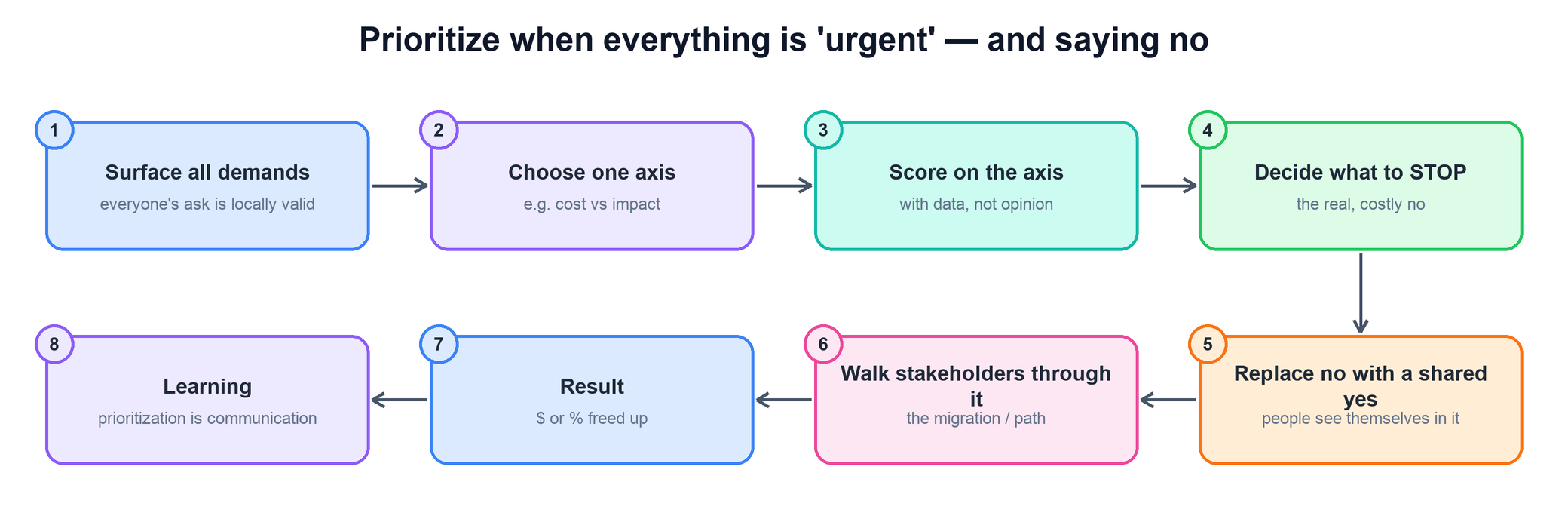
- Acknowledge that every request was locally reasonable — that is what made it hard.
- Pick one axis to decide on (for example, total cost of ownership vs. impact) and make it explicit.
- Name the real thing you said no to — vague "we focused" answers read as junior.
- Show how you turned the no into a shared yes: walk the stakeholder through the data and the path forward.
- Close with the outcome (a number if you have one) and the insight that prioritization is a communication problem.
- A clear decision axis, not a gut call.
- A concrete, costly "no" — with a named stakeholder who pushed back.
- Stakeholder management: the no landed as a better shared outcome.
- Comfort defending the decision with data.
- GSD — the competing projects and what you closed, paused, or deprioritized.
- Unidash / ODS — the cost or impact numbers behind the axis you chose.
- Planning docs — the explicit "not doing this half" list.
- Workplace / email — the message where you communicated the decision and the path.
Tell me about the most complex cross-functional project you've led. How did you keep it on track?
The signal here is influence without authority: driving teams you don't own, with different priorities and timelines, to one shared outcome.
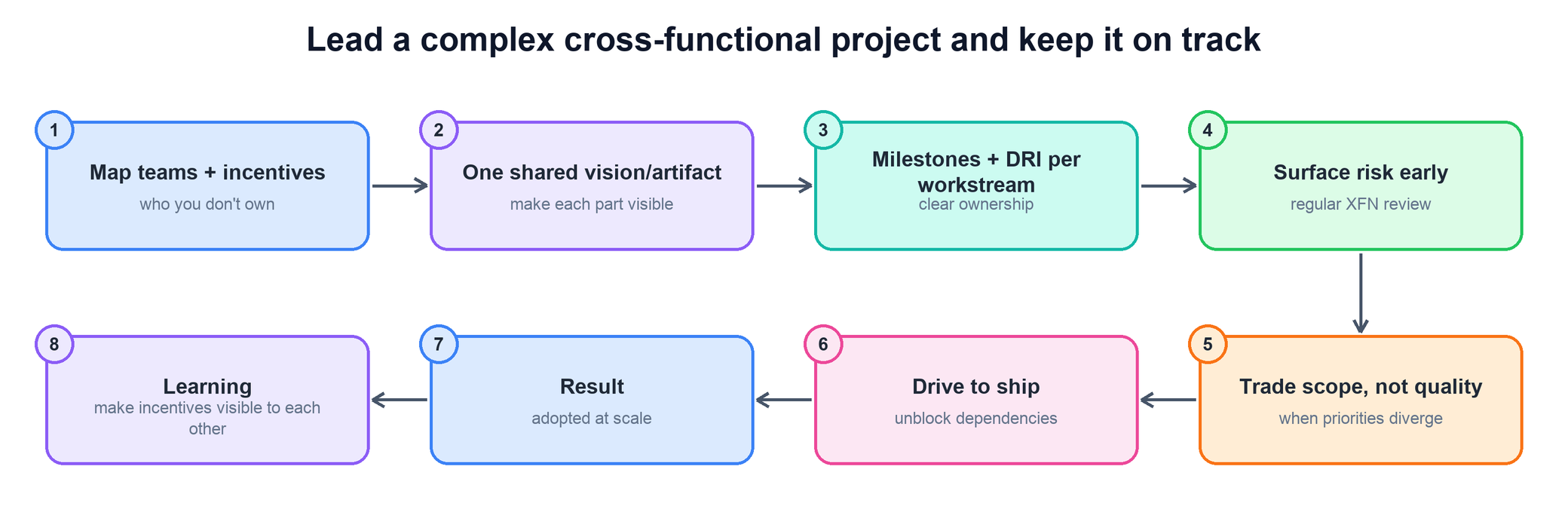
- Set the context around the teams you didn't own and their conflicting incentives.
- Describe the one shared artifact (a vision doc, an integrated design) that made each team's piece visible to the others.
- Lay out the milestone plan with a DRI per integration, and the cadence where risk surfaced early.
- Give a concrete example of trading scope, not quality, when a partner's priorities shifted.
- End with what shipped, the adoption, and the lesson about aligning incentives.
- Influence without formal authority — a moment you changed a partner's mind.
- Dependency and risk management ahead of the deadline, not at it.
- A shared artifact doing the alignment, not a status meeting.
- Shipped and adopted at real scale.
- GSD — the cross-team project, its dependencies, and per-workstream milestones.
- The shared design / vision doc (Google Docs or wiki) — the artifact itself.
- Workplace group — the cross-functional updates and risk reviews.
- Phabricator — diffs across teams, if the project was a build.
How do you align stakeholders who disagree on the technical direction?
A focused conflict-and-decision question. They want to see you move a disagreement to a committed decision without leaving scorched earth.
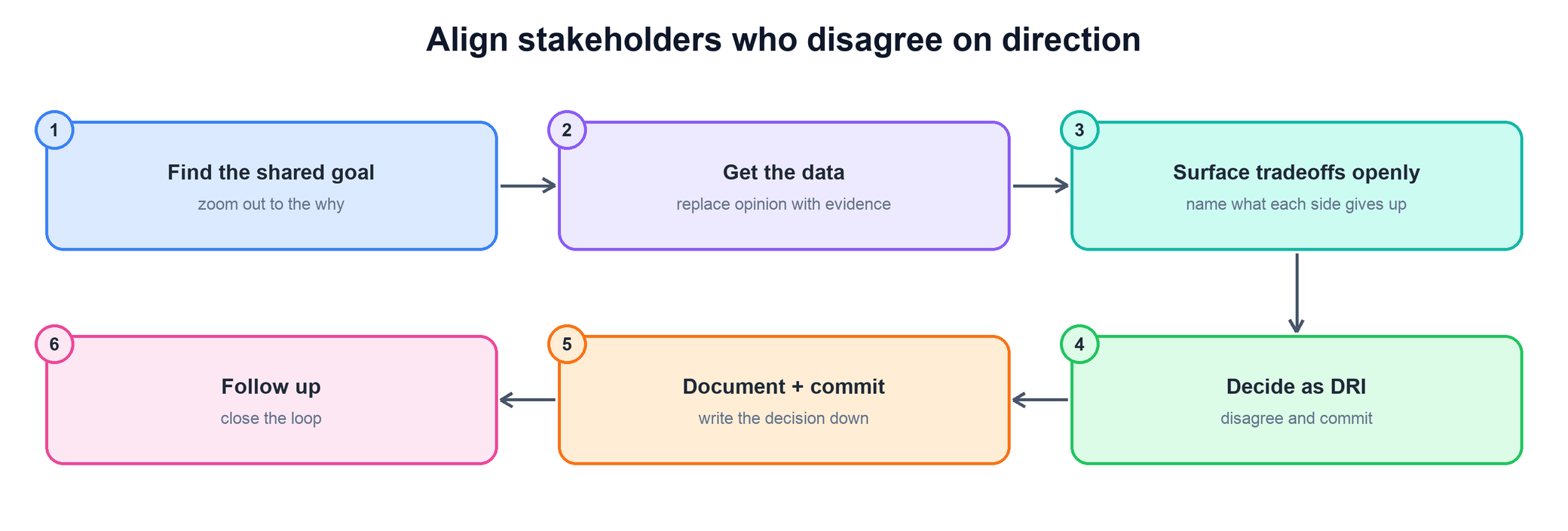
- Start by finding the shared goal — most direction fights dissolve when you zoom out to the why.
- Move the debate onto data: a prototype, a benchmark, or a cost model beats louder opinions.
- Surface the tradeoffs each side is implicitly accepting, so the choice is explicit.
- If consensus does not come, decide as the DRI and ask for disagree-and-commit; document the decision and revisit triggers.
- Close the loop: follow up so people see the decision was sound or get corrected on data.
- You separate people from the problem and lead with the shared goal.
- Decisions resolved on evidence, not seniority or volume.
- Willingness to make the call and own it when consensus stalls.
- Relationships preserved through the disagreement.
- The decision doc / RFC on the wiki — the written decision and its rationale.
- Scuba / ODS / Unidash or a prototype's numbers — the evidence that settled it.
- Workplace thread — the discussion showing disagree-and-commit in action.
Tell me about a roadmap or project that slipped. What did you do?
A perseverance-and-ownership question. They want honesty about a miss and a competent recovery — not a flawless story.
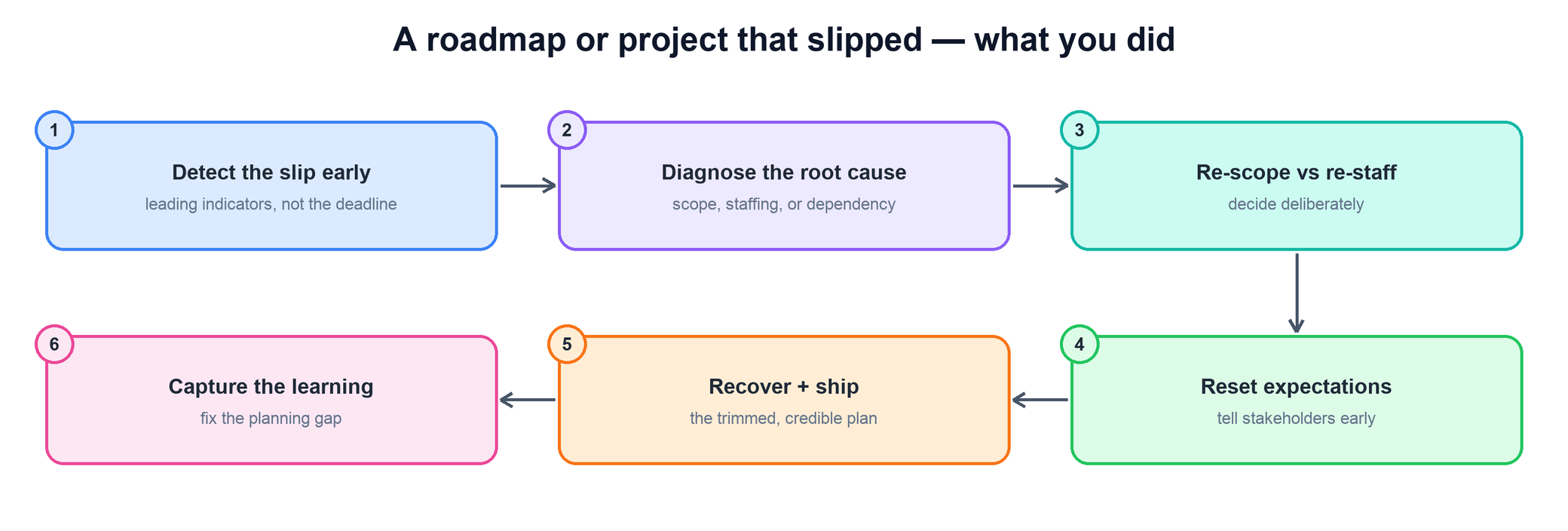
- Show you detected the slip early from leading indicators, not when the deadline arrived.
- Diagnose the root cause honestly: scope creep, understaffing, or an external dependency.
- Make the recovery decision explicit — re-scope vs. re-staff — and why.
- Reset expectations with stakeholders proactively; a credible trimmed plan beats silence.
- Finish with the durable change you made to how you plan or track.
- Early detection and a calm, structured response.
- Ownership of the miss without blame-shifting.
- A deliberate recovery decision, communicated early.
- A real learning that changed your operating model.
- GSD — the milestone history showing the slip and the reset plan.
- Status reports — where you reset expectations on the record.
- Retro / postmortem doc on the wiki — the root cause and the fix.
More questions you might get — Project / Roadmap
All of these reduce to the same spine: anchor on an outcome, name the few bets and the cuts, give owners and a metric, and land a number. Have a story ready for each.
How do you decide what makes it onto the roadmap — and what gets killed?
How to answer- Name one axis you rank on — impact per unit cost, or leverage on the top outcome — and make it explicit.
- Score, don't argue: put the candidates on that axis with data, and let the bottom of the list fall off.
- Say what you killed and the cost of killing it — a real, painful cut is the seniority signal.
- Close on a number the focus bought (faster delivery, fewer incidents) and the lesson that a roadmap is defined by its no's.
Tell me about a time you changed direction mid-roadmap. What triggered it?
How to answer- Lead with the trigger: a new data point or shifted constraint that made the old plan the wrong bet, not a whim.
- Show you weighed sunk cost against expected value and chose to pivot with eyes open.
- Reset owners and the metric for the new direction, and communicate the change before people hear it secondhand.
- Land the result the pivot unlocked and the learning about holding plans loosely and outcomes tightly.
How do you balance long-term platform investment against short-term delivery pressure?
How to answer- Reframe it as one budget: reserve a fixed slice of capacity for platform work so it competes openly, not as an afterthought.
- Tie the investment to a concrete future outcome — the velocity or cost it unblocks — so it earns its slice.
- Sequence by compounding return: ship the short-term wins that buy trust, then spend that trust on the platform bet.
- Quantify the payoff that landed (less toil, faster onboarding of new work) and the lesson that ignoring either side costs you both.
Tell me about a bet that didn't pay off. How did you decide to stop?
How to answer- State the kill criteria up front: you set a metric and a checkpoint before starting, so stopping was a decision, not a surrender.
- Show the signal that the bet wasn't converging and that you read it honestly instead of doubling down on hope.
- Own the call to stop and how you redeployed the people and time to a higher-value bet.
- Close with the cost you saved by stopping early and the learning about treating sunk cost as gone.
How do you set and communicate OKRs that your team actually believes in?
How to answer- Co-author, don't dictate: the team shapes the key results so they own the number, not just hear it.
- Make each OKR an outcome with a measurable target, not a list of tasks to check off.
- Connect it upward — show the line from each OKR to the org's top outcome so the work feels worth doing.
- Land the result you hit (or honestly missed) and the lesson that belief comes from ownership and a clear why.
Describe a time leadership's priorities conflicted with what your team needed. What did you do?
How to answer- Find the shared goal first — frame the team's need in terms of the outcome leadership cares about.
- Bring data up, not complaints: show the cost of the conflict with numbers and propose a concrete tradeoff.
- Show you managed both directions — shielding the team from churn while honestly representing leadership's constraints.
- Close on the compromise that landed and the learning about being the translation layer, not a wall.
How do you keep a multi-quarter roadmap from becoming stale?
How to answer- Build in a review cadence: revisit the roadmap against its metrics each cycle so it's a living plan, not a frozen doc.
- Re-rank on fresh data — promote, drop, or re-scope bets as costs and outcomes shift.
- Keep the outcome fixed and the path flexible, and assign owners to surface drift early.
- Land the result of staying current (avoided wasted quarters, faster reaction) and the lesson that a roadmap is a hypothesis you keep testing.