05 · People Management
How to answer the people-management questions in a senior engineering-leadership loop: the framework to structure each answer, what the interviewer is really listening for, and where inside Meta to pull the evidence that backs your story.
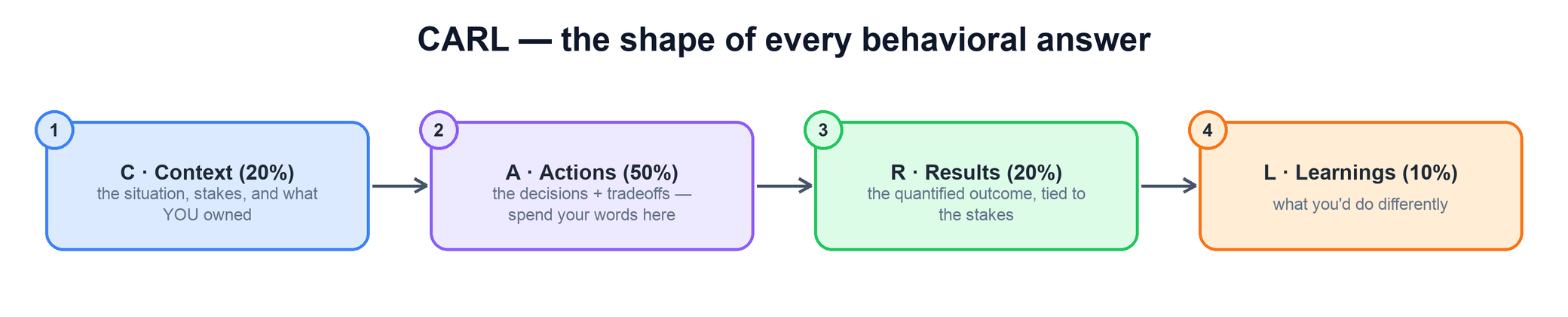
This area tests one thing: can you hire well, grow people, hold a bar, and build a team others want to stay on. Interviewers are not grading whether you managed people — they assume you did. They are grading judgment and care: did you set clear expectations, give honest feedback in time, create real stretch, and handle the hard situations — underperformance, conflict, attrition — with both rigor and humanity. Every answer below is built on the CARL shape — Context, Actions, Results, Learnings — with most of your words spent on the decisions and the human judgment behind them.
Questions on this page
- How to answer this area — the people-leadership framework
- Someone you developed — what you did, where they are now
- A difficult performance situation
- Building or scaling a team — quality and culture
- Resolving a conflict — teammates or a peer
- Delivering difficult feedback
- Your biggest mistake as a leader
- Retaining and motivating your best people
- More questions you might get
- How do you set expectations for a new report, and how do you know they're being met?
- Tell me about a strong hire you made — and a hiring decision you got wrong.
- How do you give feedback to someone who is already a high performer?
- Tell me about a time you had to let someone go. How did you handle it?
- How do you build psychological safety while still holding a high bar?
- Describe a time a top performer became disengaged. What did you do?
- How do you delegate without either micromanaging or abandoning people?
How to answer this area — the people-leadership framework
Every people-management question can be answered with the same six-part spine. Walk it in order and you will hit the signals interviewers look for without rambling.
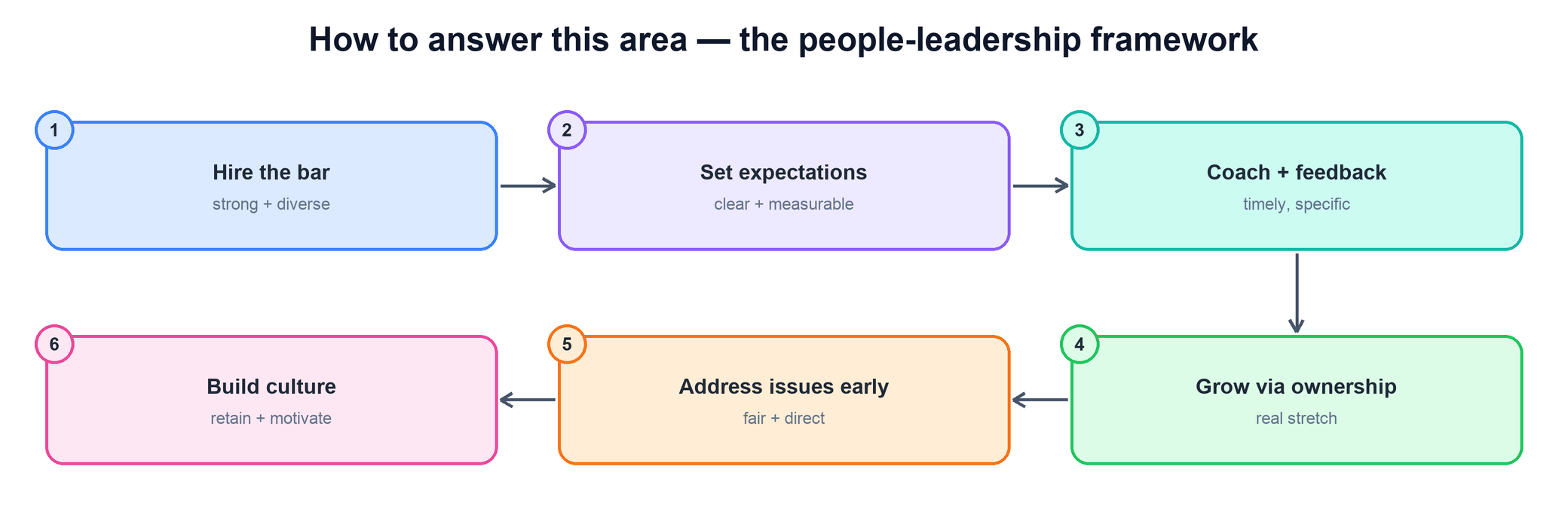
- Hire the bar. Show you raised quality and diversity of the team, not just headcount. Talk about the bar you held and the calls you made to hold it.
- Set expectations. Clear, measurable, written down. People can only meet a bar they can see — describe how you made yours legible.
- Coach and feedback. Timely and specific, not saved for review season. The strongest managers correct small things early so they never become big.
- Grow via ownership. Development happens through real, stretching work plus sponsorship — not through advice alone.
- Address issues early. Underperformance and conflict get worse with delay. Naming things early and fairly is the seniority signal here.
- Build culture. Retention and motivation are an output of everything above — close on the team health you created.
- Care and rigor — not a soft manager, not a cold one.
- A real, hard people decision — the one you didn't want to make.
- Clear expectations and honest feedback delivered in time, not deferred.
- "I" for the decisions you owned, "we" for the team's growth and wins.
- PSC packets & ratings — pull from your performance-cycle write-ups to ground how people grew under you over time.
- Promo packets — pull from packets you wrote or sponsored as evidence of development you drove.
- Calibration notes — pull from calibration outcomes to show the bar you held and defended.
- Pulse results — pull from team survey trends for engagement, manager effectiveness, and retention signals.
- 1:1 notes — pull from your own private notes for the timeline of coaching and expectation-setting.
- Peer & upward feedback — pull from feedback you received as third-party evidence of your leadership.
Tell me about someone you developed. What did you do, and where are they now?
The flagship question for this area. They want a person you grew — from where they were, through real ownership and sponsorship, to a visibly larger role today. Keep the individual anonymous.
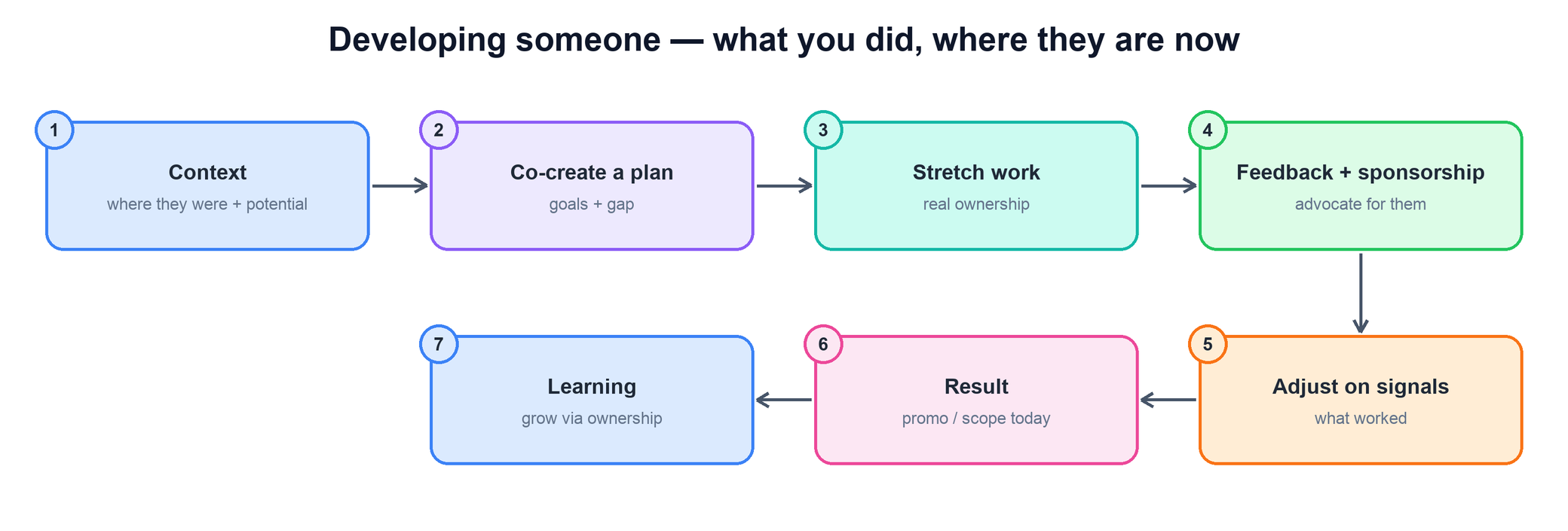
- Open with where they were and the potential you saw — the gap between today and the role you believed they could fill.
- Co-create a plan with them: concrete goals and the specific gap to close, owned together rather than handed down.
- Give them real stretch work — genuine ownership with room to fail safely, not a glorified task list.
- Pair feedback with sponsorship: advocate for them in rooms they aren't in, and adjust the plan on what's actually working.
- Land where they are now — a promotion, expanded scope, a hard problem they now own — and close with one genuine learning.
- Development driven by ownership and sponsorship, not just advice.
- A specific, measurable plan — not "I gave them more responsibility."
- A concrete outcome you can point to: promo, scope, or a role they grew into.
- Genuine investment in the person, with credit going to them.
- Promo packets — pull from a packet you wrote or sponsored to anchor the before/after scope.
- PSC packets & ratings — pull from cycle write-ups that show the trajectory you coached.
- 1:1 notes — pull from your private notes for the plan, the milestones, and the coaching timeline.
- Peer & upward feedback — pull from feedback about how you grew people.
Tell me about a difficult performance situation. How did you handle it?
This question tests whether you can hold a bar humanely — name a gap early, give a fair shot, and make the hard call on data when needed. Vague "we coached them up" answers read as junior or as avoidance.
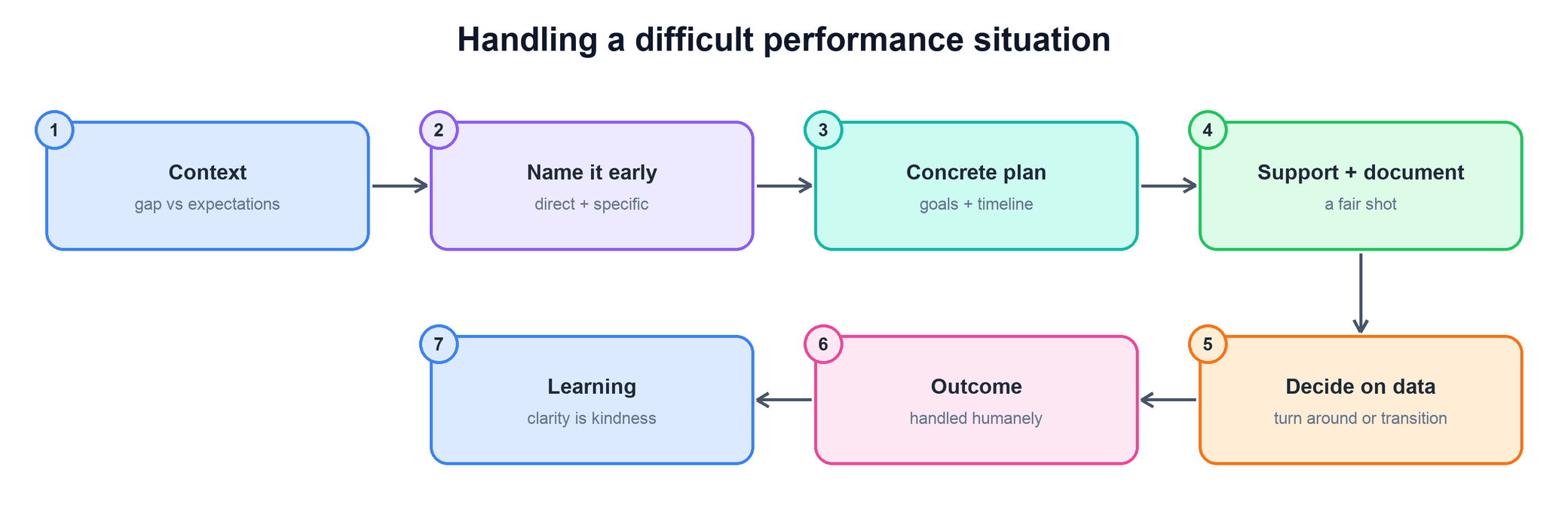
- Set the context: the gap between expectations and delivery, stated factually and without character judgments.
- Name it early — direct and specific. The most common failure is waiting; show you didn't.
- Build a concrete plan: explicit goals, a realistic timeline, and what good looks like, so they have a fair and visible path.
- Support and document in parallel — real help to succeed, plus an honest record so the decision is fair either way.
- Decide on the data: a genuine turnaround or a humane transition. Close with the outcome and the learning that clarity is kindness.
- Early, direct naming of the gap — not months of avoidance.
- A fair, documented process that gives the person a real shot.
- Willingness to make the hard call, and to make it humanely.
- Empathy and rigor held together, not traded off.
- PSC packets & ratings — pull from the cycle record that documents the gap and the expectations.
- 1:1 notes — pull from your private notes for the timeline of when and how you named the issue.
- Calibration notes — pull from calibration to ground how the bar was defined and applied consistently.
Tell me about building or scaling a team. How did you keep quality and culture as it grew?
The signal here is that you can add people fast without diluting the bar or the culture — growth as a deliberate system, not a headcount race.
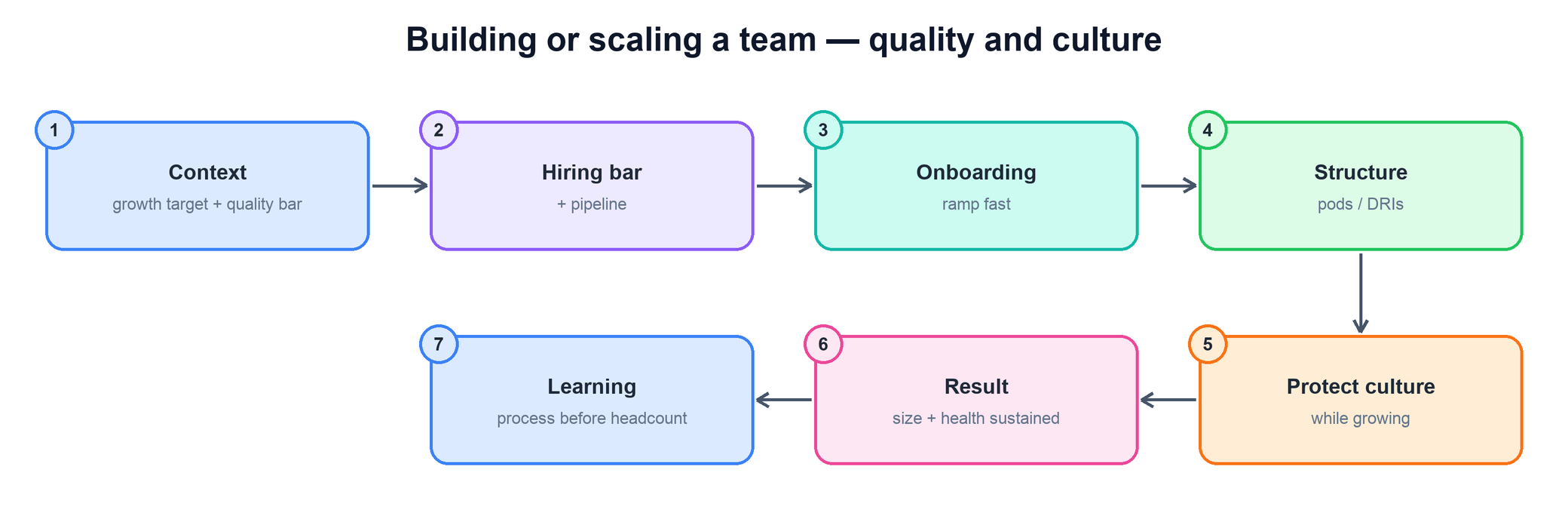
- Set the context: the growth target and the quality bar you refused to drop to hit it.
- Describe the hiring bar and pipeline you built — sourcing, the interview bar, and how you held it under pressure to fill seats.
- Show the onboarding that ramped new people fast, so growth added capacity instead of slowing the team down.
- Lay out the structure — pods, DRIs, clear ownership — that kept the team legible as it got bigger.
- Name how you protected the culture while growing, then land the result: size and health both sustained. Close with a learning.
- A held hiring bar under real pressure to lower it.
- Deliberate structure and onboarding, not ad-hoc growth.
- Culture treated as something you actively protect, with evidence.
- Quality and health sustained — not just a bigger org chart.
- Headcount / Workday — pull from the org record for the team-size growth over time.
- Pulse results — pull from survey trends to show health held as the team grew.
- Calibration notes — pull from calibration to show the bar stayed consistent across new hires.
- PSC packets & ratings — pull from cycle data to show new hires ramped and performed.
Tell me about a conflict between team members — or between you and a peer — and how you resolved it.
A focused conflict question. They want to see you move a real disagreement to a resolution that keeps the relationship intact — not avoid it, and not win it at someone's expense.
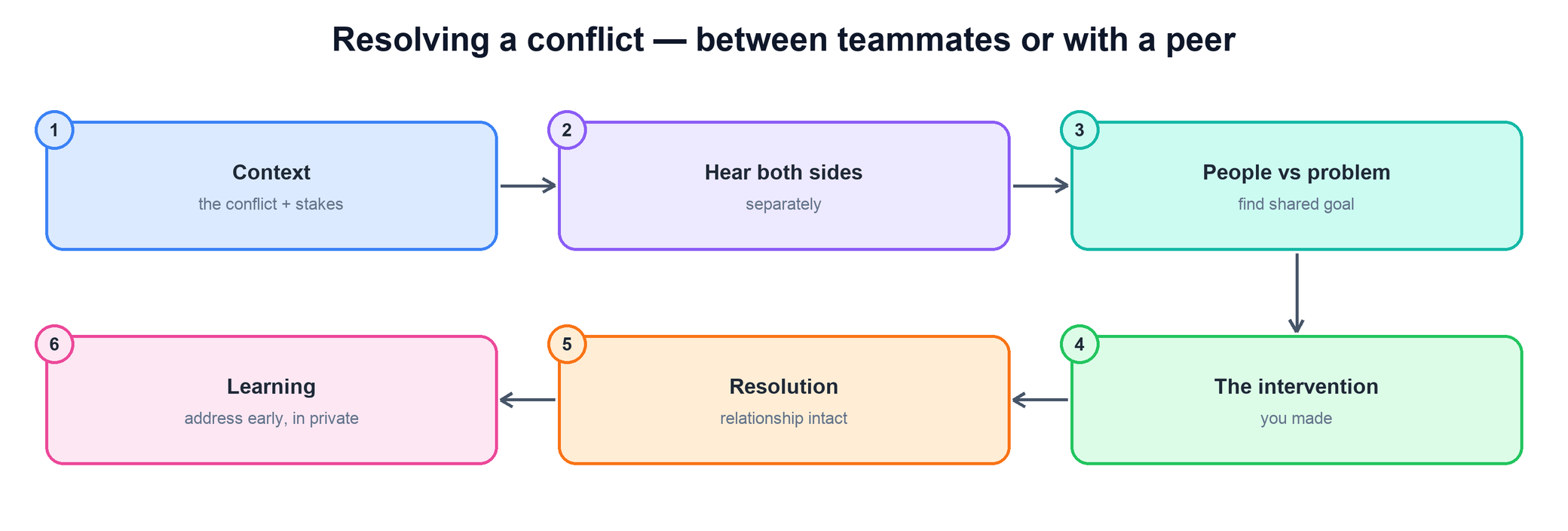
- Set the context: the conflict and the stakes — why it mattered to the work, not just to the people.
- Hear both sides separately first, so each person feels understood before you bring them together.
- Separate the people from the problem and find the shared goal underneath the disagreement.
- Describe the intervention you made — the conversation, the reframing, or the structural change that broke the deadlock.
- Land on a resolution with the relationship intact, and close with the learning: address conflict early, and in private.
- You engaged the conflict directly rather than letting it fester.
- You separated people from the problem and led with the shared goal.
- A concrete intervention, not a vague "we talked it out."
- The relationship survived — ideally got stronger.
- 1:1 notes — pull from your private notes for the timeline and the conversations you had.
- Peer & upward feedback — pull from feedback for how others experienced your handling of tension.
- Pulse results — pull from team trends if the resolution showed up in collaboration or trust signals.
Tell me about a time you had to give someone difficult feedback. How did you deliver it, and what happened?
This question tests whether you can deliver hard feedback so it actually lands and changes behavior — specific, observable, and two-way. The SBI shape (Situation, Behavior, Impact) is the cleanest frame.
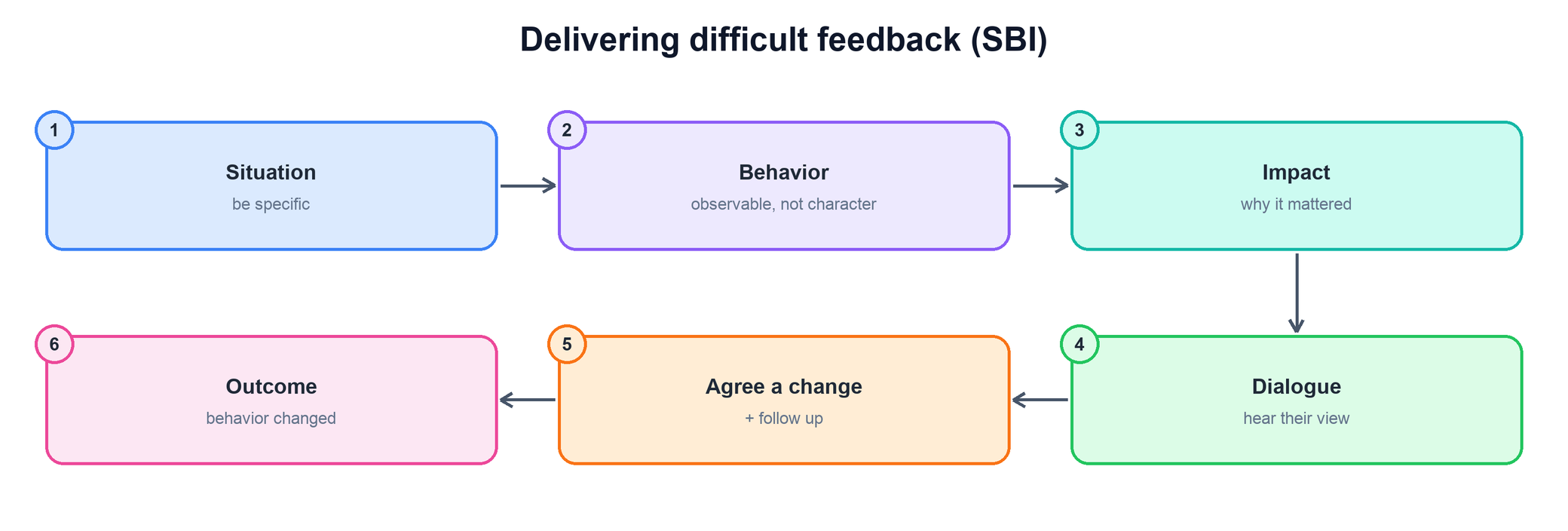
- Situation — anchor on a specific moment, not a generalization. "In last week's review," not "you always."
- Behavior — describe what was observable, not the person's character. Behavior can change; character framing makes people defensive.
- Impact — explain why it mattered: the effect on the work, the team, or the outcome.
- Open a dialogue — hear their view; the feedback may be incomplete, and buy-in beats a lecture.
- Agree a change and follow up, then close on the outcome: the behavior actually changed.
- Specific, observable feedback — not a character verdict.
- A two-way conversation, not a one-way download.
- A concrete agreement and genuine follow-up afterward.
- The feedback led to real, durable change.
- 1:1 notes — pull from your private notes for the conversation and the follow-up you tracked.
- PSC packets & ratings — pull from cycle write-ups if the change showed up in performance.
- Peer & upward feedback — pull from feedback for how your candor is experienced.
What's the biggest mistake you've made as a leader, and what did you learn?
A maturity-and-ownership question. They want a real mistake with real stakes, owned without deflection, and a durable change in how you operate — not a humble-brag dressed up as a flaw.
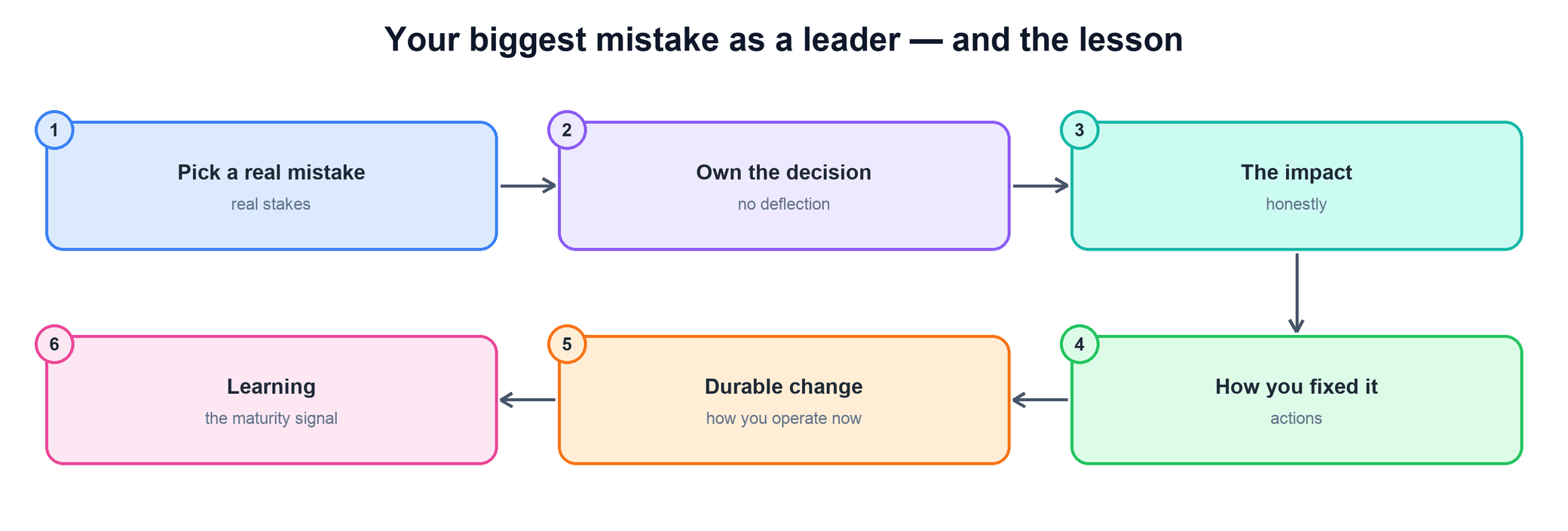
- Pick a real mistake with real stakes — a held-too-long hire, a missed signal, a wrong call on someone's growth. Not "I work too hard."
- Own the decision — no deflection onto circumstances or other people. The ownership is the signal here.
- Describe the impact honestly, including on the people affected, without minimizing it.
- Walk through how you fixed it — the concrete actions you took once you saw it.
- Close on the durable change: how you operate differently now, and the learning that proves the maturity.
- A genuine mistake with stakes — not a disguised strength.
- Full ownership, no blame-shifting.
- Honest reckoning with the human impact.
- A durable change in operating model, not just a regret.
- PSC packets & ratings — pull from your self-reflection sections where you named what you'd do differently.
- Peer & upward feedback — pull from feedback that surfaced the blind spot you later addressed.
- 1:1 notes — pull from your private notes for the moment you caught it and the fix you ran.
How do you retain and motivate your best people?
This question tests whether you treat retention as a system — knowing what drives each person, giving them meaningful work and visible growth, and acting on flight risk before it becomes a resignation.
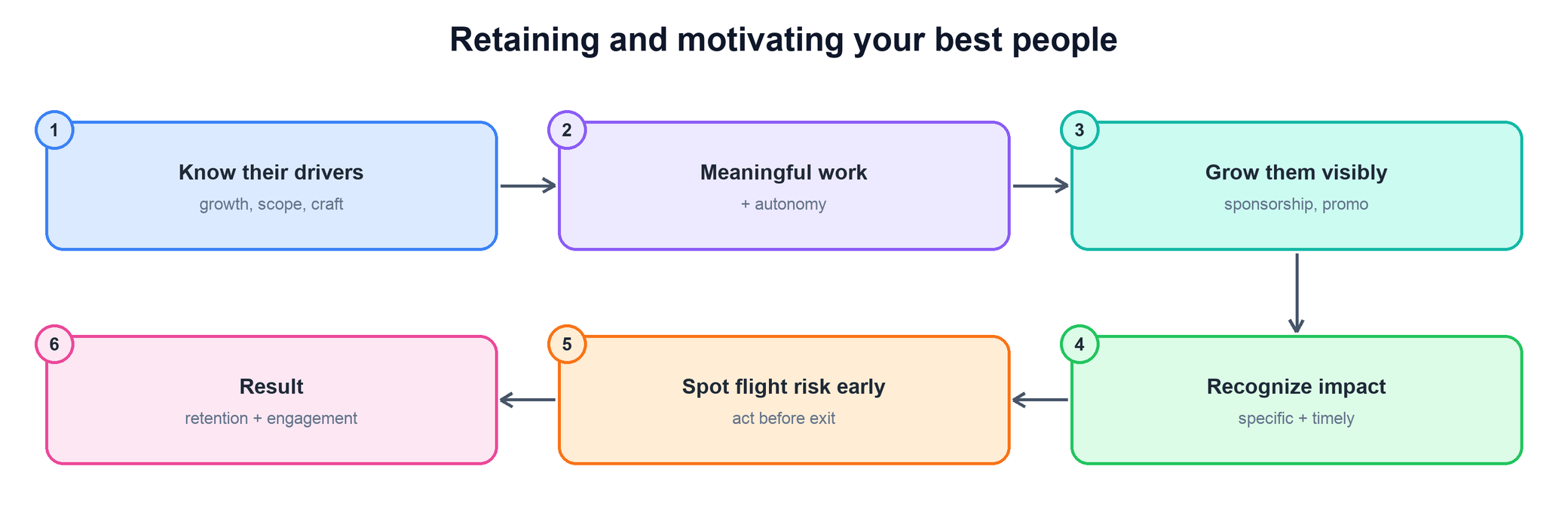
- Know their drivers — growth, scope, craft, comp, flexibility differ by person. Retention starts with knowing which one matters to whom.
- Give meaningful work with autonomy — your best people stay for problems worth solving and the room to solve them their way.
- Grow them visibly — sponsorship and promotion, so growth is felt and seen, not just promised.
- Recognize impact specifically and in time — generic praise doesn't retain; precise, timely recognition does.
- Spot flight risk early and act before the exit conversation. Close on the result: retention and engagement held.
- Retention treated per-person, not as a one-size policy.
- Proactive flight-risk management — you act before the resignation.
- Growth and recognition that are visible and specific.
- Evidence it worked: people stayed and stayed engaged.
- Pulse results — pull from engagement and intent-to-stay trends for your team.
- Promo packets — pull from packets that show visible growth you delivered for top people.
- 1:1 notes — pull from your private notes for each person's drivers and the flight-risk signals you tracked.
- Headcount / Workday — pull from the org record for retention of your strongest people over time.
More questions you might get — People Management
All of these reduce to the same spine: hire to a bar, set clear expectations, give honest feedback in time, grow people through ownership, and handle the hard cases fairly. Have a story ready for each — and keep individuals anonymous.
How do you set expectations for a new report, and how do you know they're being met?
How to answer- Write it down — a short 30/60/90 with measurable outcomes, so the bar is legible from day one, not implied.
- Co-own it — walk the expectations together and confirm they understand what good looks like, not just what to do.
- Instrument the signal — track delivery, peer feedback, and 1:1 cues, so you know early, not at review season.
- Close with a learning — clarity up front prevents the slow drift that becomes a performance conversation later.
Tell me about a strong hire you made — and a hiring decision you got wrong.
How to answer- Context for the strong hire — the bar you held, the signal you weighted, and the impact they delivered once on the team.
- Own the wrong call — name what you over-indexed on (likability, a single strength) without deflecting onto the candidate.
- Show the humane fix — how you addressed the mis-hire fairly: clear expectations, a real shot, then a clean decision.
- Learning — the calibration you changed in your interviewing so the same blind spot doesn't repeat.
How do you give feedback to someone who is already a high performer?
How to answer- Situation-Behavior-Impact — anchor on a specific moment; strong people respect precision and tune out vague praise or vague worry.
- Raise the ceiling, not just fix gaps — frame feedback as the next level of scope or influence they're ready for.
- Make it two-way — high performers have context you don't; invite their view before agreeing a change.
- Learning — withholding feedback from your best people stalls them; candor is how you keep them growing.
Tell me about a time you had to let someone go. How did you handle it?
How to answer- Context — the gap, named early and factually, after a fair and documented attempt to close it.
- Actions — an honest plan with real support, plus a clear record so the decision was fair either way.
- Result, handled with dignity — a direct, private, respectful conversation that preserved the person's dignity.
- Learning — delay is the cruelty; deciding in time, humanely, is the kindness — to them and the team.
How do you build psychological safety while still holding a high bar?
How to answer- Separate the two — safety is about how people are treated; the bar is about the work. High standards and high safety coexist.
- Model it yourself — admit your own mistakes openly, so the team learns errors are surfaced, not hidden.
- Hold the bar without shame — critique the work specifically, never the person, so honesty doesn't feel like risk.
- Learning — teams take the hardest swings precisely when they trust they won't be punished for an honest miss.
Describe a time a top performer became disengaged. What did you do?
How to answer- Spot the signal early — dropped energy, quieter in rooms, shrinking scope; name what you noticed before it became an exit.
- Diagnose the driver — a direct, curious 1:1 to find the real cause: growth stalled, recognition missing, or the work gone flat.
- Act on it — the concrete change you made: new scope, a sponsorship, a path forward they actually wanted.
- Learning — disengagement is a signal to read, not a verdict; re-engaging beats backfilling every time.
How do you delegate without either micromanaging or abandoning people?
How to answer- Delegate outcomes, not steps — agree on what good looks like and the guardrails, then leave the how to them.
- Match support to the person — calibrate check-in depth to their experience with the task, not a fixed cadence for everyone.
- Stay available, not hovering — set checkpoints they own, so help is there when needed without removing ownership.
- Learning — delegation is a development tool; the stretch and the safe room to fail are where people actually grow.