Leaders Eat Last — High-Level Learnings
A practical, high-level summary of the ideas in Leaders Eat Last: Why Some Teams Pull Together and Others Don’t by Simon Sinek — why safety and trust, not charisma or incentives, are what make people give their best to one another.
The book starts from a simple observation about the best teams: their people are not braver, smarter, or better paid than anyone else — they simply feel safe among their own. When a leader takes real responsibility for the people in their care, those people stop spending energy protecting themselves from each other and start pointing all of it outward, at the actual challenges the organization faces. What follows is a summary of the core ideas in my own words, meant as a study aid — the book itself carries the stories, biology, and history that make the argument land.
Contents
1. The Circle of Safety
The central idea of the book is the Circle of Safety. Every organization faces dangers from the outside — competitors, market swings, shifting technology, plain uncertainty. What a leader controls is what happens inside the ring. When people trust that their colleagues and their leaders have their backs, the threats inside the group disappear, and everyone can turn their attention and energy to the dangers outside. When that trust is missing, people spend their days guarding against politics, blame, and each other — and the external threats go unanswered.
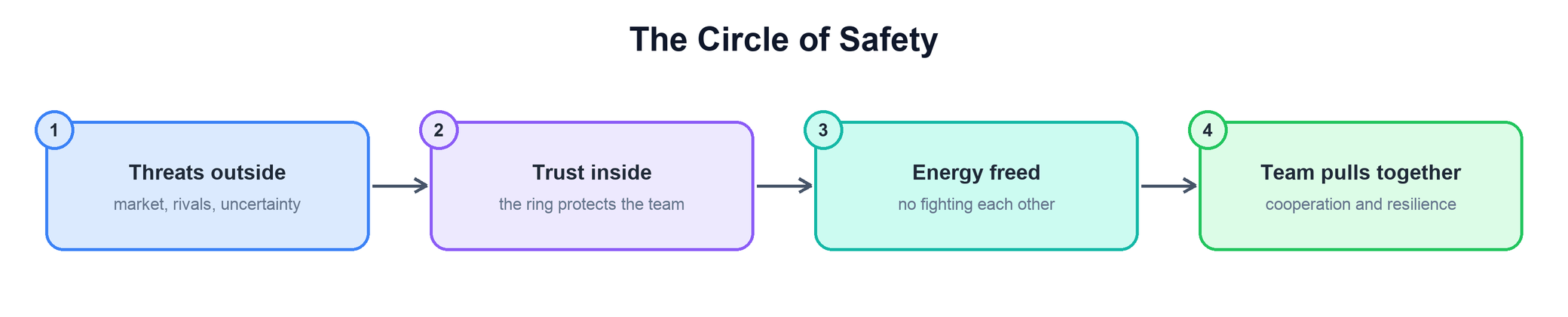
The title comes from the Marine Corps. In the mess hall, the most junior Marines eat first and the most senior eat last — no one enforces it, it is simply what leaders do. It is a small, daily signal of the deeper contract: the leader’s job is to serve those in their care, even at a cost to themselves, and in return those people give their leader — and each other — extraordinary trust and effort. Leadership is a responsibility, not a rank.
2. The chemicals that drive us
Sinek grounds the argument in biology. Our behavior in groups is steered by a handful of chemicals that evolved to keep us alive and cooperating. Four of them make us feel good, and one keeps us alert to danger. Roughly, two are selfish chemicals that reward individual accomplishment, and two are selfless, social chemicals that reward trust and belonging — and a healthy culture keeps them in balance.
| Chemical | Group | What it does |
|---|---|---|
| Endorphins | Selfish (individual) | Mask physical pain and exhaustion so we can push through hard effort; the “runner’s high.” |
| Dopamine | Selfish (individual) | The reward for making progress and hitting goals — intensely motivating, but addictive when we chase the hit for its own sake. |
| Serotonin | Selfless (social) | The feeling of pride, status, and respect; it strengthens the bond between leaders and the people who look up to them. |
| Oxytocin | Selfless (social) | The chemical of love, trust, friendship, and belonging; it builds slowly through acts of generosity and time together. |
| Cortisol | Stress response | The anxiety and stress of a perceived threat; useful in short bursts, corrosive to health and trust when it never switches off. |
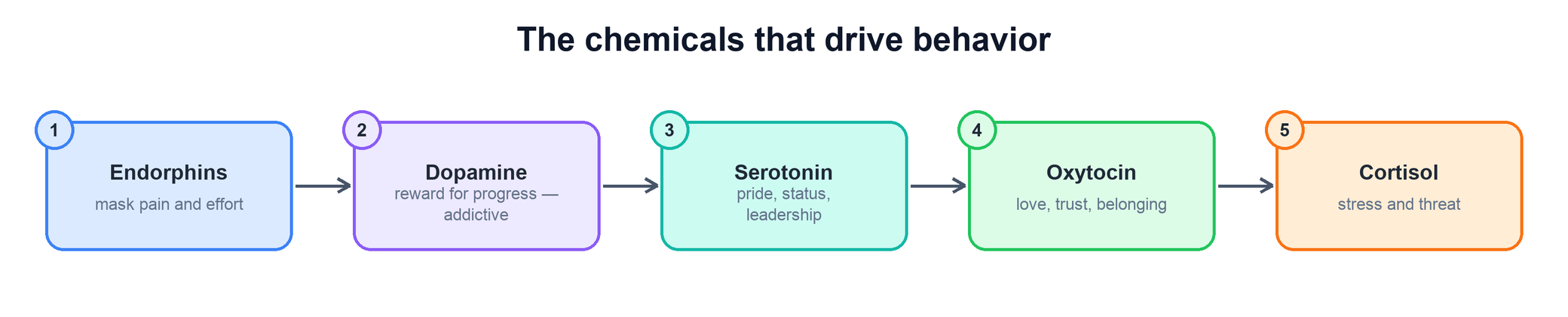
The key insight is not that any one chemical is bad, but that the mix matters. A culture that only rewards individual, dopamine-driven accomplishment and never invests in the slow, social chemicals ends up full of driven, anxious, lonely people who don’t trust each other.
3. Why the Circle of Safety works
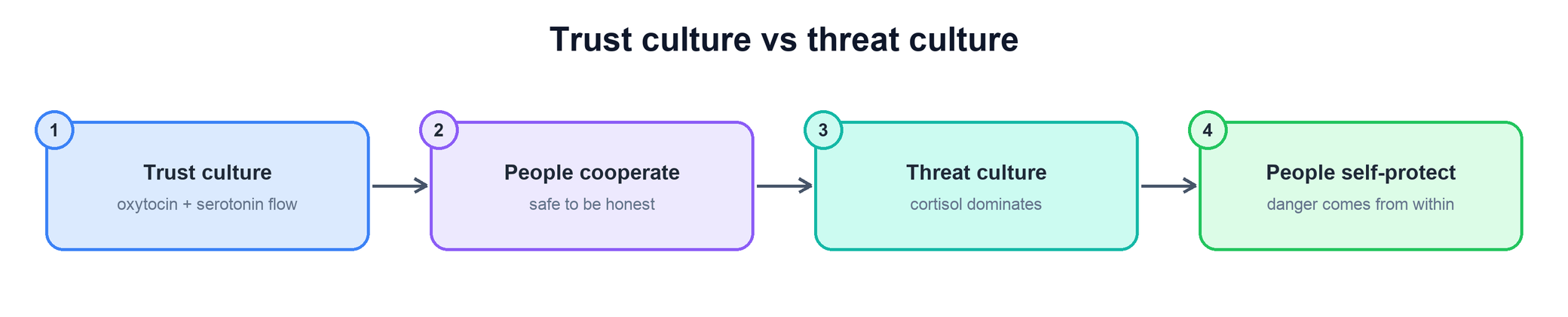
The Circle of Safety works because it changes which chemicals dominate. When people genuinely feel safe among their colleagues, oxytocin and serotonin flow: trust deepens, people cooperate without keeping score, they take risks and admit mistakes, and they extend loyalty because loyalty is being extended to them. Empathy becomes the default because there is no threat to defend against.
When people feel threatened by their own organization — by an unpredictable boss, by the fear of being cut to make a number, by a culture of blame — the opposite happens. Cortisol dominates. Chronic, low-grade stress keeps people in self-protection mode: they hoard information, avoid risk, cover their tracks, and stop trusting the person next to them. Cortisol also actively suppresses oxytocin, so fear and trust cannot coexist. The organization pays for it in health, honesty, and cooperation. A leader’s real job is to widen the circle so people spend their days in the first state, not the second.
4. Empathy and abstraction
The great enemy of the Circle of Safety is abstraction. Human empathy is built for people we can see. As organizations grow, leaders increasingly manage through spreadsheets, dashboards, and headcount numbers — and it is frighteningly easy to make a decision that harms thousands of real people when they appear only as a row in a report. Distance and scale quietly erode empathy: the further a leader sits from the humans affected by a decision, the easier it becomes to treat them as numbers to be optimized rather than people to be protected.
The antidote is to keep people connected to the humans they serve and work alongside — to put a face, a name, or a story back where the spreadsheet flattened it. Leaders who walk the floor, who know their people, and who keep the customer’s humanity in view make more humane and, ultimately, better decisions. Managing by metrics alone is managing an abstraction, not a company.
5. Destructive abundance & dopamine cultures
Sinek warns about what he calls destructive abundance: what happens when an organization grows successful enough that the pursuit of results outpaces the culture that produced them. These cultures become short-term and numbers-driven, addicted to the dopamine hit of hitting the next quarterly target. The clearest symptom is a company that lays off loyal people to protect a stock price or a forecast — treating the very people who built the success as an expense to be trimmed.
The deeper danger is addiction. Dopamine is the same chemical behind our pull toward gambling, alcohol, and our devices — and a culture engineered to reward only the next number, the next metric, the next notification, can hook its people the same way. It feels like performance, but it is chasing a chemical, and it comes at the cost of the slow, trust-building work that actually holds a team together. Every one of these choices is a small withdrawal from the Circle of Safety.
6. Integrity and leading by example
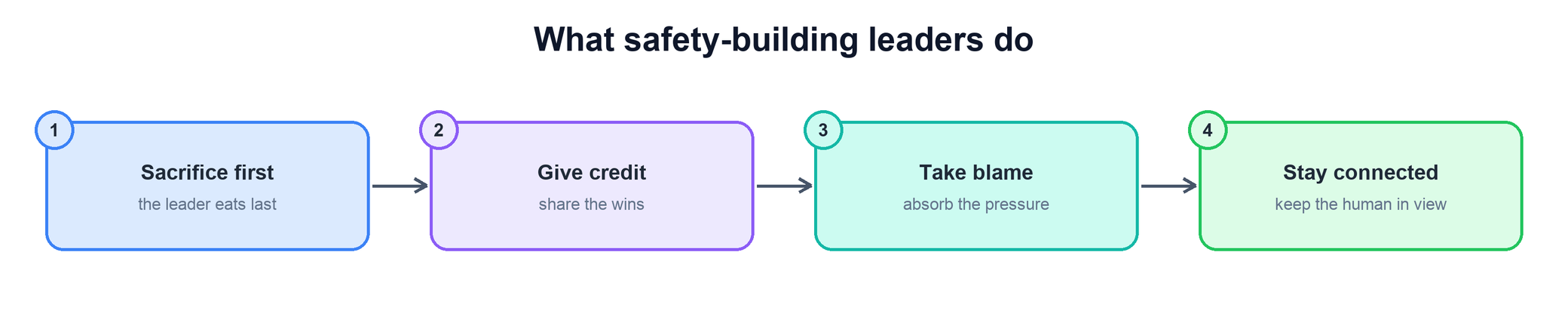
Trust is not won with words; it is earned through sacrifice. Leaders who are willing to give something up — their time, their comfort, their bonus, credit, even their own advancement — for the good of their people prove the contract is real, and their people repay them with trust and discretionary effort you cannot buy. This is the practical meaning of the title: the leader eats last. They give the credit away when things go well and absorb the blame when things go wrong. They go without so their people don’t have to.
Integrity is the day-to-day expression of this: saying what you mean, doing what you say, and behaving the same whether or not anyone is watching. People forgive honest mistakes; what breaks the Circle of Safety is the sense that a leader will protect themselves at the group’s expense. Leading by example is not a slogan — it is the mechanism by which safety spreads through an organization one act at a time.
7. Applying it at work
The ideas map directly onto engineering leadership, where the “threats outside” are real deadlines, incidents, and shifting priorities. A few concrete applications:
- Protect the team from thrash — act as a shock absorber for shifting priorities and executive churn so your engineers can stay pointed at the actual work instead of the politics around it.
- Be the DRI who absorbs pressure — when leadership is anxious about a deliverable, take that heat yourself rather than passing the cortisol straight down to the team.
- Build a healthy on-call and incident culture — a Circle of Safety is what lets a tired responder ask for help at 3am; page fairly, back each other up, and never punish someone for escalating.
- Give credit generously — name the people who did the work in reviews and to skip-levels; the leader who eats last does not take the plate first.
- Run blameless postmortems — make it safe to say “here is what I did and here is what I missed,” so the team fixes the system instead of hiding the truth to protect themselves.
8. Summary
The book reduces to a single chain of cause and effect: a leader who sacrifices for their people builds trust, trust creates a Circle of Safety, safety shifts the group from cortisol to oxytocin and serotonin, and a group in that state aims all of its energy at real challenges and pulls together.
| Idea | The one-line takeaway |
|---|---|
| Circle of Safety | Make people feel safe inside so they can fight the threats outside. |
| The chemicals | Balance selfish drive (endorphins, dopamine) with social trust (serotonin, oxytocin) — and keep cortisol in check. |
| Why it works | Safety releases trust; threat from within releases fear, and fear kills cooperation. |
| Empathy & abstraction | Distance and spreadsheets erode empathy; keep people connected to real humans. |
| Destructive abundance | Beware dopamine-chasing, numbers-first cultures that trade people for quarterly targets. |
| Integrity | Trust is earned through sacrifice; give credit, take blame, lead by example. |
| At work | Absorb pressure, protect the team, and make it safe to tell the truth. |