Breaking a Deadlock Between Powerful Stakeholders
Final Prep · Cross-functional Collaboration — two powerful stakeholders (e.g. Security vs. Developer Velocity) have flatly conflicting requirements for a shared infrastructure project; how you negotiate and resolve the deadlock.
This question tests whether you can turn a political standoff into an engineering decision. A weak answer picks a side, splits the difference into a compromise that satisfies no one, or punts the whole thing upward for someone else to decide. A strong answer shows you dig beneath the stated positions to find the real interests, reframe the conflict around a shared goal and objective criteria, generate options that were not on the table, and drive to a durable decision with a clear owner and reversible-vs-irreversible lens — escalating only to ratify, not to abdicate. Answer in CARL shape — Context, Actions, Results, Learnings — and spend most of your words on the Actions.
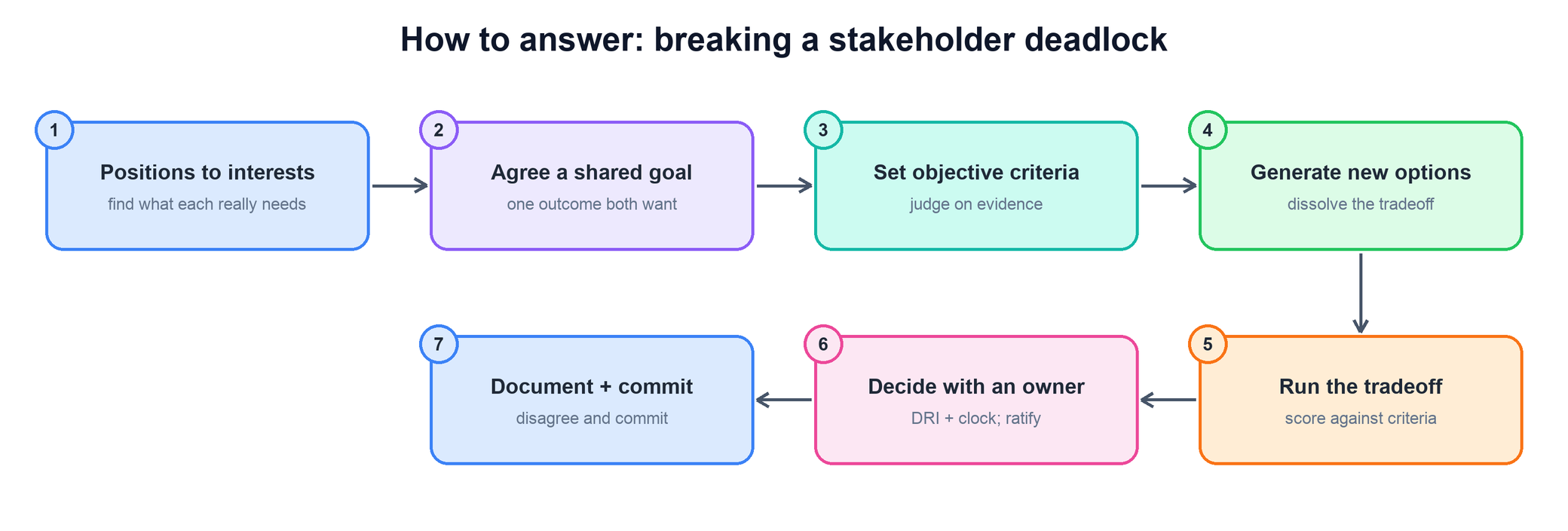
What this question is really testing
Whether you can hold neutrality and still be decisive. When Security and Developer Velocity are both right in their own frame, the failure mode is either endless debate or a leader who caves to the loudest voice. The interviewer wants to see that you can be an honest broker — both sides trust you are not captured — while still forcing a decision on a clock. It also tests your engineering judgment: the best resolutions are usually not a compromise on the axis of conflict but a third option that dissolves the tradeoff, which only comes from understanding the underlying interests deeply.
How to answer- Separate positions from interests. The stated demand (“every write must be reviewed”) hides the real interest (“we must be able to prove no unauthorized data access”) — solve the interest, and the position often becomes negotiable.
- Anchor on the shared goal. Get both sides to agree, out loud, on the one outcome they both want (a platform that is safe and fast enough to adopt) — that shared goal becomes the tiebreaker for every downstream choice.
- Agree objective criteria before debating solutions. Decide how you will judge options — risk reduced, latency added, developer friction, cost — so the decision is about evidence, not who argues hardest.
- Generate options that dissolve the tradeoff. Brainstorm beyond the two entrenched proposals — a tiered policy, automated guardrails instead of manual gates, a default-safe path with an audited fast lane — so nobody has to simply lose.
- Drive to a decision with an owner and a clock. Classify the call as reversible or not, pick a DRI, set the date, and escalate only to ratify a recommendation — never to hand off the thinking.
- Positions-versus-interests thinking, not side-picking or split-the-difference.
- A shared goal established before any solutioning.
- Objective, agreed criteria that de-politicize the choice.
- Creative third options that dissolve rather than split the tradeoff.
- Decisiveness with a clear owner, and escalation used to ratify not abdicate.
A worked example (CARL)
Context. On the Ads Events / AIMS storage team we were building a shared telemetry-and-storage platform that many teams would write to. Two powerful stakeholders deadlocked on the access-control model. The Security org insisted that every new data producer go through a manual review-and-approval gate before it could write, to guarantee auditability of sensitive events. The Developer Velocity org insisted that a manual gate would kill adoption — onboarding would take weeks and teams would route around the platform entirely. Both were senior, both had escalation power, and the platform launch was gated on resolving the model. Each had already written a doc arguing its position, and the threads had gone circular.
Actions. I refused to treat it as “pick the gate or drop the gate” and instead ran it as a facilitated design problem. First I met each side separately to get past the stated position to the real interest. Security did not actually care about manual review — they cared about being able to prove, after the fact, that no sensitive event was written by an unauthorized producer, and about catching a bad producer before it did damage. Velocity did not actually care about zero controls — they cared that onboarding a well-behaved team stayed same-day and self-serve. Once I had the interests, I got both leads into one room and made them agree, out loud, on the shared goal: a platform teams would actually adopt and that Security could stand behind. Then, crucially, before we discussed any solution, I got them to agree on the objective criteria we would judge options by — audit coverage, time-to-onboard, ongoing developer friction, and operational cost — and roughly how to weight them. That single step changed the tone, because now proposals competed on evidence rather than on who outranked whom. With the criteria fixed, we brainstormed options beyond the two entrenched ones, and the winning idea dissolved the tradeoff: a tiered model. Producers of non-sensitive data got a fully self-serve, same-day path guarded by automated policy checks and schema classification; only producers touching sensitive categories hit a review step, and even that we automated down to a lightweight approval with continuous post-hoc audit logging rather than an upfront manual gate. It gave Security provable auditability and early detection, and gave Velocity a same-day path for the common case. I wrote it up as a concrete proposal scored against our agreed criteria, took it to both leads for sign-off, and only then brought it to the shared director — not to decide, but to ratify a recommendation both sides already backed. I named a DRI to own the policy engine and set the decision date so it could not drift.
Results. Both orgs signed off and the launch gate cleared roughly on schedule. The tiered model meant the large majority of producers onboarded same-day through the self-serve path, while sensitive producers got stronger, continuously-audited controls than the original manual gate would have provided. Because the decision was anchored in criteria both sides had agreed to, it stuck — there was no re-litigation later. And both leads came away trusting me as an honest broker, which paid off on the next contested design.
Learnings. The deadlock was never really Security versus Velocity — it was two positions hiding two compatible interests, and the entire job was to surface those interests before anyone proposed a solution. The most durable resolutions are not compromises along the axis of conflict; they are third options that make the axis disappear. And the sequencing matters: agree the goal and the criteria first, because once people are arguing over solutions it is almost impossible to get them to agree on how to judge them.
Common follow-ups
What if the two sides genuinely cannot agree and a decision must be made now?
How to answer- Make a recommendation and escalate to ratify. Bring both positions, the criteria, and your recommended call to the shared decision-maker — escalation to decide is fine; escalation to avoid thinking is not.
- Use the reversibility lens. If the decision is reversible, bias to action and commit to revisit with data; save the slow, careful process for one-way doors.
- Time-box the deadlock. State up front that if there is no agreement by a date, you will escalate a recommendation — that clock itself often unlocks agreement.
- Disagree and commit. Once decided, get explicit commitment from the losing side to support execution, not just silence.
How do you stay a neutral broker when you have your own opinion?
How to answer- Declare your bias, then bracket it. Name your lean openly so both sides know it, then commit to judging by the shared criteria, not your preference.
- Let the criteria carry the verdict. If the evidence points where you leaned, it is now the data’s call, not yours — and if it points the other way, follow it visibly.
- Argue the other side’s case yourself. Steel-manning each position in the room proves you are not captured and surfaces hidden interests.
- Separate facilitator from advocate. If you must advocate strongly, hand facilitation to a neutral third party so the process stays trusted.
How do you keep the losing side committed afterward?
How to answer- Give them a real win inside the decision. Make sure the resolution addresses their core interest visibly, even if their stated position did not prevail.
- Document the tradeoffs honestly. Record what was given up and why, so nobody feels the loss was hidden or the process was rigged.
- Build in a review checkpoint. Commit to revisiting with real data at a set date — a reversible decision is far easier to commit to.
- Credit them publicly. Acknowledge the concession in the shared forum so the losing side is seen as having acted for the mission.
How is this different when the stakeholders are external partners, not internal orgs?
How to answer- Interests still rule, but leverage differs. You cannot escalate to a shared boss — so the shared goal and mutual dependency become your only real levers.
- Lean harder on objective criteria. With no common authority, an agreed, neutral scoring rubric is what keeps the negotiation from becoming a power contest.
- Protect the long-term relationship. You will deal with them again — optimize for a durable agreement both sides can defend internally, not a one-time win.
- Find the BATNA for both sides. Understand each party’s alternative to agreement; a fair deal is one that beats both walk-away options.
- Design docs — pull the two competing proposals and the final tiered-model doc scored against the agreed criteria.
- GSD — pull the launch gate, the decision date, and the DRI who owned the policy engine.
- 1:1 / meeting notes — pull the separate interest-discovery conversations that surfaced the real interests behind each position.
- Workplace posts / decision thread — pull the ratification thread showing both leads and the director signing off.
- Oncall / audit dashboards — pull the audit-coverage and onboarding-time metrics that proved the tiered model met both interests.