Pushing Back on a Release Under Business Pressure
“No” is easy and it's junior. The senior move is to make the risk undeniable and hand the business a menu of ways to still get most of what it needs.
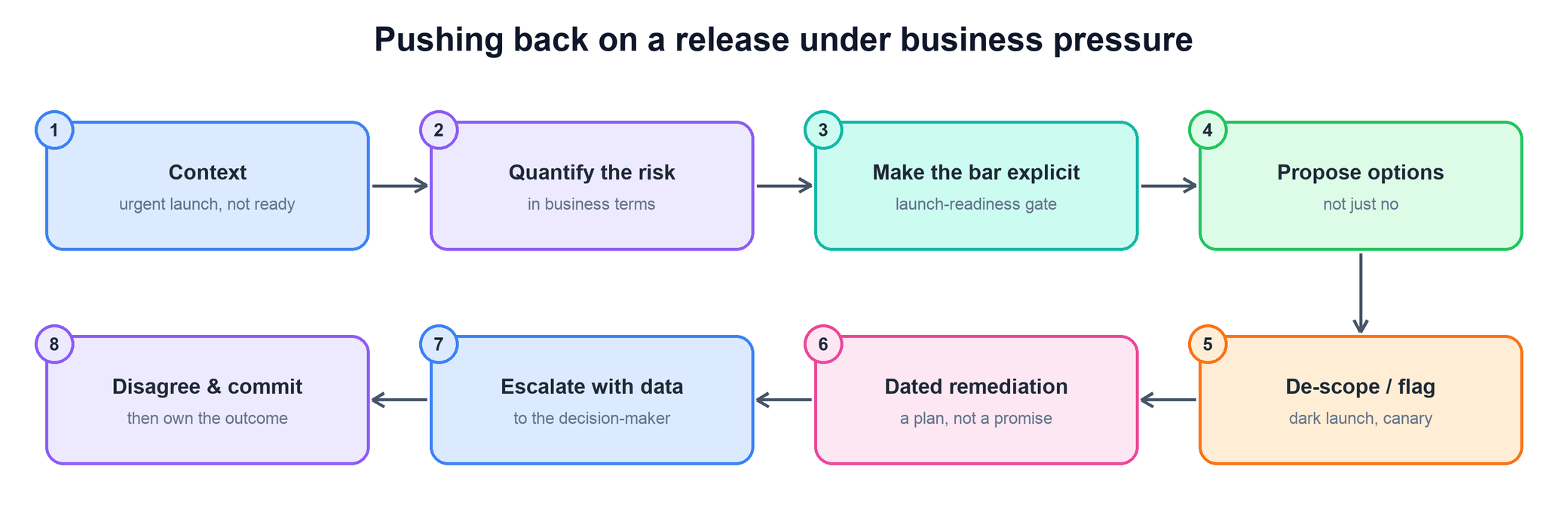
This is the classic cross-functional behavioral: “Tell me about a time you pushed back on a release that wasn't ready but the business urgently needed it.” It's a values-and-judgment question wearing a delivery hat. The interviewer wants to see that you can hold a quality, reliability, or security bar under real pressure — a deal, a launch date, a competitor — without becoming either the person who blocks everything or the person who folds the moment a director leans in. The best answers quantify the risk in the business's own language, propose options instead of just objecting, make the readiness bar explicit, escalate cleanly with data to the actual decision-maker, and then disagree-and-commit and own the outcome either way.
What this question is really testing
Whether you can carry an engineering bar into a business conversation and still be a partner, not a blocker. It probes your judgment about which risks are real, your ability to translate a technical concern into dollars and user trust, and your maturity once a decision is made. The trap answers sit at two extremes: the purist who says “I refused to ship” and treats being right as the whole job, and the pushover who “raised concerns” but shipped a fragile thing on time and let it break. The signal is a story where you changed the shape of the launch — smaller, flagged, phased, or with a dated fix — so the business got most of its urgency met and the risk got controlled, and where you committed fully to whatever call the decision-maker made.
How to answer- Quantify the risk in business terms. Don't say “it's not stable.” Say “under launch-day load this drops or mis-attributes an estimated X% of events, which is roughly $Y of ad revenue and a reporting-trust hit for advertisers.” Convert stability, security, and quality into money, users, and trust — the currency the decision-maker actually thinks in.
- Make the readiness bar explicit. State what “ready” means for this launch — load tested to N×, error budget defined, rollback tested, on-call staffed — so the conversation is about an objective gate, not your comfort level. A written bar depersonalizes the pushback.
- Propose options, not just “no.” Bring a menu: de-scope to the safe subset, feature-flag / dark launch to real traffic without user impact, a phased or canary rollout that ramps 1% → 100% with guardrails, or ship on time behind a flag with a dated remediation plan. Give the business a way to still hit its urgency.
- Escalate with data to the decision-maker. If you and the business owner don't converge, take a one-page risk-versus-options summary to the person who actually owns the tradeoff. Frame it as “here's the risk, here are the options, here's my recommendation — your call,” not “I'm blocking this.”
- Disagree and commit, then own the outcome. Once the call is made — even if it's to ship against your recommendation — get fully behind execution: staff the on-call, watch the canary, be ready to roll back. And own the result either way, including saying so if the risk you flagged didn't materialize.
- Risk translated into business terms — revenue, users, trust — not just “it might break.”
- Options offered, so the business isn't stuck between “ship broken” and “miss the date.”
- An explicit, objective readiness bar rather than a personal comfort threshold.
- Clean escalation with data to the real decision-maker, not a unilateral veto.
- Genuine disagree-and-commit and ownership of the outcome, whichever way it went.
A worked example (CARL)
CARL = Context, Actions, Results, Learnings. Spend most of your words on Actions — the specific moves only you made — and always land Results and Learnings on a concrete number.
ContextTwo weeks before a major advertiser-facing launch, my team owned a change to the ad-events ingestion path that added a new consent-and-attribution step so events could be filtered and attributed correctly under a new privacy requirement. The product and partnerships orgs had committed the launch date to external advertisers and a sales cycle depended on it. In load testing the new consent lookup, I found that under peak launch-day traffic the added synchronous call to the consent service saturated its connection pool; when it timed out, the pipeline's fallback silently dropped the event rather than retrying, and a second path mis-attributed events to the wrong campaign. My estimate: at projected launch volume we'd drop or mis-attribute on the order of 3–5% of events during peak, which would understate advertiser conversions and corrupt the very attribution reporting the launch was selling. The business urgently needed the date; shipping as-built risked a revenue-reporting SEV in front of the exact advertisers we were trying to win.
Actions- I quantified the risk in the business's language. Instead of “the consent path isn't stable,” I pulled projected launch volume from the campaign forecast and the consent service's measured throughput ceiling from load tests, and turned the 3–5% event loss into an estimated advertiser-conversion undercount and a dollar range of mis-reported spend. I framed it as a trust risk with the launch advertisers, because corrupted attribution was worse for the business than a slipped feature.
- I made the readiness bar explicit and written. I wrote a one-page launch-readiness gate: consent lookup load-tested to 2× projected peak, a defined error budget for dropped events, retries with backoff on the fallback path, and a tested rollback — and showed exactly which criteria the current build failed. That turned my pushback into an objective checklist rather than my personal nervousness.
- I brought options, not a veto. I laid out three: (1) slip two weeks to fix the synchronous bottleneck properly; (2) launch on the date behind a feature flag, dark-launching the consent path to real traffic at 1% to validate under production load while the old path still served users; (3) de-scope to the safe advertiser subset whose volume the consent service could already handle, and phase the rest in over the following two weeks. Each option had a cost, a residual risk, and a date attached.
- I ran the dark launch and canary myself to de-risk option 2. Rather than argue in the abstract, I put the consent path behind a gate and ramped it to 1% then 5% of production traffic, which confirmed the pool saturation at scale and let me tune connection limits and add bounded retries with a dead-letter queue instead of a silent drop. That converted a debate about hypotheticals into observed numbers.
- I escalated cleanly with a one-pager to the decision-maker. When product still wanted the full launch on the original date, I took the risk-versus-options summary to the director who owned the launch tradeoff, framed as “here's the quantified risk, here are three options with dates and residual risk, here's my recommendation — option 3 — but it's your call.” We aligned in that meeting on the phased de-scope, launching on the original date for the safe advertiser subset with the consent path canaried behind a flag, and a dated plan to ramp the rest.
- I disagreed-and-committed on the pieces that didn't go my way. The director wanted a more aggressive ramp than I'd proposed; once decided, I staffed extra on-call for launch week, wired the canary to auto-rollback on an event-loss threshold, and got fully behind the plan rather than re-litigating the pace.
- The launch shipped on the original date for the safe advertiser subset, so the sales commitment held, and the remaining advertisers were phased in over the next 12 days behind the canaried consent path.
- Event loss during peak stayed under 0.1% — down from the projected 3–5% — because the bounded-retry and dead-letter fix replaced the silent drop, and no attribution-reporting SEV occurred in front of the launch advertisers.
- The auto-rollback guardrail tripped once during the ramp on a consent-service blip and reverted a 5% cohort cleanly in under two minutes with zero customer-visible impact, which is exactly what a phased rollout is for.
- The launch-readiness gate I wrote became the template the org reused for the next two privacy-sensitive launches.
- Options beat objections. The conversation only moved when I stopped saying “not ready” and started offering a de-scope and a dark launch with dates. Pushback lands when it protects the business's urgency instead of fighting it.
- Quantify or you'll be overruled. Turning “unstable” into “3–5% event loss ≈ $X mis-reported spend” is what made a director take the risk seriously; a number survives the room in a way an adjective never does.
- A written readiness bar depersonalizes the fight. Once “ready” was an objective checklist, the debate was about criteria, not about whether I was being too cautious — and it outlived this launch as a reusable gate.
Common follow-ups
What if the decision-maker overrules you and ships it anyway?
How to answer- Disagree and commit — for real. Staff the on-call, wire the guardrails, and back the execution instead of quietly sandbagging.
- Leave a marker. Note the risk and the trigger that would revisit it, so it's on record without “I told you so.”
- Reserve the hard line. Only refuse to commit for a genuine security, legal, or user-safety line — and then escalate formally.
How do you estimate the risk when you don't have precise numbers?
How to answer- Bound it, don't fake it. Give a defensible range with your assumptions stated — a range beats an adjective.
- Anchor on real signals. Load-test ceilings, past-SEV blast radius, and traffic forecasts turn a guess into an estimate.
- Buy information cheaply. A dark launch or 1% canary converts hypotheticals into observed numbers fast.
How is this different from just being risk-averse and slowing the team down?
How to answer- Block classes, not everything. Reserve pushback for real reliability, security, or data-correctness risk; wave through reversible bets.
- Default to shipping safely. Flags, canaries, and de-scopes let you say yes to the date and no to the risk at once.
- Show a track record of speed. The credibility to block comes from usually helping the team ship faster.
The risk you flagged never materialized. Was the pushback still right?
How to answer- Judge the decision, not the dice. A sound call on the information you had is right even if the tail didn't hit.
- Own it honestly. Say plainly when your estimate was conservative and recalibrate for next time.
- Keep the cheap insurance. The flag and canary cost little and are why a miss would have been survivable.
- SEV / postmortems — the incident that either validated your concern or calibrated how you estimate launch risk.
- Scuba / Unidash — the event-loss, attribution-error, latency, or throughput numbers you used to quantify the risk in business terms.
- Launch / GK gating — the feature flag, canary, and auto-rollback guardrail that let you ship on the date and control the risk.
- Design-review docs — the launch-readiness bar and the risk-versus-options one-pager you brought to the decision-maker.
- Phabricator — the diffs for the bounded-retry / dead-letter fix and the flag that made the phased rollout possible.
- The internal wiki — the readiness checklist or launch-gate standard you wrote and the org later reused.
- GSD — the launch project and milestone, to show the stakes, the date commitment, and the outcome.