When a Timezone or Cultural Breakdown Threatens a Release
Final Prep · Cross-functional Collaboration — a cultural or timezone misunderstanding across geographically distributed teams threatens a major release gate; how you catch it and correct it.
This question tests whether you can lead teams you cannot see and manage the failure modes that only appear at distance. A weak answer blames the remote team, treats “we’ll add more meetings” as the fix, or misses that the real issue was a communication gap rather than a competence gap. A strong answer shows you notice the early signals, diagnose the misunderstanding without blame, correct both the immediate release risk and the working norms that caused it, and build durable practices — async-first, explicit over implicit, and cultural safety — so it does not recur. Answer in CARL shape — Context, Actions, Results, Learnings — and spend most of your words on the Actions.
What this question is really testing
Whether you understand that distributed teams fail differently than co-located ones. The interviewer wants to see that you can read weak signals — a “yes” that meant “I hear you” not “I agree,” a silence that meant disagreement, a handoff that assumed context the other side did not have — and that your instinct is to fix the system of communication, not to assign fault to the team that is far away and easy to blame. It also tests cultural intelligence: whether you create the safety for a remote team to say “I don’t understand” or “this won’t work,” which many will not do across a hierarchy or a culture gap unless you deliberately invite it.
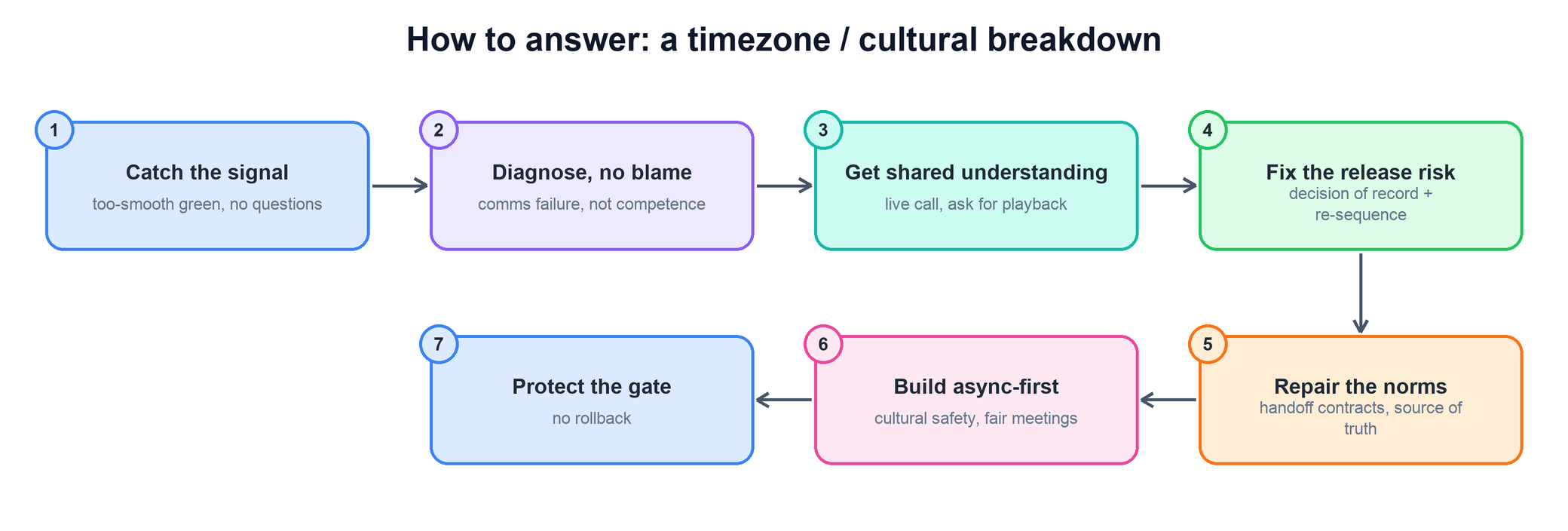
How to answer- Read the early signals. Watch for the tells of distributed breakdown — agreement that is too quick, questions that never come, status that is green until it is suddenly red, work that comes back subtly not-what-you-meant.
- Diagnose without blame. Assume a communication failure, not a competence failure — the default cause is missing shared context or a “yes” that meant something different, not a team that cannot execute.
- Get to shared understanding directly. Jump on a live call in the timezone overlap, restate the goal in both directions, and confirm understanding by having each side play back what they will do — not just nod.
- Fix the release risk and the norm together. Unblock the immediate gate, but also fix what let the gap open — written decisions of record, explicit handoff contracts, a shared source of truth that does not depend on being awake at the same time.
- Build cultural safety and async-first habits. Make it safe and expected to say “I disagree” or “I’m blocked,” rotate meeting pain fairly across regions, and default to written, decision-logged communication so no region is second-class.
- Sensitivity to the weak signals of distributed breakdown, caught early.
- A communication-failure diagnosis rather than blaming the remote team.
- Confirmation of true shared understanding, not surface agreement.
- Fixing the working norms, not just the one release.
- Cultural safety and fair, async-first practices that treat every region as first-class.
A worked example (CARL)
Context. On the Ads Events / AIMS storage team we were driving a major storage-format migration behind a hard release gate, with the work split across three sites — the core team in the US, a partner team in India owning a large slice of the data-backfill, and a consumer team in the EU that had to certify their read path before the gate. The three regions barely overlapped in the working day. About three weeks from the gate, the weekly status from the India team was consistently green, but I noticed two quiet tells: the backfill diffs were landing but the design questions I expected on a migration this tricky simply never came, and one EU certification task kept getting a “yes, on track” that never turned into an actual sign-off.
Actions. I treated the too-smooth green as a signal rather than a comfort. Instead of adding it to a status doc, I set up two live calls scheduled in the real overlap windows — early morning US for the India sync, late afternoon US for the EU one — rather than forcing everyone onto US-friendly times, which itself had been part of the problem. On the India call I did not ask “are you on track,” because I had learned that a “yes” in that setting often meant “I understand what you asked,” not “I agree it will work.” Instead I asked the engineers to walk me through how they were doing the backfill and to play back their understanding of the migration’s ordering constraint. Within ten minutes the gap surfaced: they had interpreted an ambiguous line in the design doc to mean the backfill could run in any order, when in fact it had a strict dependency — and they had not raised it because, across the hierarchy and the culture gap, flagging a possible flaw in the US team’s design felt presumptuous. It was a pure communication failure, not a competence one. I fixed both layers. Immediately, I got the two teams to co-write a one-page “decision of record” that stated the ordering constraint explicitly and the exact handoff contract between backfill and certification, and we re-sequenced the remaining backfill against it. Then I fixed the norm: I made written decision logs the default so no critical constraint lived only in someone’s head or a synchronous call one region missed; I set up an async daily handoff thread so each region started its day with the other regions’ end-of-day state; and, most importantly, I explicitly invited dissent — I told the India and EU leads, in front of their teams, that catching a flaw in our design was exactly the value I wanted from them, and I made a point of publicly thanking the engineer who had surfaced the ordering issue so the safety was demonstrated, not just stated. For the EU “yes” that never became a sign-off, the same live playback revealed they were blocked on a test-environment access issue they had been too polite to escalate; I cleared it that day.
Results. We caught the ordering problem with enough runway to re-sequence rather than firefight, and the migration passed its gate roughly on schedule — a miss would have meant a costly rollback of partially-migrated data. The EU certification unblocked once the access issue was cleared. Beyond the release, the async handoff thread and decision logs became the team’s standard way of working across sites, and both remote teams noticeably started raising concerns earlier and more directly on later projects.
Learnings. The most dangerous status in a distributed project is a smooth green, because distance hides the friction that would be visible in a room. Two habits stuck with me: never accept a “yes” as confirmation — ask for a playback of the plan in the other person’s words — and treat written, async, decision-logged communication as the default, not the fallback, so no region is disadvantaged by the clock. And the deepest fix is cultural: a remote team will only warn you early if you have made it unmistakably safe, and demonstrably rewarded, to do so.
Common follow-ups
How do you tell surface agreement from real agreement across a culture gap?
How to answer- Ask for a playback, not a yes. Have each side restate the plan and the tradeoffs in their own words — understanding shows in the paraphrase, not the nod.
- Watch for the absence of questions. On genuinely hard work, no questions usually means no engagement or no safety, not perfect clarity.
- Invite dissent by name. Ask “what would make this fail?” rather than “any concerns?” — and direct it at specific people, not the silent group.
- Confirm in writing. Follow the call with a written decision of record and ask for explicit confirmation, which surfaces lingering disagreement.
How do you run a project fairly across three timezones?
How to answer- Default to async, decision-logged communication. Make the written record the source of truth so no decision depends on being awake for a call.
- Rotate the meeting pain. Share the burden of inconvenient hours across regions instead of anchoring everything to headquarters time.
- Use structured handoffs. A daily end-of-day-to-start-of-day thread lets the follow-the-sun flow work without live overlap.
- Give every region real ownership. Assign whole areas, not just tasks, so remote teams are decision-makers, not order-takers waiting on HQ.
What if the remote team keeps saying it’s fine and it clearly isn’t?
How to answer- Change the question, not the volume. Stop asking “are you on track” and start asking to see the work, the demo, or the concrete next step.
- Build safety before you build pressure. Escalating scrutiny without safety makes people hide more; show that raising a problem is rewarded, not punished.
- Use a local champion. Empower a lead in that region who can read the team’s real state and relay concerns you would not hear directly.
- Make blockers cheap to raise. A no-blame, standing “what’s in your way” channel lowers the bar to surfacing trouble early.
How do you prevent this class of breakdown before it happens?
How to answer- Write the contracts down first. Explicit interface and handoff contracts remove the ambiguity that timezone gaps turn into silent divergence.
- Invest in relationships early. A little face-time and trust-building up front makes remote teams far more willing to flag trouble later.
- Set communication norms explicitly. Agree on what goes in writing, what needs a call, and how fast responses are expected across regions.
- Instrument shared checkpoints. Concrete integration milestones, not just status colors, make divergence visible while there is still time to fix it.
- GSD — pull the release gate, the cross-site milestones, and the re-sequenced backfill plan.
- Design docs / decision logs — pull the ambiguous line that caused the misread and the decision-of-record that fixed it.
- Cross-site sync notes — pull the live-call records where the ordering gap and the blocked EU certification surfaced.
- Workplace posts / async handoff thread — pull the daily handoff thread that became the team’s standard practice.
- Oncall / launch-gate dashboards — pull the gate criteria and the evidence the migration passed without a rollback.