Partnering with Downstream Consumers & Driving Standardization
Aligning 10+ teams that depend on your data or telemetry — with contracts, governance, and a shared standard.
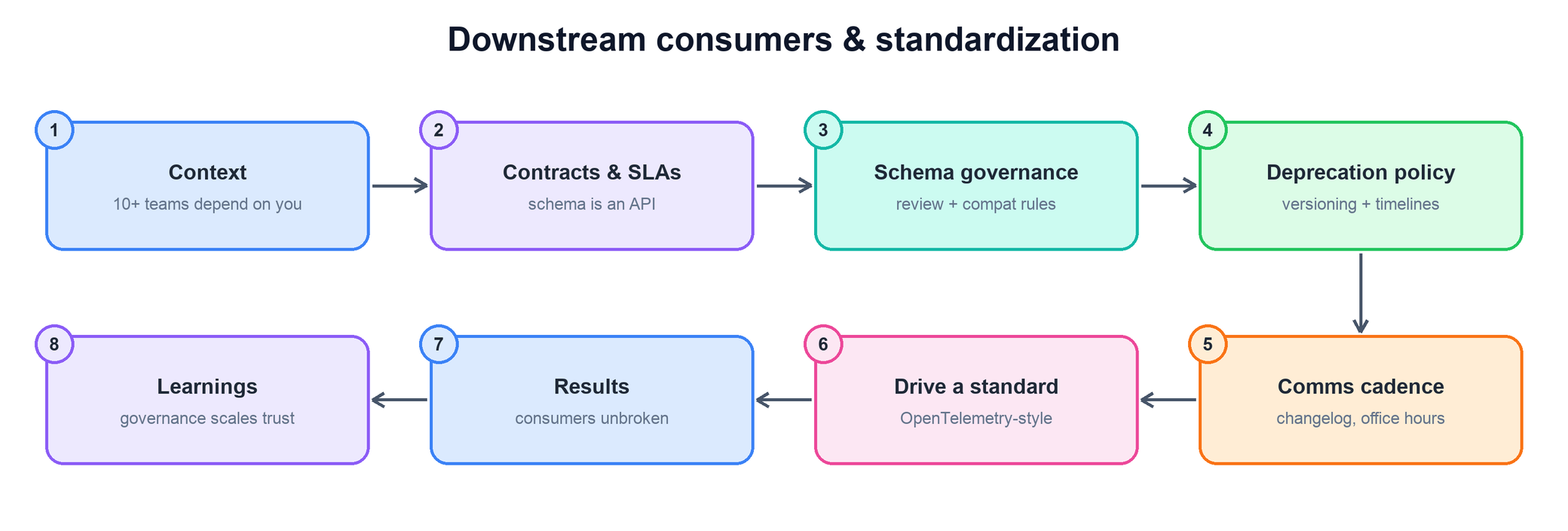
This question tests whether you can run a platform that many teams build on without breaking them and without ossifying. When you own the data or telemetry that a dozen downstream teams consume, your schema is a public API, your changes are their outages, and your ability to evolve depends entirely on how you govern the contract. The interviewer wants to see you treat consumers as customers under an explicit contract, manage change with versioning and a deprecation policy, communicate on a cadence, and — the senior move — drive a standard (a W3C or OpenTelemetry-style convention) so the whole ecosystem interoperates instead of fragmenting. The answer follows the CARL shape.
What this question is really testing
Can you evolve a widely-depended-on interface without breaking your consumers — and can you lead a group of independent teams toward a common standard rather than letting each invent its own?
How to answer- Treat the schema as a contract with SLAs. Your data shape, freshness, and availability are a promise consumers build on. Write it down — schema, semantics, latency, and completeness guarantees — so expectations are explicit, not folklore.
- Govern schema changes. Put changes through review with backward-compatibility rules: additive-by-default, no silent semantic changes, required fields never dropped without a cycle. A registry with compatibility checks turns “don’t break consumers” into an enforced gate, not a hope.
- Set a clear deprecation policy. Version the interface, announce removals with a dated timeline and a migration path, and track consumer migration to zero before you delete anything. Deprecation is a policy, not an event.
- Run a comms cadence. A changelog, a mailing list or Workplace group, and office hours so consumers hear about changes before they feel them. For 10+ teams, proactive communication is the difference between a partner ecosystem and a stream of surprise SEVs.
- Drive a standard, don’t just publish yours. The highest-leverage move is convergence: adopt or shape an industry-style convention (OpenTelemetry semantic conventions, W3C trace context) so consumers, producers, and tooling all speak one language. You lead this by building the reference implementation, migrating a lighthouse consumer, and making the standard the path of least resistance.
- An interface treated as a contract with explicit SLAs, not an implementation detail.
- Backward compatibility and governance enforced by tooling, not goodwill.
- A real deprecation policy — versioned, dated, migration tracked to zero.
- Proactive, scheduled communication with many consumers.
- Ambition to drive a shared standard across independent teams, and the mechanics to land it.
A worked example (CARL)
Context. My team owned the canonical ads events dataset that more than a dozen downstream teams consumed — measurement, billing, ranking features, and integrity among them. The schema had grown organically: fields meant one thing to one consumer and something subtly different to another, there was no versioning, and any producer-side change risked a silent break somewhere downstream. We’d had two SEVs in a quarter caused by well-intentioned schema edits, and every consumer had built its own slightly different parsing and its own naming for the same concepts.
Actions. I treated the sprawl as a governance problem, not a one-off cleanup. First I made the contract explicit: I led writing a schema spec with per-field semantics and an SLA covering freshness and completeness, and stood up a schema registry with automated backward-compatibility checks in CI, so a change that would break a consumer failed the build instead of a downstream pipeline. Then I set a deprecation policy — additive-by-default, versioned interfaces, and any removal required a dated announcement plus tracked consumer migration to zero before deletion — and I published it so it was the team’s policy, not my mood. For communication, I created a consumers Workplace group and a changelog and ran a monthly office hours, so the 12 teams heard about every change with lead time. The biggest bet was standardization: the teams had each invented their own event and attribute naming, which made cross-dataset joins and shared tooling painful. Rather than impose my team’s naming, I anchored on an OpenTelemetry-style semantic-conventions approach — a shared vocabulary for event names and attributes — and drove adoption the way you drive any standard: I built the reference schema and a conversion layer, migrated one respected consumer as a lighthouse to prove it, and ran a working group so the other teams shaped the conventions and therefore owned them. I explicitly did not try to force it in one flag day; I made the standardized path the easy default and let the compatibility checks and office hours pull teams over.
Results. Schema-change SEVs went to zero over the next two quarters because incompatible changes were caught in CI. All 12 consumers converged on the shared conventions within about two quarters, which unlocked cross-dataset tooling that had been impossible before, and the deprecation policy let us finally retire three legacy fields that had been un-removable for years. New consumers now onboarded against a documented contract in days instead of reverse-engineering the schema.
Learnings. When many teams depend on you, governance is the product — the contract, the compatibility gate, and the comms cadence are what let you move fast without breaking people. And you drive a standard the same way you drive adoption: reference implementation, lighthouse, working group ownership, and making the standard the path of least resistance — never by decree.
Common follow-ups
How do you make a breaking change when you truly need one?
How to answer- Version, don’t mutate. Ship the new shape alongside the old (v2 next to v1) so nothing breaks on day one.
- Announce with a dated timeline. Give consumers a real migration window and a clear migration path.
- Track migration to zero. Watch per-consumer traffic off the old version and concierge the stragglers before deleting.
- Automate the cutover where possible. Provide adapters or codemods so moving is near-zero-effort.
How do you get independent teams to adopt a standard they didn’t ask for?
How to answer- Give them ownership. A working group that shapes the standard adopts it; a standard handed down gets resisted.
- Show the shared win. Interop, shared tooling, and easier onboarding are the ROI — make it concrete.
- Build the reference and a lighthouse. Prove it works with one respected team before asking the rest.
- Make it the easy default. Reference implementation plus conversion tooling means the standard is the least-effort path.
A consumer built on undocumented behavior and you broke them. Who’s at fault?
How to answer- It’s a shared, systemic failure. Blameless framing — the gap is that the contract wasn’t explicit or enforced.
- Fix the contract. Document the real guarantee and add the compatibility check so the class can’t recur.
- Help them recover first. Mitigate the break before the postmortem — relationship and reliability first.
- Add a detection path. Instrument what consumers actually depend on so hidden coupling becomes visible.
- Schema registry / code search — pull the contract, versioning, and backward-compatibility checks that govern changes.
- SEV / postmortems — pull the schema-change incidents before governance, and the flat trend after.
- Workplace posts / announcements — pull the consumers group, changelog, and deprecation notices that drove the comms cadence.
- Scuba / Unidash — pull per-consumer traffic to track migration to zero and standard adoption.
- The internal wiki — pull from the schema spec, SLA, deprecation policy, and semantic-conventions doc you led.