Aligning Engineering with Finance & Physical Infra
Bridging software with the non-engineering constraints that actually bound it — budget, capacity, power, and hardware.
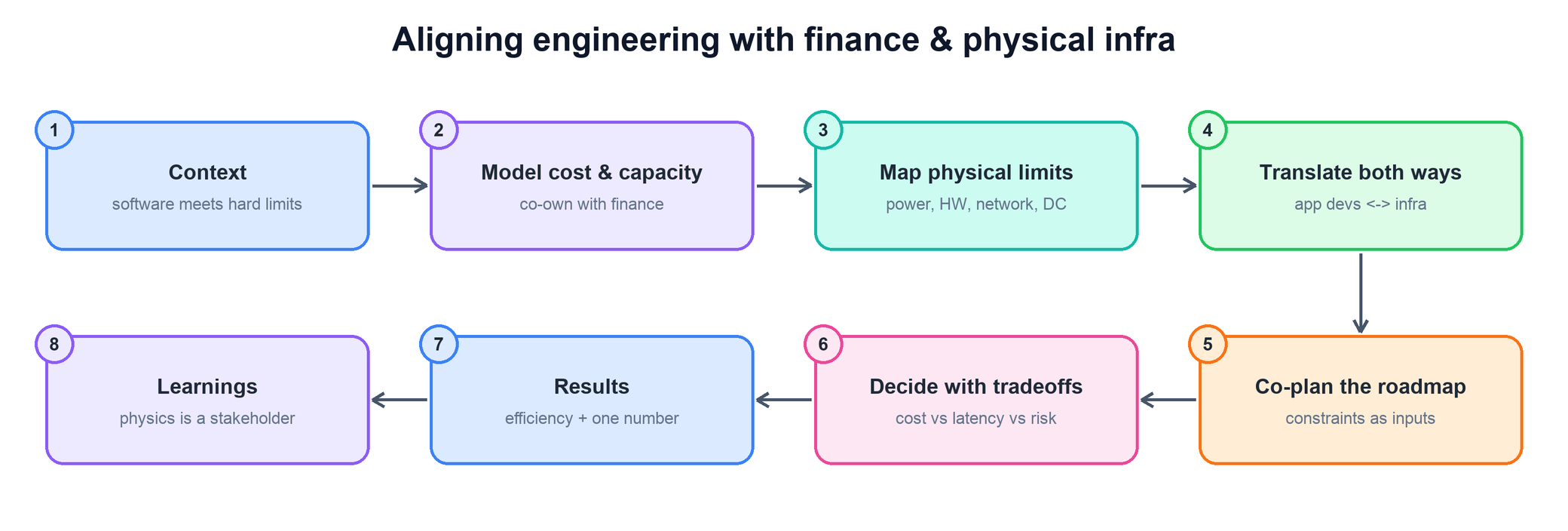
This question tests whether you understand that at scale, engineering decisions are bounded by things software engineers rarely think about: a finance capacity budget, the power draw of a datacenter row, hardware lead times, and network peering limits. A senior infra leader has to partner with finance on cost and capacity modeling and with physical-infra and datacenter teams on the hard limits — and then translate between application developers and physical reality so each side’s constraints show up in the other’s plans. The interviewer wants to see fluency across that boundary, not just clean code. The answer follows the CARL shape.
What this question is really testing
Can you operate at the seam where software meets money and physics — speaking finance’s language on cost and capacity, respecting the datacenter’s hard limits, and translating both so application teams design within reality instead of colliding with it?
How to answer- Model cost and capacity with finance, not around them. Build a capacity model that ties engineering demand (events per second, bytes stored, CPU) to dollars and to a forward-looking budget, and co-own it with finance so capacity planning is a shared, quantified conversation rather than a surprise at quarter-end.
- Map the physical limits. Know what actually bounds you — power and cooling per rack, server and NIC lead times measured in months, network and peering capacity, datacenter floor space. These are hard constraints that no amount of clever code removes; treat them as first-class inputs.
- Translate in both directions. To application developers, turn “we’re out of power in that region” into “here’s the efficiency target your service needs to hit.” To physical-infra and finance, turn product growth curves into demand forecasts they can provision against. Being the bilingual person at that seam is the whole job.
- Bring constraints into the roadmap early. Feed the physical and financial limits into design and planning up front, so teams choose an architecture that fits the power, hardware, and budget envelope — instead of designing freely and discovering at launch that the capacity doesn’t exist and can’t be bought in time.
- Decide with the full tradeoff. Make the calls explicitly across cost, latency, reliability, and lead time — e.g. accept slightly higher latency to fit a power budget, or pre-buy hardware to hedge a forecast — and show your reasoning so partners trust the decision.
- Comfort with cost and capacity modeling — fluency in finance’s language, not just latency.
- Awareness that physical limits (power, hardware lead time, network) are real and binding.
- The translator skill — connecting application design to physical and financial reality both ways.
- Constraints treated as design inputs, surfaced early, not discovered at launch.
- Explicit, defensible tradeoffs across cost, performance, reliability, and time.
A worked example (CARL)
Context. Our ads events volume was forecast to grow sharply over the next year, and the naive plan was to scale our storage footprint linearly with it. When I actually modeled that against reality with the capacity and datacenter teams, it didn’t fit: the region we were growing in was projected to hit a power ceiling before the end of the year, the incremental servers we’d need had a multi-month hardware lead time, and finance’s budget for the tier couldn’t absorb a linear cost increase. Three separate non-engineering constraints — power, hardware lead time, and budget — all said the same thing: we couldn’t just buy our way out.
Actions. I treated this as a translation and modeling problem, not just an efficiency sprint. First I built a shared capacity model with finance and the capacity team that tied our engineering demand curve — events/sec and bytes stored — directly to server count, power draw, and dollars, so all three organizations were finally looking at one set of numbers instead of arguing from three. That model made the collision concrete: it showed the exact month we’d hit the power ceiling and the budget line. Then I did the two-way translation. To the application and product teams generating the events, I converted “the region runs out of power in Q3” into a concrete, actionable target: a per-event storage-efficiency goal, because I’d shown that if we cut bytes-per-event enough, the same power and budget envelope could hold the growth. To finance and the datacenter team, I converted the product growth forecast into a demand forecast they could plan capacity and hardware orders against, with enough lead time to actually order servers. On the engineering side, my team drove the efficiency work the model pointed at — tiering colder data to cheaper storage and adopting a more efficient encoding — and I sequenced it against the physical timeline: hit the efficiency target before the power ceiling, and place the hardware order early enough to clear the lead time. Where there were genuine tradeoffs — the colder tier added read latency for old data — I made them explicit with the consumer teams and got agreement that the latency hit on cold reads was acceptable in exchange for staying within the power and budget envelope.
Results. We absorbed the full forecast growth without exceeding the region’s power budget and without the linear cost increase — the efficiency work cut per-event storage cost by roughly 40%, which kept us inside finance’s budget line. Because the demand forecast reached the datacenter team early, the hardware we did need was ordered ahead of the lead time and arrived before we were blocked. No capacity fire drill, no emergency budget ask.
Learnings. At scale, physics and finance are stakeholders as real as any product team — power ceilings and hardware lead times don’t negotiate. The highest-leverage thing I did was build one shared model that let engineering, finance, and datacenter teams reason from the same numbers, and then translate the constraint into an engineering target the app teams could actually act on. Bridging that seam is where an infra leader creates disproportionate value.
Common follow-ups
How do you talk about cost and capacity with finance partners?
How to answer- Speak in dollars and forecasts. Tie engineering demand to a cost model and a forward budget, not to latency graphs.
- Build one shared model. A single source of truth ends the three-teams-three-numbers argument.
- Give them predictability. Finance values a reliable forecast over an optimistic one — flag uncertainty explicitly.
- Frame efficiency as ROI. Show cost per unit of business value, so efficiency work reads as a return, not a chore.
How do physical constraints like power or hardware lead time change your design?
How to answer- Treat them as hard inputs. Power ceilings and lead times bound the design space before you start, not after.
- Design for efficiency when capacity is capped. If you can’t add power, you cut demand per unit — efficiency becomes the lever.
- Plan against lead time. Forecast and order early; hardware you need in Q3 is decided in Q1.
- Consider placement. Region and datacenter choice is an engineering decision when power and network differ by site.
App developers just want their feature shipped and don’t care about infra limits. How do you align them?
How to answer- Translate the limit into their terms. Give them a concrete efficiency or budget target, not a lecture on datacenters.
- Make the constraint visible early. Surface it in design review so it shapes the architecture, not the launch.
- Show the shared stakes. A launch that can’t get capacity doesn’t ship — the limit is their problem too.
- Offer the easy path. Provide efficient defaults and tooling so hitting the target is low-effort for them.
- Capacity / cost dashboards (Unidash / ODS) — pull the demand-to-dollars model, utilization, and the power or budget ceiling you planned against.
- GSD — pull from the efficiency or capacity project and the target you drove against the physical timeline.
- Design-review notes — pull the design where physical and budget constraints shaped the architecture and the tradeoffs you made explicit.
- Scuba — pull the per-event cost, bytes, and efficiency numbers that quantified the win.
- The internal wiki — pull from the capacity model and forecast doc you co-owned with finance and datacenter teams.