Delivering Under Ambiguity
Making progress when the requirements are unclear — by framing the problem, shipping small, and learning fast.
This question tests whether you can create clarity rather than wait for it. Senior scope almost always arrives ambiguous: a vague mandate, a problem no one has fully specified, competing stakeholders who each imagine a different solution. Weaker candidates freeze and ask for requirements; stronger ones frame the problem, make their assumptions explicit, and ship the smallest useful slice to turn unknowns into feedback. The interviewer wants to see you move deliberately under uncertainty — deciding reversibly, keeping the feedback loop tight, and communicating your confidence honestly. The answer follows the CARL shape.
What this question is really testing
Can you turn a fuzzy mandate into forward motion — imposing enough structure to act, learning by shipping, and making good reversible decisions — instead of stalling until someone hands you a spec?
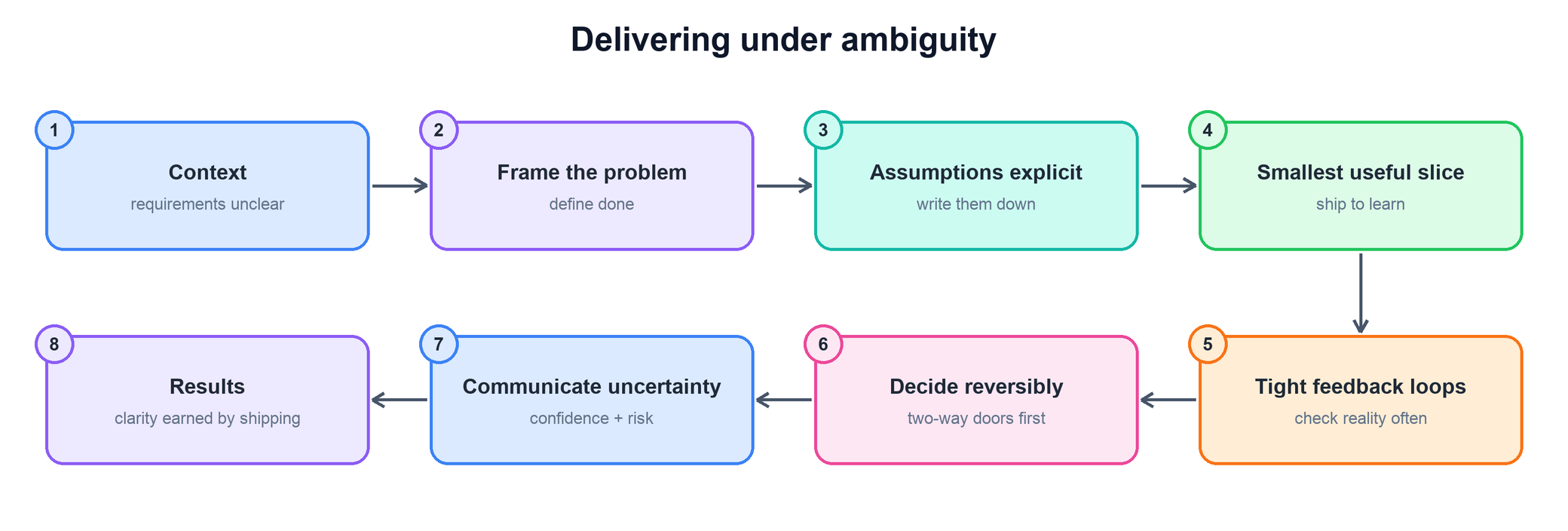
How to answer- Frame the problem and define “done.” The first act under ambiguity is to write down what you’re actually solving and what success looks like, then get that framing in front of stakeholders. A crisp problem statement is often 80% of the value — it converts a vague mandate into something you can execute against.
- Make assumptions explicit. You can’t remove uncertainty, but you can name it. Write down the assumptions you’re proceeding on so they’re visible, testable, and cheap to correct — a wrong assumption you wrote down is a course-correction; a hidden one is a failure.
- Ship the smallest useful slice. Don’t try to design the whole thing up front when you can’t. Build the smallest end-to-end piece that delivers value or answers a real question, and let contact with reality resolve the ambiguity that analysis can’t.
- Keep feedback loops tight and decisions reversible. Check your slice against reality — users, data, stakeholders — frequently, and favor two-way-door decisions you can undo cheaply. Save the irreversible, expensive commitments for when the fog has lifted.
- Communicate uncertainty honestly. Tell stakeholders what you know, what you’re assuming, and how confident you are — and update as you learn. Managing expectations under ambiguity is what keeps trust intact when the plan inevitably shifts.
- A bias to create clarity — framing and problem definition — not to wait for a spec.
- Assumptions surfaced and made testable, not buried.
- Incremental delivery that uses reality to resolve ambiguity analysis can’t.
- Reversible decisions and tight feedback loops — act without over-committing.
- Honest, calibrated communication of confidence and risk to stakeholders.
A worked example (CARL)
Context. Leadership handed my team a one-line mandate: “make ads events data more usable for ML teams.” That was it — no spec, no defined consumer, no success metric. Several ML teams each had a different idea of what they wanted, ranging from a new feature store to faster access to lower latency, and the risk was spending a half building something elaborate that no one actually needed.
Actions. I resisted the urge to either ask for a full spec (there wasn’t one to give) or to guess and build big. Instead my first deliverable was a framing doc, not code: I wrote down what I believed the problem actually was, an explicit “done” definition — a measurable reduction in the time an ML engineer spends getting from raw events to a usable training feature — and the assumptions I was proceeding on, chief among them “the real pain is data access latency and schema wrangling, not missing data.” I circulated that to the ML teams and to leadership, which turned a vague mandate into a concrete thing people could react to; a couple of my assumptions got corrected immediately, which was exactly the point. Then, rather than build a full feature store, I shipped the smallest useful slice: a thin, well-documented access layer and a couple of pre-computed common features for one ML team, done in about three weeks. That slice was the experiment — it let me test the core assumption against reality instead of debating it. I kept the feedback loop tight, sitting with that team weekly to see what actually helped, and I deliberately kept every decision reversible: I didn’t commit to a storage format or a long-term API until the slice told me what mattered. Throughout, I communicated in terms of confidence — “high confidence access latency is the pain, low confidence on which features matter, here’s how we’ll learn” — so stakeholders knew the plan would evolve and weren’t surprised when it did. The slice validated the latency assumption but disproved my feature guess — the teams wanted self-serve feature definition, not my pre-baked features — which redirected the whole roadmap early and cheaply.
Results. The framing doc plus a three-week slice replaced what would have been a multi-month build against the wrong target. We cut the tested team’s raw-events-to-feature time by more than half, and because the slice surfaced the real need early, the eventual platform we built was self-serve feature definition — something we’d have missed entirely if we’d designed the full system up front. Three more ML teams adopted it within two quarters.
Learnings. Under ambiguity, the highest-leverage move is framing — a written problem statement and explicit assumptions create more clarity than more meetings. And you learn the most by shipping a small, reversible slice: it converts unanswerable up-front debates into cheap, real feedback, and it’s far better to be redirected in week three than in month four.
Common follow-ups
How is delivering under ambiguity different from just having bad requirements?
How to answer- Ambiguity is the job at senior levels. No one has the answer yet — your value is creating it, not receiving it.
- Don’t wait, frame. With bad requirements you push back; with genuine ambiguity you write the first draft of the truth.
- Reduce it by shipping. Some questions are only answerable by contact with reality, not by more clarification.
- Own the framing. Taking on the problem definition is exactly the leadership the situation calls for.
How do you avoid analysis paralysis without being reckless?
How to answer- Separate one-way from two-way doors. Move fast on reversible calls; slow down only for the expensive, irreversible ones.
- Timebox the analysis. Give a decision a deadline and a smallest-experiment to resolve it, rather than open-ended study.
- Ship to learn. A small slice answers questions that no amount of upfront analysis can.
- Write assumptions down. Explicit assumptions let you proceed now and correct cheaply later.
You committed to a direction under uncertainty and it turned out wrong. What then?
How to answer- That’s the design working. Reversible decisions and small slices exist so a wrong bet is cheap to unwind.
- Redirect fast and openly. Update stakeholders with what you learned — honest course-correction preserves trust.
- Bank the learning. The disproved assumption is real information that sharpens the next decision.
- Check your communication. If people were surprised, you signaled too much confidence — calibrate it next time.
- The internal wiki / Google Docs — pull from the framing doc, problem statement, and explicit-assumptions list you wrote to create clarity.
- GSD — pull from the project where scope started vague and show how you sliced it and redirected on feedback.
- Design-review notes — pull the record of the assumptions tested and the reversible decisions you made.
- Scuba / Unidash — pull the metric that defined “done” (e.g. time-to-feature) and its before/after.
- Workplace posts — pull the updates where you communicated confidence, assumptions, and the evolving plan to stakeholders.