Designing for Testability in Distributed Microservices
A system design interview guide to making a massively distributed microservices architecture testable — from the shape of the test suite to contract tests, hermetic environments, chaos engineering, and safely verifying in production.
In a monolith, testing is mostly a solved shape: unit tests underneath, a few end-to-end tests on top, one process to run. Break that monolith into hundreds of independently deployed services and testing becomes a distributed-systems problem in its own right. Any request now crosses a dozen network hops owned by a dozen teams; a full end-to-end environment is expensive, slow, and perpetually broken; and the interesting failures are no longer logic bugs but timeouts, retries, partial outages, and version skew between services that were tested in isolation. Testability stops being something you add at the end and becomes something you design for. This guide works through that design: the test pyramid rebalanced for microservices, consumer-driven contract tests that catch integration breaks without a shared environment, techniques for isolating dependencies, fault injection and chaos engineering for the failures that only appear under stress, and the discipline of verifying safely in production with canaries, shadow traffic, and probers. Observability is the connective tissue — see the companion Distributed Tracing guide for the request-level visibility these techniques lean on.
Contents
1. Requirements & Scope
“Design for testability” is open-ended, so the first move is to state what testability actually has to deliver in a distributed system, and where the hard parts are.
- Fast, reliable feedback. A developer changing one service must get a trustworthy signal in minutes, without spinning up the whole fleet. Slow or flaky feedback is the disease that kills testing cultures.
- Independent deployability. Each service must be testable and releasable on its own. A test strategy that requires all services to be in lockstep defeats the point of microservices.
- Integration safety without a full environment. We must catch breaking changes at service boundaries before deploy, without relying on a fragile, shared end-to-end environment as the only gate.
- Resilience verification. The dominant failures are partial — a slow dependency, a dropped call, a bad node. The system must be testable against those, not just against clean logic.
- Confidence in production. No pre-prod environment fully mirrors production scale and traffic, so verifying safely in production must be a first-class, designed capability — not a euphemism for “we don’t test.”
- Non-goals. This is about testability as an architectural property, not a tutorial on any one framework.
2. The Test Pyramid, Rebalanced
The classic test pyramid still holds, but microservices reshape it. The instinct to lean on end-to-end tests — “just run the whole thing and click through it” — is exactly wrong at scale: those tests are slow, brittle, and flaky because any of a hundred services can knock them over. The winning shape keeps the base wide and fast and adds a distinctly distributed layer — contract tests — to cover the seams between services without a shared environment.
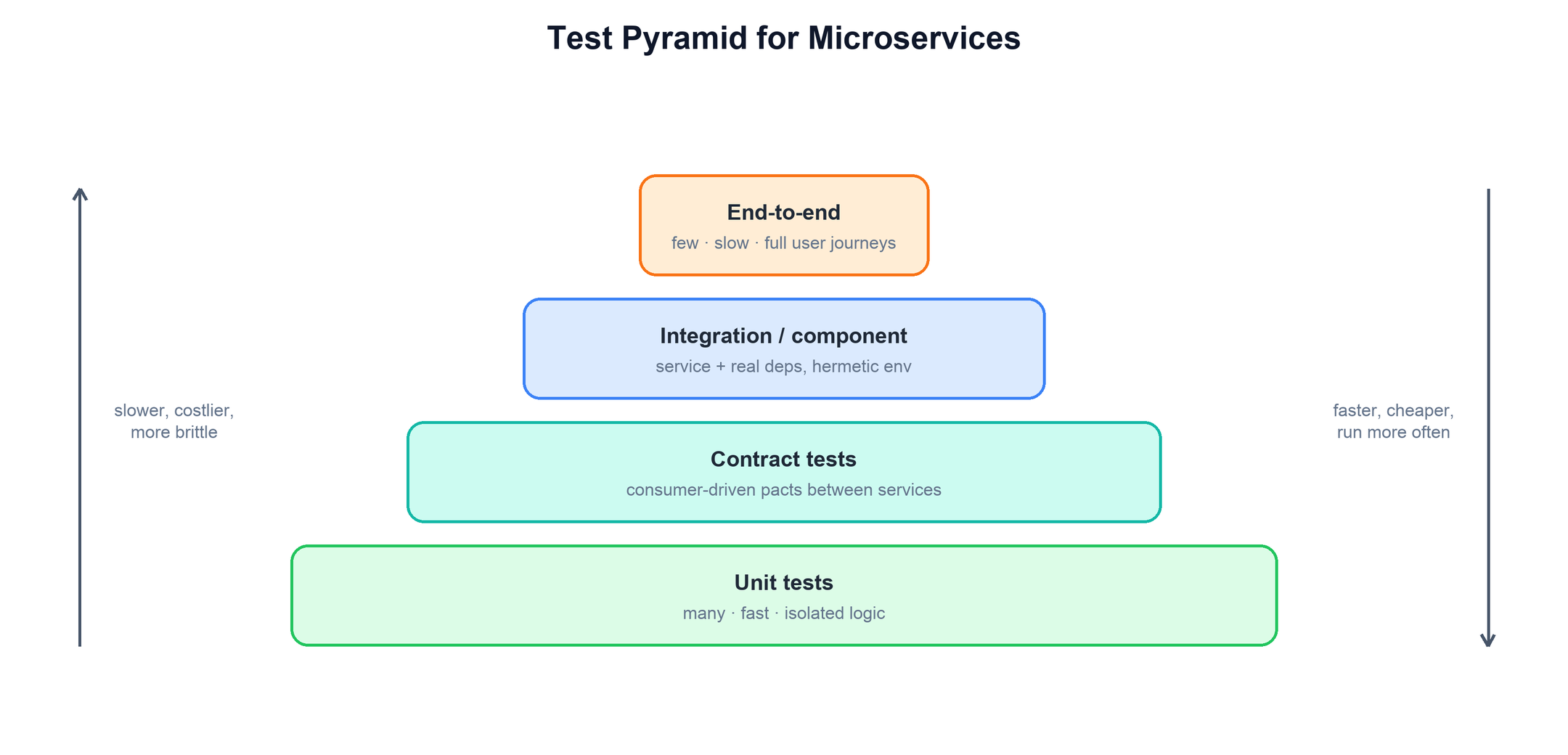
| Layer | Scope | Speed & count |
|---|---|---|
| Unit | One function/class, no I/O. | Milliseconds; thousands. The bulk of coverage. |
| Contract | The API between a consumer and a provider. | Fast; one per integration. Replaces most cross-service E2E. |
| Integration / component | One service with its real adjacent deps (DB, cache) in a hermetic env. | Seconds; dozens per service. |
| End-to-end | A full user journey across many services. | Minutes; a handful of critical paths only. |
The key inversion versus the naive approach: push coverage down. Every bug you can catch with a unit or contract test is a bug you did not need a flaky end-to-end run to find. Reserve end-to-end tests for a few golden critical paths (sign-up, checkout) and accept that everything else is covered by cheaper, more reliable layers.
3. Contract Testing
The signature problem of microservices is integration break: service A is tested against its own mock of service B, service B evolves its API, and both suites stay green while production breaks. Consumer-driven contract testing (the model popularized by Pact) closes that gap without ever standing up both services together.
- The consumer defines the contract. A’s tests run against a mock of B and, as a side effect, record exactly what A sends and what it expects back — the fields, types, and status codes A actually depends on. That recording is the contract.
- The provider verifies against it. B’s CI replays every consumer’s contract against the real B and fails if B no longer satisfies one. B learns it is about to break A before deploying, from a fast test in its own pipeline.
- A broker shares contracts. A contract broker stores contracts and verification results and gates deploys with “can-I-deploy?” checks — can this version of B be released given every consumer that depends on it?
The payoff is decoupling: teams verify compatibility independently, in their own pipelines, at unit-test speed, without a shared integration environment as a bottleneck. Contract tests check the shape of the interaction, not deep behavior — they complement, not replace, the provider’s own functional tests.
# consumer side: expectation becomes the contract
expect GET /orders/42 -> 200 { id, total, status }   # only fields A uses

# provider CI: verify the real service still honors it
for contract in broker.contracts_for("orders-svc"):
  assert real_service.satisfies(contract)            # fail fast, pre-deploy
can_i_deploy("orders-svc", version) -> check all consumers
4. Isolating Dependencies
To test one service without dragging in the other ninety-nine, you have to stand in for its dependencies. The trick is choosing the right kind of stand-in for the level of the pyramid — too shallow and the test proves nothing, too heavy and it becomes a slow, flaky end-to-end test in disguise.
- Mocks. Assert on how a collaborator is called (this method, these args). Cheap and precise for unit tests, but over-mocking couples the test to implementation and can pass while reality diverges — the failure contract testing exists to catch.
- Fakes. Lightweight working implementations — an in-memory database, a fake queue. They behave correctly enough to test real logic without the real dependency’s cost, and are the workhorse of integration tests.
- Stubs / service virtualization. A canned, network-level replica of a dependency that returns programmed responses (and can be told to inject latency or errors). Useful for third-party APIs you cannot run locally or want deterministic control over.
- Hermetic environments. A fully self-contained, reproducible environment — the service plus its real adjacent dependencies (its own database, cache) spun up in containers, seeded deterministically, with no shared mutable state and no network to the outside. Hermeticity is what makes a test give the same answer every run on every machine; it is the antidote to “works on my laptop” and shared-staging contention.
The design principle behind all of these is dependency injection: a service should receive its collaborators (clients, clocks, config) from outside rather than constructing them internally. Code written that way can be handed a fake or a stub in a test and the real thing in production without changing a line — testability is largely a consequence of this one design choice.
5. Fault Injection & Chaos Engineering
Unit and contract tests verify correct behavior on the happy path. But in a distributed system the failures that cause outages are the unhappy ones — a dependency that got slow, a call that timed out, a region that vanished — and those are precisely the paths that never run in a normal test. Fault injection deliberately provokes them; chaos engineering does it as a disciplined, ongoing experiment.
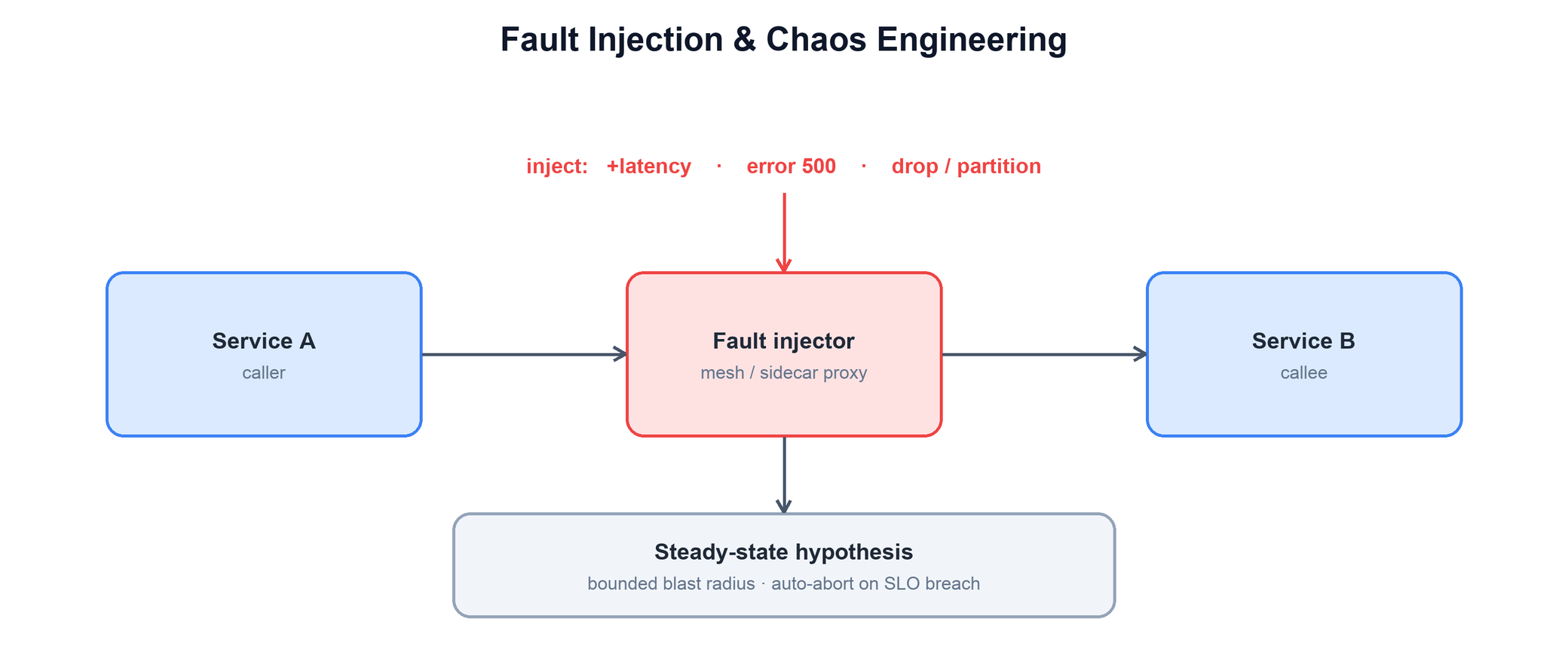
- What you inject. Added latency (does the caller’s timeout and retry behave?), error responses (does the circuit breaker trip and the fallback engage?), and dropped or partitioned calls (does the system degrade gracefully or cascade?). A service mesh makes these injectable without touching application code.
- Chaos engineering discipline. Define the normal steady state as a measurable SLO, form a hypothesis (“killing one replica will not move p99”), inject the fault, and compare. The value is in disproving the comforting assumption that a fault is handled when it is not.
- Blast radius & safety. Start in a hermetic or staging environment, then run controlled experiments in production on a small slice of traffic, with an automatic abort (a “big red button”) the moment real user impact appears. Chaos without a bounded blast radius is just an outage.
- Game days. Scheduled, human-in-the-loop drills of larger failures (lose a zone, fail over a database) that test the people and runbooks as much as the code.
6. Testing in Production
No staging environment matches production’s scale, data shape, or traffic mix, so some classes of bug are only discoverable in production. The mature stance is not to avoid production but to make testing there safe by design, decoupling deploy from release and always keeping a fast path back.
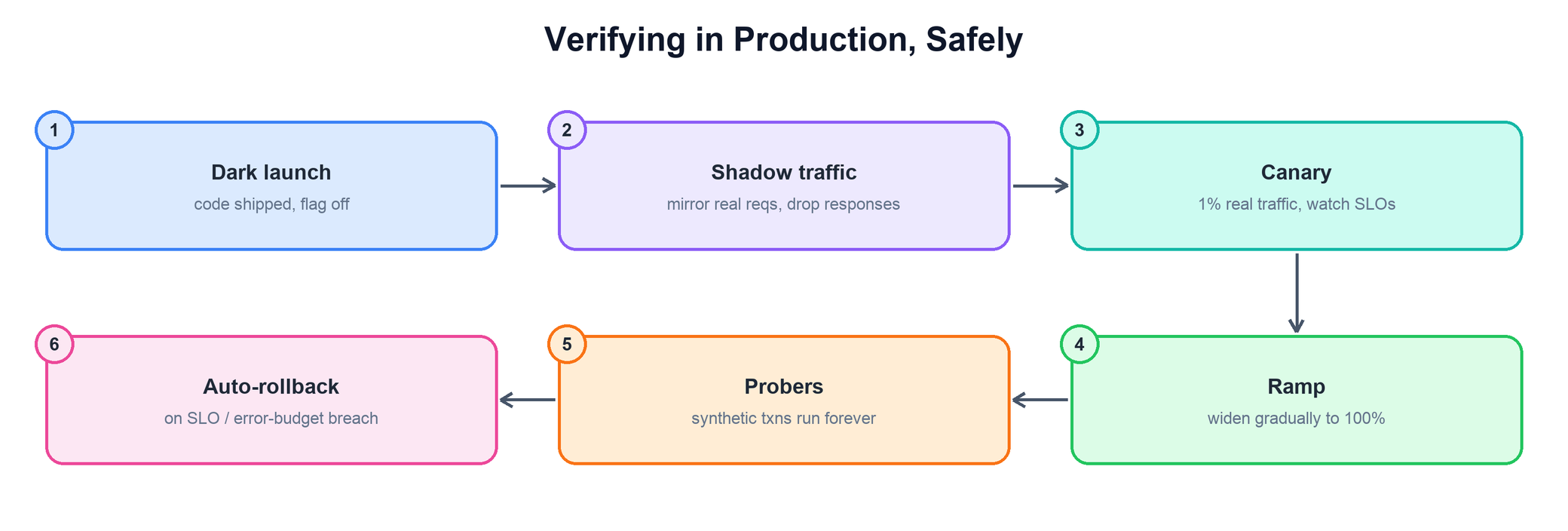
- Dark launch / feature flags. Deploy the code turned off, then enable it for internal users or a fraction of traffic via a flag. Deploy and release become separate events, so a bad feature is switched off instantly without a redeploy.
- Shadow traffic (mirroring). Copy real production requests to the new version and discard its responses. The new code sees real load and real data shapes with zero user impact — ideal for validating a rewrite or a performance change before it serves anyone.
- Canary release. Route a small slice (say 1%) of real traffic to the new version and compare its SLOs against the stable version. If error rate or latency regresses, roll back before the blast radius grows; if it holds, ramp gradually to 100%.
- Synthetic transactions / probers. Scripted “fake users” that continuously exercise critical journeys against production and alert on failure. They catch breakage the moment it appears — often before a real user hits it — and double as the health signal that gates canaries and drives auto-rollback.
- Observability as the oracle. All of this depends on being able to tell good from bad in production. Distributed tracing ties a request’s path across services into one timeline, making it the primary tool for diagnosing why a canary regressed — see the Distributed Tracing guide.
7. Determinism, Data & Load
Three cross-cutting concerns decide whether the whole strategy is trustworthy: are the tests deterministic, is the test data managed, and does the system survive sustained load?
- Deterministic vs flaky tests. A flaky test — one that passes and fails without a code change — is worse than no test: it trains everyone to ignore red. The usual culprits are shared mutable state, real wall-clock time, and unmocked network calls with race conditions. The cures are hermetic isolation, an injectable clock, controlling concurrency and ordering, and quarantining a flaky test immediately rather than letting it erode trust in the suite.
- Test data management. Distributed tests need consistent data across services. Options span synthetic generated data (safe, but may miss real edge cases), seeded fixtures per hermetic environment (reproducible), and anonymized production snapshots (realistic, but must be scrubbed of PII). Each test should set up and tear down its own data so runs stay independent — shared, mutated data is a top source of flakiness.
- Staging vs testing-in-production. Staging is valuable for hermetic integration and contract verification but can never match production; treat it as a fast gate, not a source of truth, and lean on the production techniques above for scale-dependent confidence.
- Load & soak testing. Load tests find the throughput ceiling and the latency knee; soak tests run at sustained load for hours or days to surface slow leaks — memory growth, connection-pool exhaustion, disk fill — that a short test never reveals. Both are essential because a distributed system’s worst behavior often shows up only over time and at scale.
8. Bottlenecks & Tradeoffs
Testability is a balance of confidence against cost and speed; the tensions are real and worth naming.
- Confidence vs speed. End-to-end tests give the most realistic confidence but are the slowest and flakiest; unit tests are fast but miss integration bugs. Resolve it by shape, not by picking one — wide base, narrow tip, contract tests for the seams.
- Realism vs isolation. Real dependencies catch real bugs but make tests slow and non-deterministic; mocks and fakes are fast but can drift from reality. Contract tests are the bridge that keeps fakes honest.
- Test coverage vs maintenance. More tests catch more bugs but cost more to maintain and slow the pipeline; over-mocked tests especially rot. Aim coverage at behavior and boundaries, not at line counts.
- Safety vs realism in production testing. Testing in production gives ultimate realism but risks user impact; shrinking the blast radius (canary %, shadow, flags, auto-rollback) trades a little realism for a lot of safety.
- Staging cost vs value. A full staging fleet is expensive and perpetually drifting from production; hermetic per-test environments plus production verification often beat a heavyweight shared staging environment.
9. Summary
Testability in distributed microservices is an architectural property, not a phase. The design pushes fast feedback down, covers the seams without a shared environment, provokes the failures that matter, and treats safe production verification as part of the plan.
| Concern | Mechanism |
|---|---|
| What shape should the suite take? | Rebalanced pyramid: wide unit base, contract layer for seams, narrow E2E tip. |
| How to catch integration breaks early? | Consumer-driven contract tests verified in each provider’s own pipeline. |
| How to test a service in isolation? | Dependency injection + fakes/stubs in a hermetic, deterministic environment. |
| How to verify resilience? | Fault injection (latency/error/partition) and disciplined chaos with bounded blast radius. |
| How to gain confidence at real scale? | Test in production safely: dark launch, shadow traffic, canary, probers, auto-rollback. |
| How to keep tests trustworthy? | Kill flakiness with isolation and injectable time; manage test data per run. |
| How to catch slow, scale-only failures? | Load tests for the ceiling, soak tests for leaks over time. |
| How to tell good from bad? | Observability — distributed tracing as the oracle for every layer. |