When a Remote or Vendor Team Falls Behind
Final Prep · People Management — how to change a process or timeline when a global vendor or remote team is slipping, by diagnosing the real cause with empathy before adapting the plan, protecting the relationship, and communicating the change upward with options.
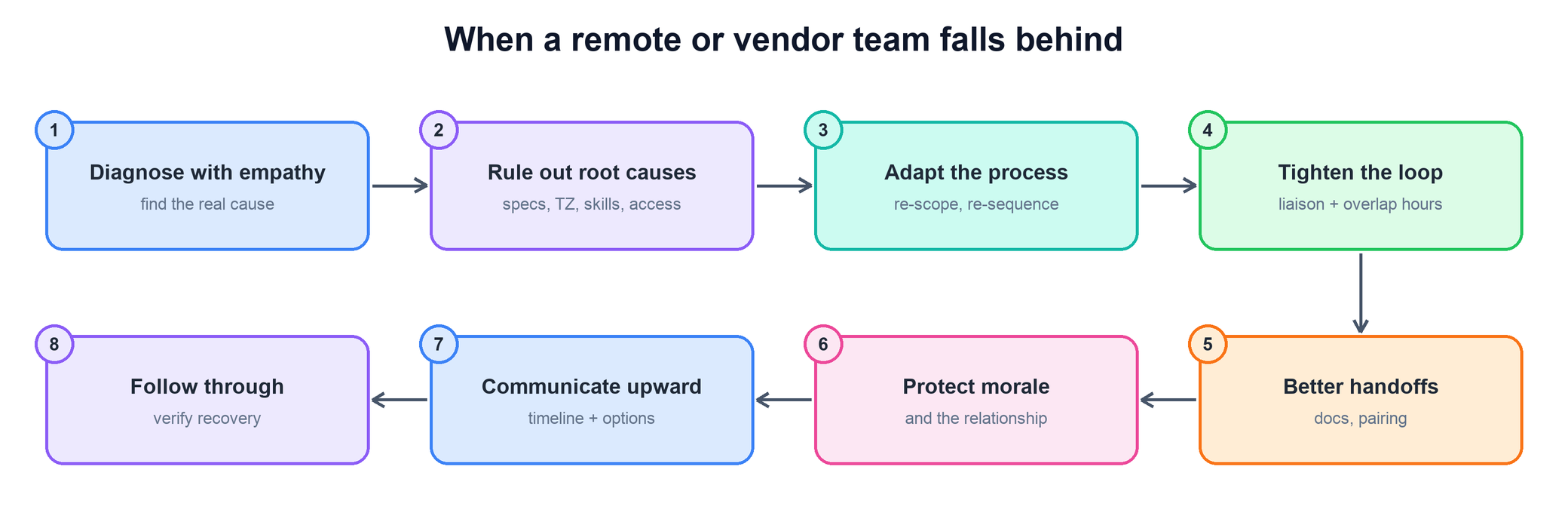
This question tests how you respond to a partner team missing its commitments — and the trap is baked into the phrasing. The lazy answer assumes the remote or vendor team is simply not working hard enough and reaches for pressure or replacement. The senior answer starts with diagnosis and empathy: a team falls behind far more often because of unclear specs, timezone latency in the feedback loop, a skills or domain gap, tooling and access friction, or dependency starvation where they’re waiting on you. Once you know the real cause, you adapt the process or timeline creatively — re-scope, re-sequence, embed a liaison, write better handoff docs, add overlap hours, or pull work back to unblock them — while protecting morale and the relationship, communicating the timeline change upward with options, and following through. Answer in CARL shape. The broader async operating model sits in Managing Globally Distributed Teams.
What this question is really testing
Whether your first instinct under a slipping timeline is curiosity or blame. A leader who assumes low effort will apply pressure, damage the relationship, and usually make the slip worse — because the actual cause (a spec they couldn’t interpret across a language and timezone gap, access they never got provisioned, a dependency you owe them) is untouched by pressure. The senior signal is treating the remote or vendor team as capable people operating in a harder environment than your co-located team, diagnosing the specific failure in the working relationship and process, and being willing to change your own plan and your own team’s behavior to fix it. It also tests maturity in managing up: surfacing the slip early with options rather than hiding it, and protecting a long-term partnership rather than winning a short-term point.
How to answer- Diagnose the real cause with empathy first. Get on a call, ask what’s actually blocking them, and assume competence. Distinguish among unclear specs, timezone latency, a skills gap, tooling or access friction, and dependency starvation — each has a different fix.
- Rule out the causes you can see in your own process. Often the slip is partly self-inflicted: ambiguous requirements, a feedback loop that takes a full day to close because of the timezone gap, or a dependency they’re waiting on from your side. Own your half.
- Adapt the process or timeline creatively. Don’t just push the date. Re-scope to the critical subset, re-sequence so they work on unblocked pieces, or move a chunk of work back to your team to unblock theirs.
- Tighten the feedback loop. Embed a liaison or point of contact who overlaps their hours, add a short daily overlap window, and shorten review turnaround so a question doesn’t cost them a full day of idle time.
- Improve handoffs and transfer skill. Write clearer specs and handoff docs, pair engineers across sites, and invest in ramping them on the domain — a skills gap is closed by teaching, not by pressure.
- Protect morale and the relationship, then communicate upward with options. Keep the conversation blameless so the team stays motivated, and take the timeline change to your leadership early with concrete options — re-scope, extend, or add help — not just bad news. Then follow through and verify recovery.
- Curiosity before blame — you diagnose the specific cause instead of assuming low effort.
- Willingness to change your own process and your own team’s behavior, not just pressure the partner.
- Creative adaptation — re-scope, re-sequence, embed, pair — rather than only moving the date.
- Care for morale and the long-term relationship with a remote or vendor team.
- Mature managing-up: early, honest communication of the slip with options attached.
A worked example (CARL)
Context. On an Ads Events Infra project we had a vendor team in a far timezone building a set of data-quality validators against our event schemas — a well-scoped chunk we’d carved off so my core team could focus on the pipeline itself. Six weeks in, they were roughly a third behind plan and the gap was widening. The easy read, and the one a couple of stakeholders were pushing, was that the vendor was underperforming and we should escalate or claw the work back. I wasn’t convinced that was the actual problem, and clawing it back would have blown my own team’s roadmap.
Actions. I started by diagnosing rather than escalating. I set up a call in a slot that was reasonable for their hours — not ours — and asked, without blame, what was actually slowing them down. The picture that came out was almost entirely process, not effort. First, the specs: our validation requirements assumed deep tribal knowledge of our event taxonomy that the vendor had no way to know, so they were guessing, building the wrong thing, and reworking it. Second, the feedback loop: whenever they had a question, they posted it at the end of their day and got an answer at the end of ours — effectively one round-trip per day, so a two-hour clarification was costing them a full day of idle or misdirected work. Third, access: they’d never been fully provisioned for our staging environment, so they couldn’t test against realistic data and were validating against toy fixtures. None of that is a work-ethic problem. So I adapted the process on my side. I rewrote the specs into concrete, example-driven acceptance criteria — here is a valid event, here is each way it can be malformed, here is the expected validator behavior — which removed the guesswork. I embedded one of my engineers as a liaison who shifted a couple of hours to overlap the vendor’s morning, so questions got answered in-session instead of a day later, and I set a two-hour review SLA on their pull requests during that window. I fast-tracked their staging access with our access team. Then I re-scoped and re-sequenced: I identified the subset of validators that covered the highest-volume event types, made that the must-have for the original date, and moved the long-tail validators into a fast-follow, so the timeline slip became a scope decision rather than a pure delay. Finally, I took it upward properly — I told my manager and the stakeholder the date was at risk, but I brought three options (re-scope to the critical subset on the original date, hold full scope and extend by a few weeks, or add a second vendor engineer) with a recommendation, rather than just reporting a slip. Throughout, I kept the framing blameless with the vendor lead so their team didn’t feel scapegoated and disengage.
Results. Within about two weeks of the changes their throughput roughly doubled — most of the gain came from the same-day feedback loop and the example-driven specs, not from anyone working harder. We shipped the critical-subset validators on the original date via the re-scope, and the fast-follow long tail landed a few weeks later at full quality. The validators caught a class of malformed events we’d been silently accepting, which was the point of the project. And the relationship held: the vendor team stayed engaged and we ran two more projects with them, which wouldn’t have happened if I’d escalated and treated them as the problem.
Learnings. When a remote or vendor team falls behind, the cause is usually in the interface between us, not in them — unclear specs and a slow feedback loop across a timezone gap will sink a capable team every time. The most leverage came from things entirely within my control: better specs, a liaison in their hours, and faster reviews. My rule now: before I ever question a partner team’s effort, I audit my own team’s handoffs and responsiveness first, because that’s where the fix almost always is — and I bring options, not just bad news, when the date has to move.
Common follow-ups
How do you tell the difference between a process problem and a genuine performance problem?
How to answer- Fix the process first, then measure. Clear the specs, access, and feedback-loop issues; if throughput jumps, it was process — which it usually is.
- Look for the pattern. Are they building the wrong thing (spec problem) or the right thing too slowly (skills or capacity problem)? Different signals, different fixes.
- Check your own half honestly. Late reviews, missing dependencies, and ambiguous requirements masquerade as vendor underperformance.
- If it truly is performance, address it directly with the vendor lead through the contract relationship — but only after you’ve ruled out the environment.
How do you communicate the timeline slip to your leadership?
How to answer- Early, not at the deadline. Surface the risk as soon as the trend is clear, so there’s room to act — hiding it removes every good option.
- Bring options, not just news. Re-scope to critical, extend the date, or add help — each with a cost, and a recommendation.
- State the real cause plainly. If part of it was our specs or reviews, say so; it builds trust and points at a durable fix.
- Reframe as a scope decision. A slip you turn into “ship the critical 80% on time, fast-follow the rest” is a decision leadership can make, not just a delay to absorb.
How do you protect the relationship while still holding the bar?
How to answer- Blameless diagnosis. Attack the process, not the people — a team that feels scapegoated disengages and slips further.
- Own your share out loud. Naming your own specs or review lag as part of the cause earns the credibility to ask for changes on their side.
- Hold quality, flex the plan. Keep the acceptance bar firm while adapting scope and timeline — that’s holding the bar without crushing morale.
- Invest for the long term. Ramping and pairing signal you see them as a lasting partner, which pays back across future projects.
What if pulling the work back to your own team is genuinely the right call?
How to answer- Make it a last resort, on evidence. Only after the process fixes have failed to move throughput — not as a first reflex.
- Do it partially and cleanly. Pull back the critical path to protect the date while leaving the vendor a well-defined, unblocked piece to keep momentum.
- Cost it honestly upward. Absorbing the work has a real hit to your own roadmap — put that trade-off in front of leadership.
- Protect the relationship anyway. Frame it as load-balancing, not punishment, so the partnership survives for the next project.
- GSD — pull the burndown showing the slip, the re-scoped milestones, and the throughput recovery after the process changes.
- Workplace posts — pull the status update where you surfaced the slip upward with options and the recommendation you made.
- Migration / project dashboards — pull the validator coverage and the class of malformed events caught after the work shipped.
- 1:1 and meeting notes — pull the blameless diagnosis call with the vendor lead and the specific causes it surfaced.
- SEV records & the internal wiki — pull any data-quality SEVs the validators prevented, and the example-driven specs and handoff docs you wrote.