Scaling a Team While Holding Quality
Final Prep · People Management — how to grow a team fast without diluting the hiring bar, the culture, or the quality of what it ships.
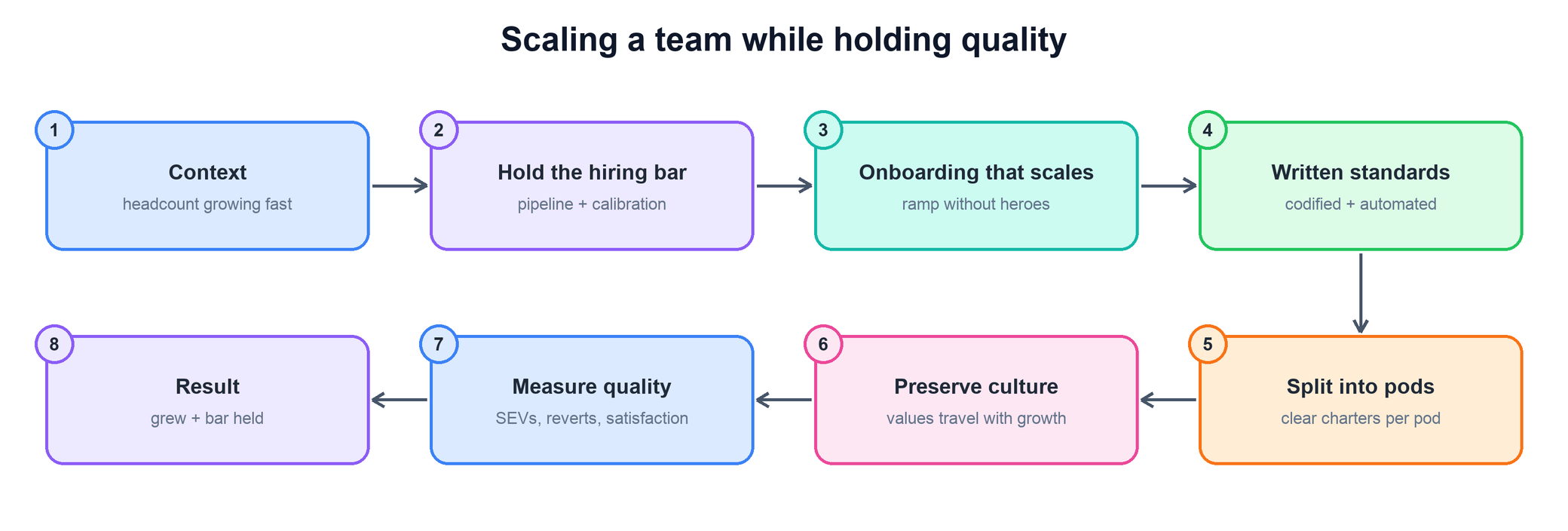
This question tests whether you can grow an organization without breaking it. Rapid growth is where most teams lose their edge: the hiring bar slips under headcount pressure, onboarding can’t keep up, culture gets diluted by too many new people at once, and quality quietly erodes as the standards that lived in a few heads stop scaling. The interviewer wants the mechanisms that hold the line: a defended hiring bar and pipeline, onboarding that scales without heroics, written standards plus automation so quality doesn’t depend on tribal knowledge, pods with clear charters to keep teams the right size, and deliberate work to preserve culture as you grow — sometimes building from scratch. Answer in CARL shape.
What this question is really testing
Whether you treat quality as something you engineer into the system rather than something you personally inspect. At small scale a strong leader can hold the bar by being in every review and interview; at scale that’s impossible, and the leaders who don’t make the shift watch their team’s quality decay. The senior signal is moving the bar out of your head and into artifacts, automation, and structure — a written hiring rubric, automated quality gates, pod charters, onboarding that doesn’t depend on you — and the discipline to protect the hiring bar under pressure, because a single bad hire at scale is more expensive than a slow one.
How to answer- Defend the hiring bar. Never trade quality for speed of headcount — a wrong hire costs more than an open req. Build a real pipeline, calibrate interviewers, and keep the bar explicit and consistent so it doesn’t drift under pressure.
- Build onboarding that scales. Ramp shouldn’t depend on you or a couple of heroes. Invest in docs, starter projects, buddies, and a clear 30/60/90 so new hires get productive fast and absorb the bar early.
- Codify standards and automate. Move quality from tribal knowledge into written standards and automated gates — CI, tests, lint, code-owners — so the bar holds constant as the number of people applying it grows.
- Split into pods with clear charters. Keep team units small and focused; as you grow, split into pods with unambiguous ownership and charters rather than one sprawling group where accountability blurs.
- Preserve culture and measure quality. Grow in absorbable increments, seed each pod with culture-carriers, onboard to the values explicitly, and watch the quality metrics (SEVs, reverts, review latency, satisfaction) so erosion shows up early, not in an incident.
- Quality engineered into systems and structure, not held by personal inspection.
- A hiring bar defended under headcount pressure — slow beats wrong.
- Onboarding and standards that don’t depend on the leader or a few heroes.
- Pods with clear charters to keep accountability crisp as scale grows.
- Culture preservation as a deliberate act, with quality measured for early warning.
A worked example (CARL)
Context. I was asked to roughly double the Ads Events Infra storage team over about three quarters to take on a major expansion of the events pipeline’s scope. Going from a tight, senior-heavy group to nearly twice the size fast is exactly where quality dies: the reflex is to lower the hiring bar to fill reqs, onboarding gets improvised, and the standards that lived in a handful of senior engineers’ heads stop reaching everyone. I’d seen teams around us grow this way and end up slower and less reliable than before they scaled. The core problem was that the bar was implicit — it worked at small scale because I and two seniors were in every review and every interview loop, and that was about to become impossible.
Actions. I made the whole effort about moving quality out of heads and into systems. On hiring, I held the bar as non-negotiable and said so explicitly to my leadership when the pressure to just fill seats came: a wrong hire on an infra team is a multi-quarter reliability and morale cost, far worse than a slow req. I built out the pipeline (sourcing, referrals) so we had volume to be selective, wrote down an explicit rubric for what “strong” meant for our roles, and calibrated the interviewers so the bar was consistent across loops rather than varying by who happened to interview. On onboarding, I built a program that didn’t depend on me: a written ramp guide, a curated set of starter projects that touched the real systems safely, a buddy for every new hire, and a clear 30/60/90 with a first meaningful ship early — so new engineers absorbed the bar by doing, not by osmosis. On standards, I codified what had been tribal: written design and code standards, a definition of done, and — critically — automation, because automation is the only thing that holds a bar constant as the number of people rises. We pushed formatting, tests, lint, and known anti-patterns into CI, and set up code-owners so review routed to accountable people automatically instead of relying on everyone knowing who to ask. On structure, rather than let one big group blur, I split into pods, each with a clear charter and unambiguous ownership of part of the pipeline, and I seeded each pod deliberately with a senior culture-carrier so the new people had someone embodying the bar next to them. Finally, I instrumented quality itself — SEV rate, revert rate, review latency, and on-call load, tracked as we grew — so if scaling was eroding quality I’d see it in the numbers within weeks rather than discovering it in an incident.
Results. We hit the headcount target over the three quarters without dropping the hiring bar — I held several reqs open rather than settling, and the calibrated loops kept quality consistent. More importantly, the quality metrics held through the doubling: SEV and revert rates stayed flat or improved rather than spiking the way they usually do during rapid growth, and new hires reached meaningful productivity noticeably faster than the team’s prior ad-hoc ramp. The pod structure gave clean accountability, and the codified standards plus automation meant the bar no longer depended on me being in every review — which was the whole point.
Learnings. The mindset shift that made it work was accepting that I could no longer be the quality bar; I had to build it into the system. The single highest-leverage move was automation — every standard I could turn into a gate was one I no longer had to enforce by hand across twice as many people. And the hardest discipline was holding the hiring bar under pressure; every time I’ve relaxed it “just this once” in the past, it cost more than the empty seat would have. The lesson: scale quality through artifacts, automation, and structure — and never buy headcount speed with the bar.
Common follow-ups
How do you protect the hiring bar under pressure to fill roles fast?
How to answer- Frame the cost honestly. A wrong hire on an infra team is a multi-quarter reliability, review-load, and morale cost — far more expensive than an open req; make that case to leadership explicitly.
- Build pipeline for selectivity. Volume at the top (sourcing, referrals) is what lets you stay picky without stalling — a thin pipeline is what forces bar-lowering.
- Calibrate interviewers. A written rubric and calibrated loops keep the bar consistent so it doesn’t drift down loop by loop under pressure.
- Be willing to hold the req open. Slow beats wrong — the discipline to not settle is the bar.
How do you onboard at scale without it depending on you?
How to answer- Systematize the ramp. A written guide, curated starter projects, a buddy, and a clear 30/60/90 make onboarding repeatable instead of improvised per hire.
- Get an early real ship. A meaningful first launch quickly builds confidence and teaches the bar by doing.
- Distribute the load. Buddies and pod leads carry onboarding so it doesn’t bottleneck on you or two seniors.
- Teach the values explicitly. Onboard to the reliability and quality culture on day one, not by osmosis, so growth doesn’t dilute it.
How do you split a growing team into pods?
How to answer- Split along ownership boundaries. Pods should map to coherent parts of the system with clear charters, so accountability is unambiguous.
- Keep pods small. Small, focused units preserve the tight communication and ownership that big groups lose.
- Seed each with a culture-carrier. A senior who embodies the bar in every pod is how standards and values propagate as you split.
- Define the interfaces. Clear contracts between pods prevent the ambiguity and finger-pointing that come from fuzzy boundaries.
How do you preserve culture as you grow — or build one from scratch?
How to answer- Grow in absorbable increments. Too many new people at once dilutes culture faster than it can transmit; pace hiring to what the team can absorb.
- Encode values in artifacts. Written standards, a definition of done, and the postmortem norm let culture scale beyond word-of-mouth.
- Lead by example and by hiring. Culture is set by what you reward and who you bring in — hire for values fit, not just skills, and recognize the behaviors you want.
- From scratch, be explicit early. When building new, name the values and operating norms deliberately from the first hires — the founding team’s habits become the culture.
- Hiring data — pull the pipeline, offer/accept, and bar-consistency (calibration) numbers across the growth period.
- SEV / incident & revert records — pull the quality trend through the doubling to prove the bar held.
- Onboarding / ramp metrics — pull time-to-first-ship and time-to-productivity for new hires.
- GSD — pull the pod charters and ownership map created during the split.
- The internal wiki & eng-satisfaction surveys — pull the written standards/onboarding docs and the team-health signal through growth.