Delivering High-Stakes Feedback & Retaining Talent
Final Prep · People Management — you must deliver tough feedback to a senior engineer who believed they were ready for promotion but leadership disagreed; how you manage the conversation and keep the person engaged.
This question lives at the intersection of honesty and retention, which is exactly where it’s easy to fail. A weak answer either softens the message until the person walks away thinking they were robbed, or delivers the verdict so bluntly that a strong engineer starts looking for the exit that afternoon. The interviewer wants to see that you deliver the message clearly and without surprise, that you can separate the disappointment from the path forward, that you turn a “not yet” into a concrete, sponsored growth plan, and that you actively re-recruit a person you can’t afford to lose — without ever making a promise you can’t keep. Answer in CARL shape (Context, Actions, Results, Learnings), with most of your words on the actions.
What this question is really testing
Two things. First, candor under pressure: will you tell a talented person a hard truth clearly, or will you fudge it to avoid the discomfort and leave them confused about where they actually stand? Second, retention judgment: can you deliver a disappointing decision and still leave the person motivated, trusting you, and committed to the work — because losing a strong engineer over a badly handled promo conversation is a self-inflicted wound. The trap the interviewer is watching for is a manager who either over-promises (“you’ll definitely get it next cycle”) to soften the blow, or who treats the conversation as a one-way verdict rather than the start of a plan.
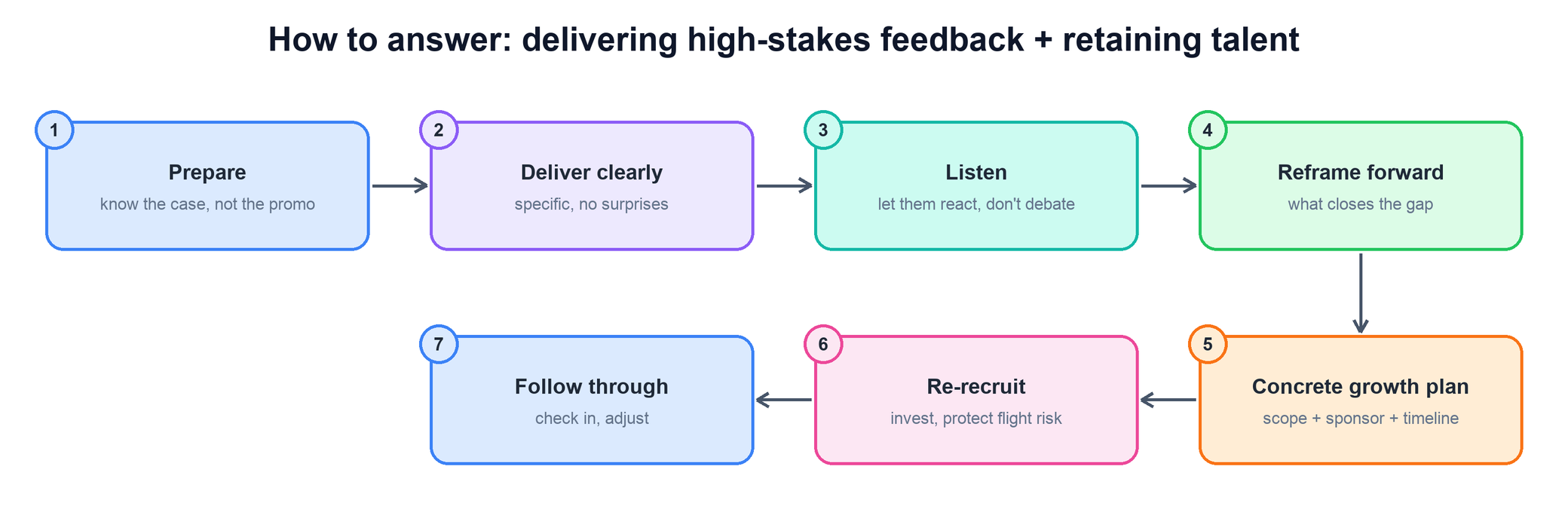
How to answer- Prepare the specifics, not the promo outcome. Walk in able to name the exact gap in observable terms — scope of impact, cross-team influence, ambiguity handled — and the evidence behind it, so the decision reads as a bar, not an opinion.
- Deliver it clearly and early, with no surprise. Lead with the decision plainly, own it as the manager, and make sure it confirms feedback they’ve already been hearing — a promo “no” should never be the first time they learn about the gap.
- Let them react before you problem-solve. Disappointment and even anger are legitimate; sit with it, acknowledge the contribution honestly, and don’t rush to fix the feeling or debate the decision in the moment.
- Reframe from verdict to path. Turn “not yet” into a concrete growth plan — the specific stretch work, the sponsorship and visibility you’ll provide, and what “ready” will demonstrably look like — without guaranteeing a cycle.
- Actively re-recruit. Name what you value in them, make sure they feel seen, and invest fast in the growth work — retention is earned in the weeks after the conversation, not in the meeting itself.
- Clarity and candor — the message lands cleanly, no hedging.
- “No surprises” — the decision confirms prior feedback.
- Empathy that doesn’t collapse into false promises.
- A concrete, sponsored path forward, not just a rejection.
- Deliberate retention moves — treating a strong engineer as a flight risk to invest in.
A worked example (CARL)
Context. On the Ads Events storage team I had a senior engineer — call her P — who was one of my strongest ICs and had convinced herself, with real justification, that she was ready for the next level. She’d led a hard migration and kept our on-call healthy. But in calibration the decision was “not this cycle”: her impact was excellent but concentrated inside our team, and the next level required demonstrated influence across the org and ownership of genuinely ambiguous, cross-team problems. She was a real flight risk — the kind of person who gets recruiter pings weekly — and a botched conversation could easily have cost me her.
Actions. I did not save this for the calibration readout — I’d been naming the cross-team-scope gap in our 1:1s for two cycles, so the decision would confirm a theme rather than blindside her. When the outcome landed, I told her plainly and early: the answer was no for this cycle, I owned that as her manager, and here was precisely why — not effort or skill, but that her impact, while excellent, hadn’t yet crossed team boundaries in the way the bar required. Then I stopped talking and let her react. She was disappointed and pushed back, and I didn’t debate the verdict or rush to make her feel better; I acknowledged, genuinely, that the migration work had been outstanding and that the disappointment was fair. Once she’d had room, I reframed it from a rejection into a plan. Together we picked a specific stretch: taking DRI on a cross-team reliability initiative that touched three orgs, exactly the ambiguous, boundary-spanning work the level demanded. I committed to the sponsorship side — getting her into the forums where that work is visible, introducing her to the partner-team leads, and putting my own credibility behind her in the next calibration — and I was explicit that I could not promise a cycle, only that this was the work that would make the case undeniable. Critically, I re-recruited her on purpose: I told her directly what she meant to the team, made sure the growth work was genuinely interesting and not busywork, and checked in weekly in the following month, when flight risk is highest, to adjust and to keep her engaged rather than drifting.
Results. She stayed, and she stayed engaged. She took the cross-team initiative and drove it to a clean landing over the next two quarters, which built exactly the visible, boundary-spanning track record the level required, and she was promoted the following cycle on a much stronger case than she’d have had this time. Just as important, she later told me the conversation was hard but fair — that she never felt managed or handled — which is the trust I most needed to preserve. It doesn’t always end in a promotion, but the retention and the trust are the part I control.
Learnings. The conversation is won or lost long before it happens: if the promo “no” is a surprise, you’ve already failed as a manager. And clarity and warmth are not opposites — the kindest thing I could do was tell her the exact truth and then put real weight behind helping her close the gap. The one line I never cross is the false promise; borrowing next cycle’s credibility to soften today’s disappointment destroys trust the moment it doesn’t come true.
Common follow-ups
What if they threaten to leave on the spot?
How to answer- Don’t counter-negotiate in the moment. Acknowledge the frustration as real and resist making a panicked promise you’ll regret — a retention move made under threat teaches the wrong lesson.
- Separate the feeling from the decision. A threat to leave is often disappointment talking; give it room and revisit the substance once the heat is down.
- Re-recruit on genuine value. Reconnect them to the work, the growth path, and what you value in them — not to a title you can’t guarantee.
- Accept you might lose them. If the only thing that keeps them is a promise you can’t honestly make, that’s a departure you should let happen rather than buy on credit.
How do you avoid over-promising the next cycle?
How to answer- Commit to inputs, not outcomes. Promise the sponsorship, the stretch work, and your advocacy — never the calibration result, which you don’t solely control.
- Name the uncertainty out loud. Say plainly that doing the work makes the case strong but doesn’t guarantee a cycle, so trust survives whatever happens.
- Define “ready” observably. Anchor on demonstrable evidence of the next level so the bar is theirs to clear, not a mood to read.
- Write it down. A shared growth plan keeps both of you honest and prevents the conversation from drifting into implied guarantees.
What if you disagreed with the calibration decision yourself?
How to answer- Fight it in the room, not after. Advocate hard during calibration; that’s where the decision is actually made and where your engineer needs you.
- Own the outcome once it’s final. Don’t throw the process under the bus to the engineer — “I fought for you but they said no” erodes their faith in the whole system.
- Translate it into real gaps. Convert the decision into concrete, actionable feedback so it’s useful even if you’d have weighted things differently.
- Use it to sharpen your case. If you believe they were close, build the evidence trail that makes next cycle unarguable.
How do you keep them motivated in the weeks after?
How to answer- Front-load the investment. Get the stretch work and introductions moving immediately, so “not yet” visibly becomes momentum rather than a dead end.
- Increase 1:1 cadence briefly. Check in more often during the high-risk window to adjust, remove blockers, and keep them from quietly disengaging.
- Make the growth work meaningful. Ensure the stretch is genuinely important, not a consolation task — smart people can smell busywork instantly.
- Recognize progress publicly. Give visible credit as the new scope lands, building the track record and the morale at the same time.
- Perf / calibration records — pull the exact leveling gap and the evidence behind the decision so the message is a bar, not an opinion.
- 1:1 notes — pull the running feedback trail that proves the promo “no” confirmed a known theme rather than surprising them.
- Growth / development plan doc — pull the shared plan with stretch scope, sponsorship, and the definition of “ready.”
- GSD — pull the cross-team stretch initiative and its milestones as evidence of the widening scope.
- Calibration / promo-packet notes — pull your advocacy and the committee’s reasoning to translate the outcome into concrete next steps.