Growing Engineers into Technical Leaders
Final Prep · People Management — how to turn strong individual contributors into technical leaders by delegating scope, sponsoring their growth, and building a real leadership pipeline.
This question tests whether you are a force multiplier — whether the engineers who work for you become dramatically more capable, or just get their tickets closed. The best senior leaders are measured by the leaders they produce. The interviewer wants the specific mechanisms: delegating scope, not tasks; using stretch projects and a tech-lead apprenticeship to build capability; the crucial difference between mentorship and sponsorship; growing decision-making and influence; and building a pipeline so the team keeps producing leaders after you. There’s also room to speak to deep-domain mentorship — e.g. bringing engineers to depth in distributed systems. Answer in CARL shape.
What this question is really testing
Whether you can let go — give away the interesting, ambiguous, high-leverage work rather than hoarding it — and whether you understand that growing leaders is different from being a good individual mentor. The sharpest signal is knowing the difference between mentorship (advice, in private) and sponsorship (spending your own capital to put someone forward for visible, career-making opportunities). Many managers mentor; fewer sponsor. They’re also checking that you delegate scope (an outcome to own) rather than tasks (steps to execute), because scope is what forces the judgment that makes a leader.
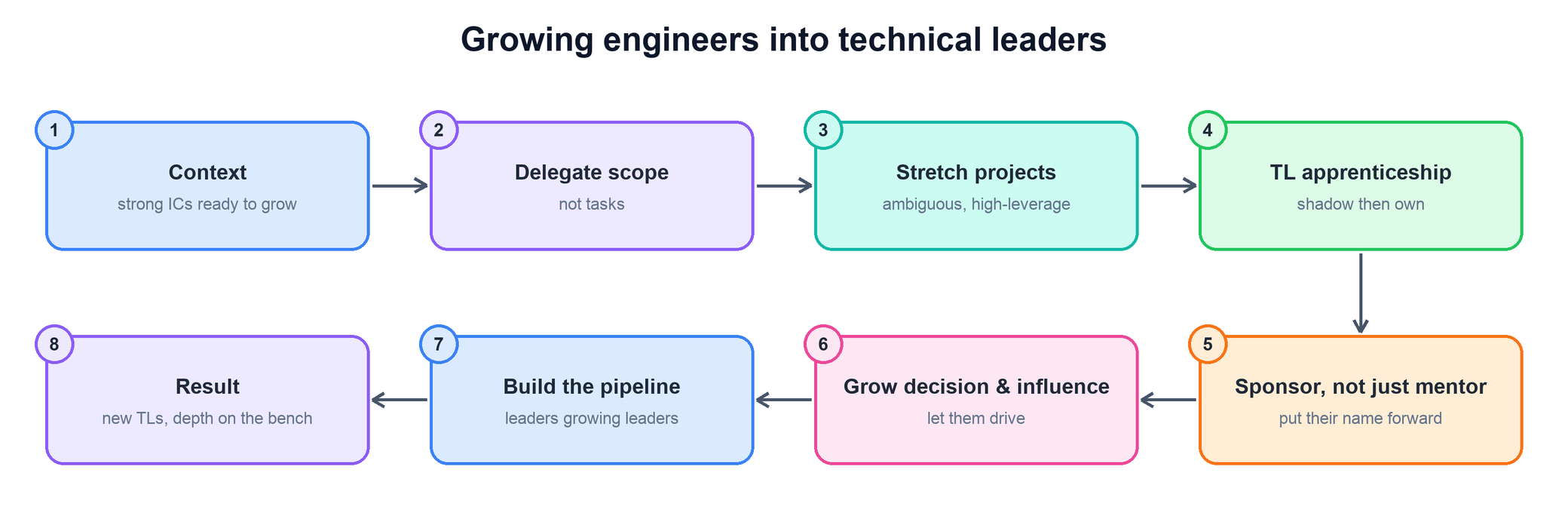
How to answer- Delegate scope, not tasks. Hand over an outcome to own — “get the migration to launch” — not a checklist of steps. Scope forces the decision-making and tradeoffs that grow a leader; tasks just fill a queue.
- Use stretch projects. Deliberately assign work slightly beyond someone’s current level, with a safety net, so they grow into the next level by doing it rather than waiting to be promoted first.
- Run a tech-lead apprenticeship. Let them shadow a TL, then co-lead, then own — a gradual transfer of the leadership surface (design direction, unblocking, cross-team representation) with you as backstop.
- Sponsor, don’t just mentor. Mentorship is advice; sponsorship is spending your capital — putting their name forward for the visible project, the design-review spotlight, the promotion case — when they aren’t in the room.
- Grow decision-making and build the pipeline. Push decisions down and resist rescuing too early, so they build judgment and influence; then make growing others part of their job, so the pipeline compounds and you’re producing leaders who produce leaders.
- Willingness to give away the best work — scope, not tasks.
- A clear grasp of sponsorship vs mentorship, and evidence you sponsor.
- Stretch and apprenticeship as deliberate capability-building, not sink-or-swim.
- Decision-making pushed down, with the restraint not to rescue too early.
- A pipeline mindset — measured by the leaders you produce, not your own output.
A worked example (CARL)
Context. On Ads Events Infra I had a strong senior engineer — call her P — who was excellent technically but boxed in: she executed brilliantly on work others scoped, but hadn’t yet led a cross-team effort, driven a design others rallied behind, or grown anyone. She was ready for the tech-lead step but had no track record to make the case, and I was the bottleneck — I was still holding the most interesting architectural work myself. Meanwhile the team had a looming multi-quarter effort: re-architecting the storage tiering for the events pipeline, which touched two other teams and had real ambiguity. It was exactly the kind of work I’d normally have kept.
Actions. I decided to make that re-architecture P’s vehicle to grow, and I was deliberate about how. First, I delegated the scope, not the tasks: I framed it as “you own getting the events pipeline onto a tiering design that hits our throughput and cost goals without regressing freshness” — an outcome with hard ambiguity — rather than handing her a spec to implement. I explicitly did not tell her the design; the design was hers to figure out. Second, I set up a tech-lead apprenticeship structure around it: for the first month she co-led with me in the room, watching how I ran the design review and handled the cross-team negotiation; then I progressively stepped back until she was running it and I was just a backstop she could pull in. Third — and this is the part I think mattered most — I sponsored her, not just mentored her. Mentoring was the weekly 1:1 where I coached her through tradeoffs. Sponsoring was different: I put her name forward to represent the effort directly to the two partner teams’ leads, I had her present the design at the org-level review instead of presenting it myself, and when the effort came up in leadership calibration I made the explicit case for her readiness with evidence. I spent my capital to make her visible. Fourth, I grew her decision-making by resisting the urge to rescue — when she hit a hard call on the freshness tradeoff, I asked questions instead of giving the answer, and let her make and own a decision I might have made differently (it turned out well; even if it hadn’t, the reversible ones are how you learn). I only held the line on the genuinely one-way risks. Fifth, I made growing others part of her remit: I had her bring a mid-level engineer onto the effort as her own apprentice, so she started building the next layer of the pipeline while I built her.
Results. P drove the re-architecture to launch over three quarters — it hit the throughput and cost targets and held the freshness SLA. She was promoted to the tech-lead level that cycle, with the effort as the centerpiece of the case, and the design-review and cross-team work I’d sponsored gave her the visible track record she’d been missing. The mid-level engineer she mentored on it grew into owning a subsystem. And I got a durable multiplier back: I was no longer the bottleneck on architectural work, which freed me for higher-leverage things. Over the following year, two more engineers on the team stepped into tech-lead roles, partly because P was now producing them too.
Learnings. The hardest and most important move was giving away work I wanted to do myself. My instinct was to keep the interesting architecture; the leverage came from handing it over as scope and backing it with sponsorship. The lesson: mentorship grows skills, but sponsorship grows careers — and a leader is measured not by what they build but by the leaders they build. Delegating scope (not tasks) and resisting the rescue are what turn a strong IC into someone who can carry ambiguity.
Common follow-ups
What’s the difference between mentorship and sponsorship?
How to answer- Mentorship is advice; sponsorship is action. A mentor tells you how to navigate; a sponsor spends their own capital to put you in the room and forward for opportunities.
- Sponsorship happens when they’re not there. Advocating for someone in calibration, staffing them on the visible project, letting them present instead of you — that’s the career-making lever.
- Both matter, but sponsorship is scarcer. Many managers mentor; the differentiated leaders also sponsor, and they sponsor deliberately, not just their favorites.
- Sponsor equitably. Watch that sponsorship goes to the capable, not just the visible or the similar — it’s a powerful equity lever when used consciously.
How do you delegate without abdicating — or micromanaging?
How to answer- Delegate the outcome, agree the guardrails. Be clear on the goal, the constraints, and the checkpoints; leave the path to them.
- Match support to their level. More scaffolding on the first stretch, less each time — the apprenticeship model of shadow, co-lead, own.
- Stay a backstop, not a driver. Be available for the hard calls without taking the wheel; presence, not control.
- Resist the rescue. Let them own reversible mistakes — that’s where judgment is built; only intervene on genuine one-way-door risk.
How do you grow someone in deep-domain expertise, like distributed systems?
How to answer- Pair them with hard, real problems. Depth comes from owning genuinely hard systems work — a consistency, sharding, or failure-mode problem — not from courses alone.
- Connect them to depth. Pair with a domain expert, route them into the design reviews and postmortems where the hard tradeoffs are debated.
- Teach through incidents and design. Postmortems and design docs are the highest-density lessons in distributed systems — have them lead the analysis.
- Give room to go deep. Depth needs sustained focus on one area; protect their time from being spread thin across everything.
How do you build a leadership pipeline, not just one leader?
How to answer- Make growing others part of the job. Once someone becomes a TL, their remit includes producing the next one — leaders growing leaders is how a pipeline compounds.
- Spread the stretch opportunities. Distribute the high-leverage, visible work deliberately rather than always to the same person.
- Track the bench. Know who’s next for each critical role, and close the readiness gaps before you need them.
- Measure yourself by output-of-others. A team that keeps producing leaders after you leave is the real evidence you built a pipeline, not a dependency.
- Perf / calibration records — pull the promotions and level changes of the people you grew, and your sponsorship case for them.
- GSD — pull the stretch project scoped as an outcome you delegated, and the leadership surface (design, cross-team) they owned.
- 1:1 notes — pull the growth plan and the coaching-vs-rescuing decisions over time.
- Design-review docs & Phabricator — pull evidence the person led the design and drove decisions, not just implemented them.
- Eng-satisfaction surveys — pull the growth and career-development signal from your reports.