Delegating Without Abdicating
Final Prep · People Management — you handed a critical, abstract architectural initiative to a tech lead and realized midway that they were drowning; how you step back in without micromanaging or demoralizing them.
This is the hardest thing about delegation: the recovery. A weak answer either abdicates — “I trusted them, so I stayed out of it” while the initiative slid off a cliff — or overcorrects into a takeover that solves the project and destroys the person’s growth and confidence. The interviewer wants to see that you delegated the outcome with clear guardrails, that you had lightweight checkpoints that let you notice trouble early, that you can read the signals of someone drowning, that you diagnose the real cause before you act, and above all that you can step back in as a partner rather than a rescuer — helping them regain footing and leaving them the win. Answer in CARL shape (Context, Actions, Results, Learnings), with most of your words on the actions.
What this question is really testing
Two things. First, your model of delegation: do you understand that delegating an outcome is not the same as disappearing, and that the manager stays accountable even when the tech lead is responsible? The abdication failure — handing off and going dark until the deadline — is what the interviewer is probing for. Second, whether you can intervene without doing damage: the moment you realize someone is drowning, the easy move is to take the work back, which fixes the quarter and quietly tells your best people you don’t trust them. The signal they want is a leader who re-engages with enough support to unblock and enough restraint to preserve ownership, learning, and dignity.
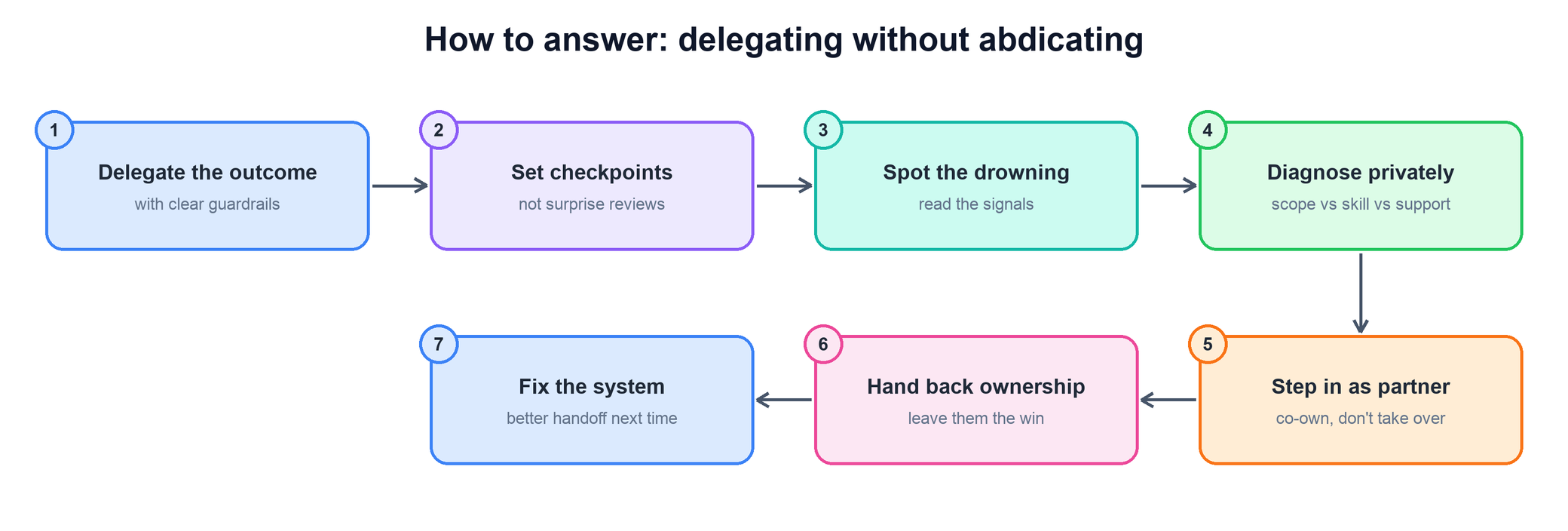
How to answer- Delegate the outcome, not the recipe — with guardrails. Hand over the goal and the constraints and let them own the how; but be explicit up front about the non-negotiables, the decision rights, and when to pull you in, so autonomy has a frame.
- Build checkpoints so trouble surfaces early. Set a lightweight cadence — milestones, a design review, regular 1:1s — that lets you see progress and risk without hovering, so “drowning” shows up as a signal, not a deadline miss.
- Read the signals and diagnose before you act. Slipping updates, vagueness where there used to be clarity, avoidance, expanding scope — treat these as data, then figure out privately whether the real problem is unclear scope, a skill gap, or missing support, because each has a different fix.
- Step in as a partner, not a rescuer. Re-engage with them — help decompose the ambiguity, pair on the hardest architectural call, remove the organizational blockers — rather than taking the keys; protect their standing with the team and never intervene in a way that reads as a demotion.
- Hand ownership back and fix the system. Once they have footing, deliberately step back out and leave them the win; then learn from it — was the initiative over-scoped for the level, was the handoff too thin — so the next delegation is set up to succeed.
- Delegation of outcomes with guardrails — not abdication, not a recipe.
- Checkpoints that surface risk early rather than at the deadline.
- Diagnosis before intervention — scope vs skill vs support.
- Re-engaging as a partner who preserves ownership and dignity.
- Handing the win back, plus a systemic fix so it doesn’t recur.
A worked example (CARL)
Context. On the Ads Events storage team I handed a genuinely hard, abstract initiative — re-architecting a core piece of our storage admission-control path — to a strong senior engineer, T, who I was intentionally stretching toward tech-lead scope. It was the right growth bet: high-impact, ambiguous, exactly the kind of problem that builds a lead. About a third of the way in I realized he was drowning. The problem was, on reflection, over-scoped for a first ambiguous initiative, and he’d gone quiet in a way that was out of character.
Actions. Because I’d set up checkpoints at handoff — a design milestone and our regular 1:1 — I caught it as a signal rather than at a blown deadline. The tells were clear: his updates had gone vague where he’d normally be crisp, the design doc kept getting reorganized without converging, and he was avoiding the hardest architectural decision rather than making it. My first move was diagnosis, not rescue, and I did it privately so nothing read as a public loss of confidence. In our 1:1 I didn’t interrogate the status; I asked where he felt stuck, and it came out that the problem wasn’t skill — he was very capable — it was that the ambiguity was so large he couldn’t find a place to stand, and he was reluctant to admit he was underwater on a stretch assignment he badly wanted to nail. That diagnosis changed everything: the fix was scoping and support, not taking the work back. So I stepped in as a partner. We spent a session together decomposing the giant ambiguous problem into a sequence of concrete decisions, and I explicitly re-scoped the initiative into phases so there was a reachable first milestone instead of one intimidating monolith. On the single hardest architectural call — a durability-versus-latency tradeoff — I paired with him as a thought partner, but I was careful to let him make and own the decision rather than making it for him. I also cleared the organizational blockers that were his to escalate but not his to solve, like getting time from a partner team. Then, deliberately, I stepped back out: I made clear it was still his initiative, I didn’t insert myself into his updates or his standing with the team, and I let him carry it. Throughout I protected his dignity — none of this was visible to the team as a rescue, and I framed the re-scoping as a normal engineering decision, not a bailout.
Results. T regained his footing quickly once the problem was decomposed and phased. He landed the first phase on the re-scoped timeline, made the hard durability tradeoff himself and defended it well in design review, and drove the full re-architecture to completion over the following two quarters. Just as important, he came out of it more confident and genuinely more capable at handling ambiguity — which was the whole point of the stretch — and he went on to lead larger initiatives. The initiative succeeded and the person grew, rather than one at the expense of the other.
Learnings. The first lesson was on me: I under-scaffolded a first ambiguous assignment. A stretch is only fair if the ambiguity is sized to what the person can find purchase on, and phased milestones aren’t training wheels — they’re how you make a huge problem tractable. The second: the instinct to take the work back is almost always wrong, because it fixes the quarter and costs you the engineer’s growth and trust. Stepping in as a partner and then deliberately stepping back out is harder and slower than rescuing, but it’s the only version that leaves you with a stronger leader at the end.
Common follow-ups
How did you know they were struggling and not just quiet?
How to answer- Watch for a change from their baseline. Vagueness where they’re normally crisp and avoidance of the hard decision are stronger signals than raw pace.
- Use the checkpoints you set. A design milestone or 1:1 that isn’t converging surfaces trouble long before a deadline does.
- Ask, don’t assume. Open with “where are you stuck?” rather than a status interrogation, so the real blocker can surface safely.
- Read the doc, not just the update. Circular reorganizations and unmade decisions in the artifact reveal drowning that a green status hides.
How do you step in without demoralizing them?
How to answer- Keep it private and framed as support. Diagnose one-on-one so nothing reads as a public loss of confidence.
- Partner on the problem, don’t take the keys. Decompose and pair on the hard call, but let them make and own the decision.
- Protect their standing. Don’t insert yourself into their updates or their relationship with the team; keep it their initiative visibly.
- Name it as normal. Frame re-scoping as ordinary engineering judgment, not a bailout, so the stretch stays a stretch.
How do you decide whether to re-scope versus coach versus reassign?
How to answer- Match the fix to the diagnosis. Unclear scope calls for decomposition and phasing; a skill gap calls for pairing and coaching; missing support calls for unblocking.
- Re-scope when the problem is too big, not the person too small. Phasing an over-large initiative is usually kinder and more effective than pulling it.
- Reassign only as a last resort. Reserve it for a genuine fit or timing mismatch, and do it in a way that doesn’t brand the person as having failed.
- Protect the outcome and the person together. If the initiative is truly critical and time-bound, add help around them before you consider removing them from it.
How do you delegate the next thing differently?
How to answer- Size the ambiguity to the person. Give a first ambiguous assignment a reachable first milestone instead of one intimidating monolith.
- Make guardrails and check-ins explicit at handoff. Agree up front on decision rights, non-negotiables, and when to pull you in.
- Normalize asking for help. Set the expectation that surfacing a blocker early is the job, not an admission of failure.
- Fix the systemic gap. If the handoff was too thin, improve how the team scopes and hands off stretch work generally.
- 1:1 notes — pull the diagnosis conversation and the shift from vague to crisp updates that told you they were stuck.
- Design doc / review history — pull the non-converging revisions and the eventually-owned architectural decision as evidence of the arc.
- GSD — pull the original scope, the re-scoped phased milestones, and the eventual completion.
- Perf / growth records — pull the tech-lead stretch goal and the capability growth the initiative was meant to build.
- Oncall / reliability dashboards — pull the impact of the landed re-architecture on the admission-control path to close the loop on outcome.