Reviewing a Security-Critical Change
The interviewer hands you a diff for a service that moves money and asks “what's missing?” The senior answer is a checklist you run, not a vibe you have.
This is the depth question in the code-review track. You're handed a pull request for a microservice that handles secure transactions — a payments path, a consent write, a credential exchange — and asked what a senior reviewer would flag. The trap is to comment on style and a missing null check and stop. The signal is that you run the change through a repeatable security-and-correctness checklist, name the classes of risk that would cause a SEV or a breach, and then describe how you'd deliver that feedback so it lands and the diff still ships. What follows is the checklist a senior reviewer runs, plus a wrong-versus-right snippet, plus how to give the feedback.
What this question is really testing
Whether you have an internalized threat model for code that touches money, secrets, or user data — and the discipline to apply it the same way every time rather than relying on catching something clever in the moment. The interviewer wants to hear that you review for the classes of failure that hurt (a breach, a double-charge, a leaked secret, a data-corruption SEV), that you weight the failure and error paths as heavily as the happy path, and that you can prioritize: what actually blocks the land versus what's a follow-up. They're also listening for whether you'd deliver a security block without shaming the author, because a reviewer who's feared gets routed around.
How to answer- Start with the threat model, not the code. Say out loud what this service protects — money movement, credentials, PII — and who the adversary is. That framing is what makes the rest of the checklist purposeful rather than a laundry list.
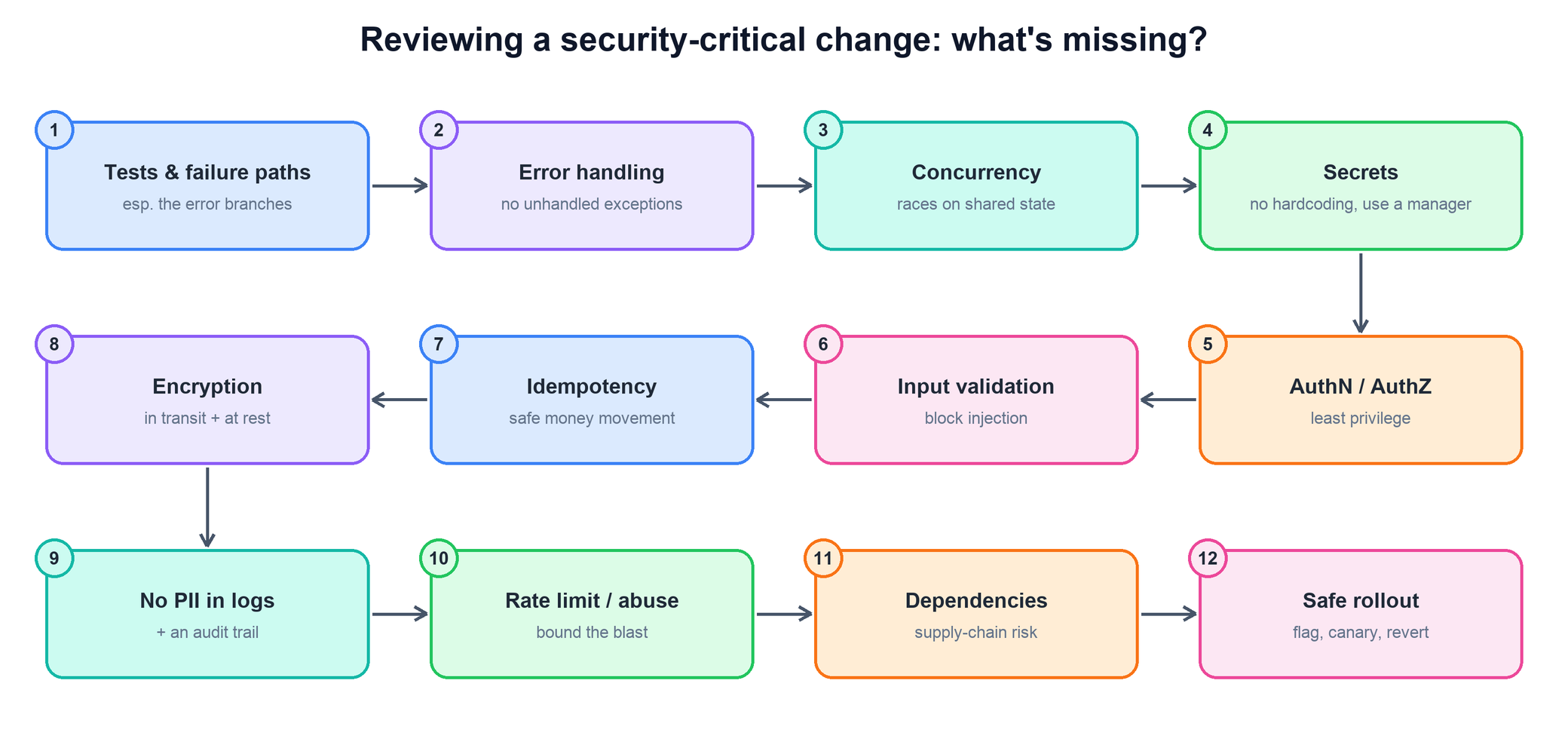
- Run the checklist and name the classes. Missing tests on the failure paths; unhandled exceptions and error paths; races and concurrency on shared state; secrets handling; authn/authz; input validation and injection; idempotency; encryption; PII in logs and an audit trail; rate limiting and abuse; dependency and supply-chain risk; and a safe rollout. Group them — don't just recite.
- Weight the failure paths. Most bugs in a transaction service hide in the error branch: the retry that double-charges, the exception that leaves a half-written record, the timeout with no compensation. Say explicitly that you review the unhappy paths hardest.
- Separate blocking from follow-up. A hardcoded secret or a missing authz check blocks the land; a metric you'd like on the fallback branch is a fast-follow. Be explicit, so the author knows exactly what stands between the diff and green.
- Show how you'd give the feedback. Lead with the risk and the reasoning, link the standard or a past SEV, and offer the fix — “this reads the key from an env var; route it through the secrets manager, here's the pattern” — so the block is a path forward, not a wall.
- A threat model stated first, so the review is purposeful, not a checklist recital.
- The high-severity classes named — secrets, authz, injection, idempotency — not just tests and null checks.
- The failure and error paths reviewed as hard as the happy path.
- Clear blocking-versus-follow-up prioritization.
- Feedback framed to teach and unblock, not to shame — a security reviewer people want, not avoid.
The checklist a senior reviewer runs
Group your findings the way you'd group them in the review so the author can act on them. Everything above the fold blocks a land; the operational hardening is where you separate must-fix from fast-follow.
| Area | What you look for | Why it’s here |
|---|---|---|
| Tests & failure paths | Unit and integration tests that exercise the error branches, retries, and partial failures — not just the happy path | The bugs that hurt live in the paths no one tested |
| Error handling | No unhandled exceptions; no bare except; errors surfaced, not swallowed; resources released on the failure path | A swallowed error in a money path is a silent data bug |
| Concurrency | Races on shared mutable state; check-then-act on balances; correct locking or an atomic compare-and-set | Two concurrent requests must not both spend the same funds |
| Secrets & credentials | No hardcoded secrets or keys; pull from a secrets manager; least-privilege scopes; rotation possible | A committed secret is a breach waiting in git history |
| AuthN / AuthZ | Caller is authenticated and authorized for this resource; no missing object-level checks (IDOR) | Authn without per-object authz is the classic escalation |
| Input validation & injection | Validate and bound all external input; parameterized queries; no shell string-building; no unsafe deserialization | SQL, command, and deserialization injection all start here |
| Idempotency | Money movement carries an idempotency key; a retry or duplicate delivery cannot double-apply | At-least-once delivery means retries will happen |
| Encryption | TLS in transit; sensitive fields encrypted at rest; correct algorithms, no home-rolled crypto | Transactions and PII must be protected on the wire and on disk |
| PII in logs & audit | No card numbers, tokens, or PII in logs or error messages; a tamper-evident audit trail of who did what | Logs leak, and money movement needs a forensic record |
| Rate limiting & abuse | Per-caller limits, bounded retries with backoff, and abuse/fraud guards on the endpoint | An unbounded money endpoint is a fraud and DoS surface |
| Dependencies | New libraries vetted, pinned, and scanned; no unmaintained or typo-squatted packages | Supply-chain risk enters through a one-line import |
| Safe rollout | Behind a gate/flag; canary or staged ramp; a fast, tested rollback | You want to turn a bad change off in minutes, not redeploy |
Wrong versus right
The two anti-patterns you flag most often on a transaction path are a hardcoded credential and an unchecked, non-idempotent charge. Here's what you comment on, and the fix you offer alongside the block.
What you'd block# WRONG: hardcoded secret, unchecked exception, no idempotency
API_KEY = "sk_live_9f3a2b7c1d4e" # secret in source → leaks via git history
def charge(user_id, amount):
conn = payments.connect(API_KEY)
# SQL built by string interpolation → injection
row = conn.query("SELECT balance FROM acct WHERE id = " + user_id)
# check-then-act race + no retry guard → double-charge
if row["balance"] >= amount:
conn.debit(user_id, amount) # raises on timeout; nobody catches it
logging.info("charged %s for %s card=%s", user_id, amount, row["card"])
# ^ PII (card) in logs; no audit record; no authz check on user_id# RIGHT: secrets manager, handled errors, idempotent, authorized, no PII
def charge(caller, user_id, amount, idempotency_key):
if not authz.can_debit(caller, user_id): # per-object authz
raise PermissionError("not authorized for account")
api_key = secrets_manager.get("payments/api_key") # least-privilege, rotatable
try:
with payments.connect(api_key) as conn:
# parameterized query + atomic conditional debit → no race
result = conn.debit_if_sufficient(
account_id=user_id, amount=amount,
idempotency_key=idempotency_key, # retry-safe
)
except PaymentTimeout as err:
audit.record("charge_timeout", user_id, amount) # forensic trail
raise ChargeFailed("payment provider timeout") from err # handled + chained
audit.record("charge_ok", user_id, amount)
logging.info("charged account", extra={"user_id": user_id, "amount": amount})
# ^ no card / PII in logs; structured context only
return resultCommon follow-ups
You have limited time — what do you check first?
How to answer- Triage by blast radius. Secrets, authz, and injection first — each is a breach or escalation on its own.
- Then correctness of money movement. Idempotency and the race on shared balance state, because those cause silent financial loss.
- Defer the polish. Log hygiene and an extra metric are fast-follows; don't spend the security block on them.
How do you review the parts you're not a security expert in?
How to answer- Review what you can judge. Tests, error paths, input handling, and clear intent don't need a specialist.
- Pull in a security reviewer. Route crypto and threat-model questions to the security team or a code-owner rather than rubber-stamping.
- Turn gaps into questions. “What stops a replay here?” often surfaces a real hole and teaches you the area.
The author says the missing tests will come in a follow-up diff. Do you block?
How to answer- Block tests on the failure paths. For a money path, the error-branch tests are part of the change, not a follow-up.
- Be pragmatic on the rest. A non-critical happy-path test can land as a fast-follow with a tracked task.
- Anchor on the standard. “Our bar is tested failure paths for transaction code” makes it the policy talking, not you.
How do you deliver a hard security block without alienating the author?
How to answer- Lead with the risk and the why. “This can double-charge on retry” beats “this is wrong.”
- Offer the fix. Link the secrets-manager pattern or the idempotency helper so the block is a path forward.
- Separate person from code. Praise the good parts; make clear the bar is the arbiter, not your taste.
- Phabricator — the review thread where you blocked on a secret, an authz gap, or a non-idempotent charge, and the fix you proposed.
- SEV / postmortems — the incident where a missed check (double-charge, leaked secret, injection) validated a class you now always review for.
- Security review tooling — the static-analysis, secret-scanning, or dependency-scan finding that backed your comment.
- Launch / GK gating — the flag, canary, or gated rollout that let you ship the change reversibly.
- Scuba / Unidash — the metric (error rate, duplicate rate, auth-failure rate) that turned a security opinion into evidence.
- The internal wiki — the security review checklist or transaction-code standard you followed or set.
- GSD — the project or milestone the change belonged to, to show the stakes and the outcome.