The Five Dysfunctions of a Team — High-Level Learnings
A practical, high-level summary of the ideas in The Five Dysfunctions of a Team: A Leadership Fable by Patrick Lencioni — why teams that look fine on paper quietly fail, and how to fix them one layer at a time.
Most teams do not fall apart because the people are incompetent or the strategy is wrong. They fall apart because a handful of very human behaviors — guarding your image, avoiding an awkward argument, staying quiet when a peer drops the ball — compound into a group that cannot pull in the same direction. Lencioni tells the story through a fable about a struggling executive team, but the model underneath is what matters: five dysfunctions that stack on top of one another, each one made possible by the one below it. What follows is a summary of that model in my own words, meant as a study aid — the full book is worth reading for the story and the exercises behind each idea.
Contents
1. The model
The central idea is a pyramid of five dysfunctions, each resting on the one beneath it. They are not five separate problems to attack in any order — they are a single chain of cause and effect. A crack at the base propagates all the way up, which is why the model is fixed bottom-up: you cannot get real accountability if there was never real commitment, and you cannot get commitment without honest conflict, and you cannot have honest conflict without trust. Build the base and each higher layer becomes reachable.
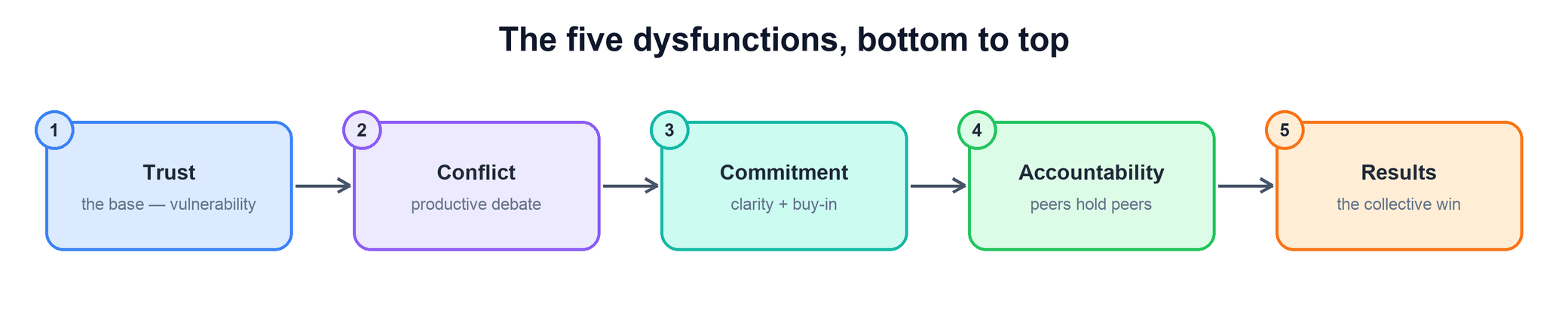
Stated as the five dysfunctions, from the base to the peak:
- Absence of Trust — the foundation; people won’t be vulnerable with each other.
- Fear of Conflict — without trust, teams avoid honest debate.
- Lack of Commitment — without debate, people don’t truly buy in.
- Avoidance of Accountability — without buy-in, peers won’t hold each other to the standard.
- Inattention to Results — without accountability, people drift toward their own goals over the team’s.
2. Dysfunction 1 — Absence of Trust
Trust is the base of the pyramid, but the book means a very specific kind of trust: vulnerability-based trust. This is not the ordinary, predictive trust of “I can rely on you to do what you said.” It is the willingness to be genuinely exposed in front of the team — to admit a mistake, name a weakness, ask for help, or say “I don’t know” without fear it will be used against you. On a trusting team, no one wastes energy managing their image.
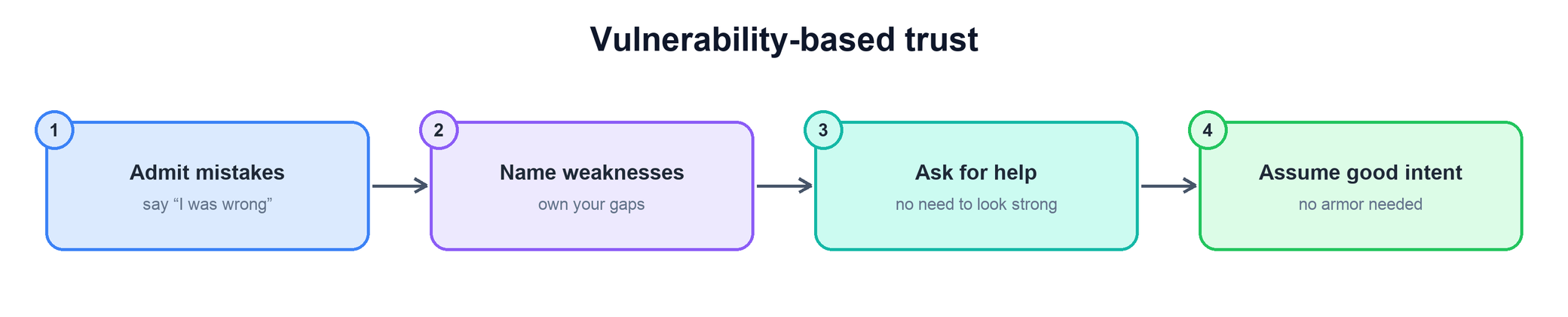
Symptom: people conceal weaknesses and mistakes, hesitate to ask for help, dread meetings, and hold back honest opinions to avoid looking bad. Everyone is polite and nothing is real.
Fix: the leader has to go first — modeling vulnerability by openly owning their own mistakes and limitations sets the permission for everyone else. Structured exercises help too: personal-history sharing, honest strengths-and-weaknesses discussions, and consistent follow-through so people learn that being open is safe rather than costly.
3. Dysfunction 2 — Fear of Conflict
Teams that lack trust are incapable of unfiltered, passionate debate about ideas. Instead they settle for artificial harmony — a surface calm where everyone nods in the meeting and then relitigates the decision in the hallway afterward. The crucial distinction is between productive ideological conflict (a hard argument about the best answer) and destructive interpersonal conflict (attacks on people). Healthy conflict is about ideas and stays respectful; it is the fastest way to a good decision and it is a sign of a strong team, not a broken one.
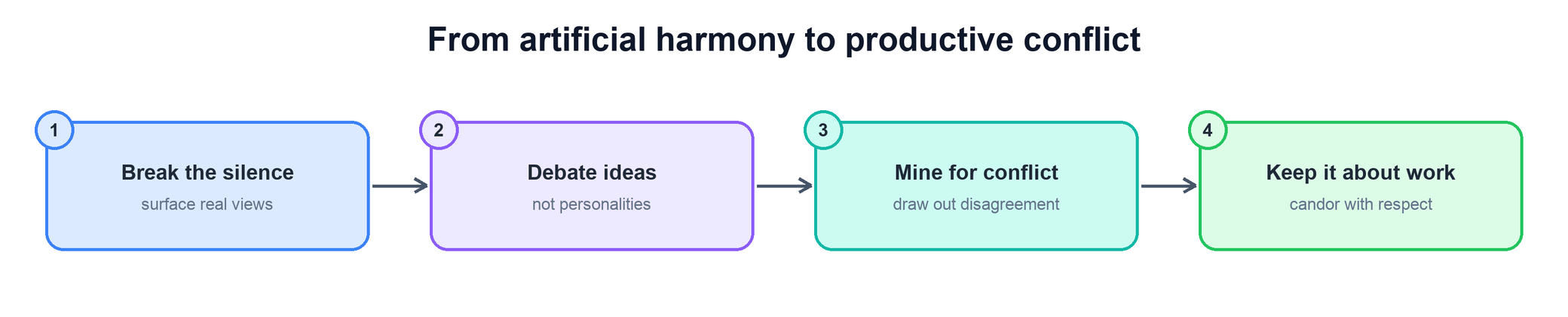
Symptom: boring, guarded meetings; important topics avoided; back-channel politics and personal attacks replacing open debate; decisions made without the friction that would have improved them.
Fix: legitimize conflict by naming it as a good thing and expecting it. Someone can act as a “miner of conflict” who deliberately draws out buried disagreements, and real-time permission (“this is exactly the debate we need”) reassures people that the discomfort is healthy and worth pushing through.
4. Dysfunction 3 — Lack of Commitment
Without honest debate, people do not genuinely buy in — they may nod along, but they never truly commit. Commitment does not require consensus or certainty; it requires two things: clarity (everyone knows exactly what was decided) and buy-in (everyone was heard, so they can support the decision even if it wasn’t their first choice). This is the essence of “disagree and commit”: once your view has been genuinely aired and weighed, you get behind the decision fully, even if you argued against it.
Symptom: ambiguity about direction and priorities; endless second-guessing and revisiting of decisions; missed windows because the team waited for perfect certainty; a “fear of failure” that masquerades as caution.
Fix: close every discussion by explicitly restating the decision, who owns it, and the deadlines — then confirm everyone can commit. Cascade the message so the whole org hears the same thing. Deliberately favor clarity and closure over waiting for consensus or guarantees.
5. Dysfunction 4 — Avoidance of Accountability
When there was no real commitment, people have no firm standard to hold each other to — and so they don’t. The key insight here is that the most effective accountability is peer-to-peer, not just top-down from the manager. On a healthy team, peers call each other out on behaviors and results that hurt the group, precisely because they respect each other and share a clear standard. Waiting for the boss to be the sole enforcer is slow and breeds resentment.
Symptom: mediocrity tolerated; missed deadlines and low standards go unaddressed; resentment builds among the people who do meet the bar; the leader becomes the lone source of discipline.
Fix: make goals and standards public so everyone can see who owes what. Use regular, lightweight progress reviews and team rewards tied to collective outcomes so peers naturally lean on each other. The leader’s job is to be the backstop, not the first line — encouraging the team to police itself.
6. Dysfunction 5 — Inattention to Results
At the top of the pyramid is the ultimate failure: people putting something ahead of the collective results of the team. That something is usually individual ego and status (personal career, recognition) or the survival of their own sub-team (protecting their department’s budget, headcount, or turf) rather than the shared scoreboard. When every layer below has failed, there is nothing left to keep people focused on the one thing that actually matters — whether the team as a whole wins.
Symptom: the team stagnates and loses to competitors; results-oriented people leave; individuals chase personal or departmental wins; success is measured by titles and turf, not team outcomes.
Fix: keep the collective results visible and public — a small set of shared, outcome-based goals that the whole team is measured against. Tie rewards and recognition to team results rather than individual heroics, so that the group’s success is unambiguously everyone’s success.
7. Putting it together
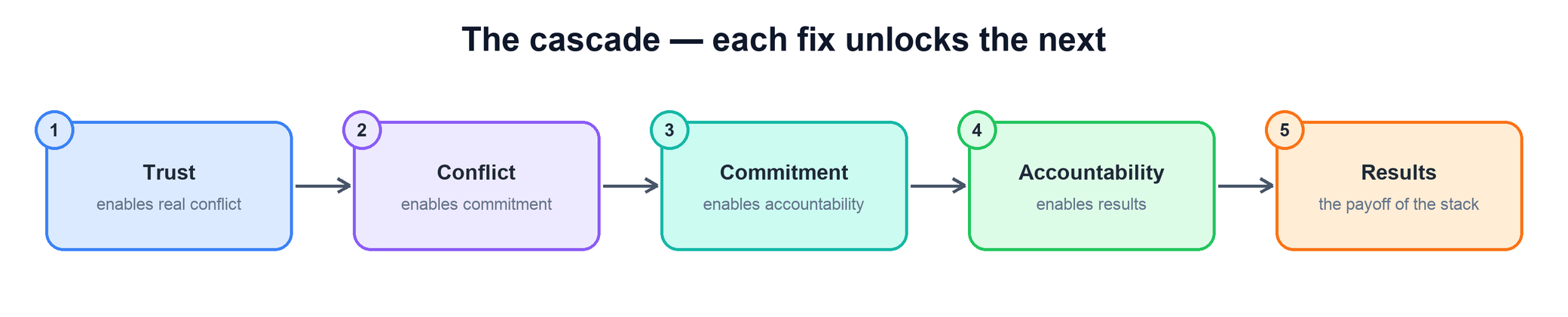
The power of the model is the cascade: each dysfunction is not just a problem in isolation, it actively enables the next one up. No trust makes fear of conflict inevitable; unaddressed conflict guarantees weak commitment; weak commitment removes the standard needed for accountability; and without accountability, attention to collective results collapses. Fix a lower layer and you unlock the one above it — which is why the model is always worked bottom-up.
| Dysfunction | What it looks like | The fix / behavior |
|---|---|---|
| Absence of Trust | People hide mistakes and weaknesses; everyone manages their image; no one asks for help. | Vulnerability-based trust — leader goes first, admit mistakes, share history, assume good intent. |
| Fear of Conflict | Artificial harmony in meetings; real debate happens in the hallway; back-channel politics. | Mine for conflict; legitimize passionate debate about ideas; keep it about work, never people. |
| Lack of Commitment | Ambiguity, endless revisiting of decisions, waiting for certainty; no real buy-in. | Clarity + buy-in; restate decisions and owners; “disagree and commit.” |
| Avoidance of Accountability | Low standards tolerated; missed deadlines ignored; only the boss enforces anything. | Peer-to-peer accountability; public goals and standards; regular progress reviews. |
| Inattention to Results | Ego, status, and sub-team survival beat team outcomes; the team stagnates. | Make collective results public; reward team outcomes over individual heroics. |
8. Applying it at work
The model maps cleanly onto the daily rhythms of an engineering team. A few concrete practices:
- Trust — use 1:1s and team offsites to build real relationships; leaders openly own their own mistakes and gaps so the team learns that vulnerability is safe.
- Conflict — run healthy design and architecture debates where the best argument wins; treat a hard technical disagreement as a good meeting, not a failed one.
- Commitment — use disagree-and-commit in planning; close every planning discussion by restating the decision, the owner, and the date, then confirm everyone can get behind it.
- Accountability — treat peer code review, design review, and on-call handoffs as peer-to-peer accountability, where teammates hold each other to the bar rather than waiting for the manager.
- Results — track team-level metrics (reliability, delivery, customer outcomes) and reward them over individual heroics, so the shared scoreboard is what everyone optimizes for.
9. Summary
The whole model reduces to a single chain: build trust, and honest conflict becomes possible; have real conflict, and genuine commitment follows; commit clearly, and peers can hold each other accountable; be accountable, and the team can finally focus on collective results.
| Layer | The one-line takeaway |
|---|---|
| Trust | Be vulnerable — admit mistakes and ask for help; the leader goes first. |
| Conflict | Debate ideas openly; artificial harmony is a warning sign, not a virtue. |
| Commitment | Clarity plus buy-in; disagree and commit, don’t wait for certainty. |
| Accountability | Peers hold peers to the standard, not just the boss. |
| Results | Put the team’s collective outcome ahead of ego, status, and turf. |