An Elegant Puzzle — High-Level Learnings
A practical, high-level summary of the ideas in An Elegant Puzzle: Systems of Engineering Management by Will Larson — the case for treating engineering management not as a series of heroic saves but as a set of systems you can observe, model, and gently steer.
The central move of this book is a reframe: the problems an engineering leader faces — overloaded teams, stalled projects, unclear careers, endless meetings — are not isolated fires to be fought one at a time. They are the visible output of underlying systems, each with its own stocks, flows, and feedback loops. Once you see the system, you can stop reacting and start looking for the small, durable change that shifts its behavior for good. What follows is a summary of the core ideas in my own words, meant as a study aid — the book is worth reading for the concrete playbooks and depth behind each one.
Contents
1. Management as systems thinking
The organizing idea of the whole book is that a leader should approach org problems the way a systems engineer approaches a distributed system: as stocks and flows connected by feedback loops, with a few high-leverage points where a modest push produces an outsized, lasting effect. A stock is something that accumulates — open roles, technical debt, unreviewed diffs, on-call fatigue. A flow is the rate that fills or drains it — hiring throughput, the rate you pay down debt, the rate work arrives.
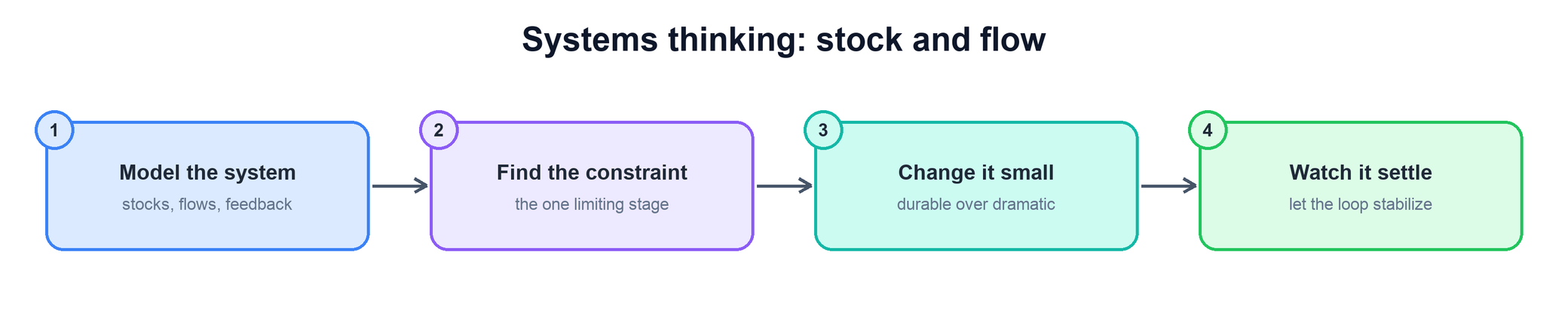
The payoff of this lens is that it pulls you away from heroics. A heroic save — the manager who personally clears the backlog over a weekend — changes the stock once and leaves the flow untouched, so the problem returns. A systems change — adjusting how work enters the team — alters the flow, so the improvement compounds and holds. The rest of the book is largely a catalog of these systems and the leverage points inside them.
2. Organizations & team sizing
Before you can tune a system you have to build a stable one, and the book is opinionated about shape. Teams work best at roughly six to eight engineers — large enough to own a real area, absorb on-call, and survive someone going on leave; small enough that a manager can actually know the work. Managers, in turn, do their best work with four to six reports: enough to justify a full-time manager, few enough to coach each person. The two rules that matter most are to keep teams stable (churn destroys the trust and context that make a team fast) and to keep them fully staffed before starting anything new, because an understaffed team spends all its energy just holding the line.
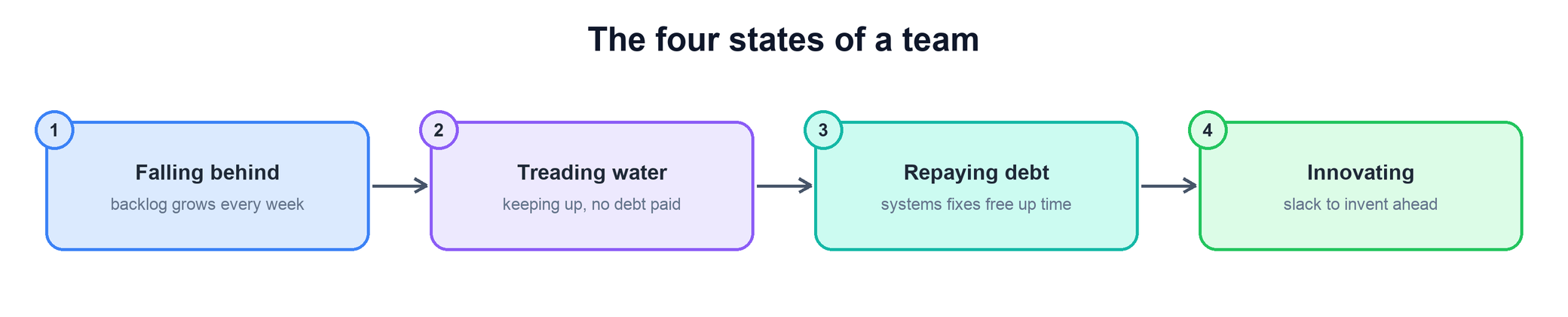
That last point leads to the book's most quoted model: at any moment a team sits in one of four states, and a leader's job is to know which state a team is in and make the one move that advances it.
| State | Symptom you'll see | The move to advance it |
|---|---|---|
| Falling behind | The backlog grows every week; the team can never catch up and morale sags. | Add people — hire until the team can at least keep pace with incoming work. |
| Treading water | The team keeps up with critical work but has no slack to fix root causes. | Consolidate effort onto a few problems whose fixes create durable time savings. |
| Repaying debt | Systems investments are underway and starting to free up real capacity. | Protect the time — hold the line on new commitments until the debt is paid. |
| Innovating | The team has genuine slack and is inventing ahead of demand. | Give away your slack — take on ambitious work or lend capacity to teams that are behind. |
The sequence is a ladder: you climb from falling behind to innovating one rung at a time, and the mistake most leaders make is trying to innovate while still treading water, which just drops the team back down.
3. Org design & growth
As an organization grows, its structure has to change with it, and the book treats org design as its own kind of engineering. The guiding question is always sizing for the work: does the shape of the org match the shape of the problems it owns? When a team grows past its effective size, you split it — but along a clean seam, so each new team owns a coherent area with as few cross-team dependencies as possible. When a small but important area has no owner, you gap-fill, temporarily stretching an existing team until it earns a team of its own.
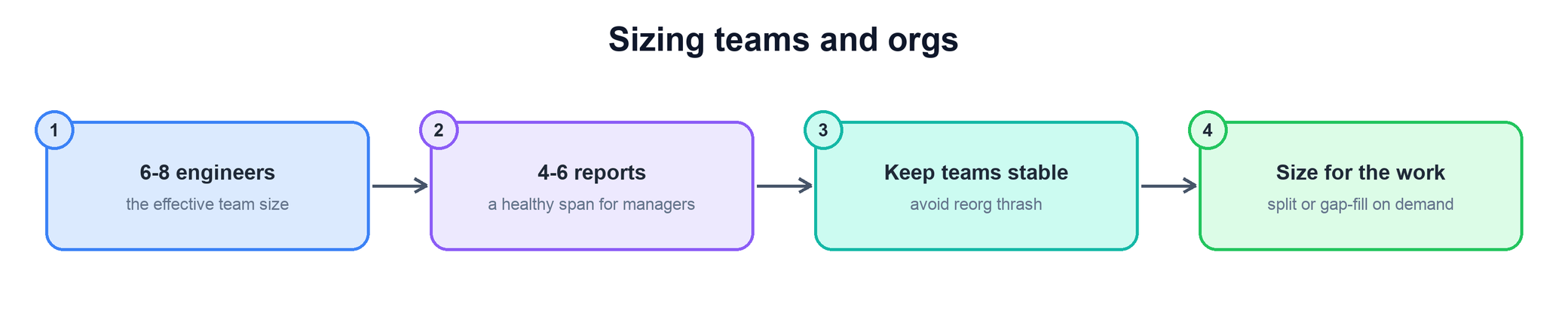
The strongest warning here is against reorg thrash. Reorgs are seductive because they feel like decisive action, but each one resets relationships, ownership, and momentum, and the cost is almost always underestimated. The book's counsel is to reorganize rarely and deliberately, to design for the org you'll have in a year rather than the one you have today, and to remember that a mediocre structure held stable usually beats a better structure that never settles.
4. Systems thinking in practice
This section makes the opening metaphor concrete by working real problems as stock-and-flow models. Take hiring: candidates flow through a funnel — sourced, screened, interviewed, offered, accepted — and the team's headcount is the stock at the end. If offers aren't converting, adding more sourcing at the top does nothing; the constraint is downstream. On-call load works the same way: incidents flow in, engineer energy is the stock that drains, and the fix is rarely "try harder" — it's reducing the inflow of pages or the toil each one costs.
Three habits fall out of modeling problems this way:
- Find the constraint. Every system has a single stage that limits the whole; improvements anywhere else are wasted until you address it. Locate that bottleneck before you spend energy.
- Prefer small, durable changes. A big dramatic intervention is hard to reason about and often overshoots. A small change to a flow, left to compound, is more predictable and far more likely to stick.
- Let the loop settle. Systems have delay. After a change, resist the urge to keep tweaking — give the feedback loop time to reach a new equilibrium so you can actually read the effect.
The mindset shift is from asking “what should I do about this today?” to asking “what property of the system produced this, and what one push changes that property?”
5. Controls: vision, strategy & metrics
If systems thinking is how you understand an org, controls are how you steer it: the small set of documents and signals that keep a growing organization aligned without you being in every room. The book is careful to separate two ideas that are constantly confused.
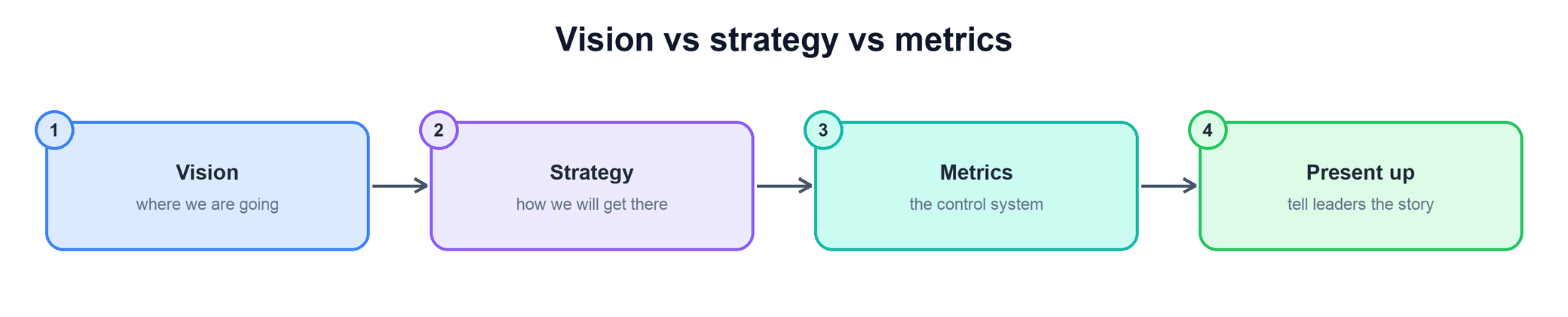
- Vision describes where we are going — an inspiring, durable picture of the future state, written so that a person on the team can use it to make a decision without asking. It should age slowly and rarely change.
- Strategy describes how we will get there — the concrete, opinionated set of choices and tradeoffs that turn the vision into a path. A good strategy diagnoses the real problem, picks a small number of bets, and is honest about what you are choosing not to do.
- Metrics act as a control system — the feedback that tells you whether the strategy is actually moving the vision closer, and lets the org self-correct without top-down intervention. The art is choosing metrics that capture the outcome you want, not the ones that are merely easy to count.
The book also treats presenting to leadership as a distinct skill and a control in its own right: lead with the conclusion, bring the data, name the decision you need, and tell a story leaders can act on. Done well, presenting up is how you convert your strategy into the air cover and resourcing that let it succeed.
6. Career & leveling
A large part of a leader's leverage is in growing people, so the book gives careers the same systems treatment. Leveling rubrics exist to make growth legible — a shared, written definition of what each level means, so expectations aren't a matter of taste and promotions aren't a surprise. From the rubric flow the practical artifacts: the promotion packet that documents impact against that bar, and the career narrative that frames someone's arc as a coherent story of increasing scope rather than a list of tickets closed.
Two pieces of pragmatic advice stand out. The first is the “run less software” posture: prefer boring, well-supported, off-the-shelf solutions over bespoke systems you'll have to maintain forever, because every custom thing is a long-term tax on the team. The second is the distinction between opportunity and snacking: it is tempting to fill your time with easy, satisfying, low-value work — “snacks” — because it feels productive, but real growth comes from deliberately taking on the harder, higher-leverage work even when it's uncomfortable. A leader's job is to steer both themselves and their reports away from snacking and toward genuine opportunity.
7. Process that scales
Process gets a bad name because most of it is added reactively and never removed. The book's stance is that good process is a system for making a growing org's work predictable, and it should be as light as it can be while still doing that job. A few recurring themes:
- Planning should match the horizon — enough structure to coordinate across teams and set expectations, not so much that it becomes theater. Plan at the altitude where the plan will actually be used.
- Saying no is a core skill, not a failure of teamwork. Every yes is a commitment of finite capacity; protecting the team's focus by declining low-value asks is how you keep it out of the “falling behind” state.
- Managing work in progress — limit how much is in flight at once. Too much concurrent work slows everything through context-switching and half-finished efforts; finishing beats starting.
- Meetings worth having — each recurring meeting should earn its place with a clear purpose and outcome. Kill the ones that don't, and design the ones that remain so people leave with decisions, not just updates.
8. Applying it at work
The most reusable moves for a tech lead or engineering manager, distilled:
- Diagnose the team's state first. Before acting, decide whether the team is falling behind, treading water, repaying debt, or innovating — and make only the move that state calls for.
- Model the problem as stocks and flows. For any recurring pain (hiring, on-call, review latency), draw the flow, find the single constraint, and push there instead of everywhere.
- Prefer small durable changes over heroics. Change the flow, not just the stock, so the fix compounds; then let the loop settle before touching it again.
- Keep teams stable and fully staffed. Resist the urge to reorg or start new work while a team is understaffed — you'll only push it down the ladder.
- Separate vision from strategy. Write down where you're going and the concrete bets for getting there; don't let one masquerade as the other.
- Use metrics as a control loop. Pick metrics that reflect the real outcome and let the org self-correct against them.
- Steer people toward opportunity, not snacks. Make growth legible with a rubric, and coach yourself and your reports toward the harder, higher-leverage work.
- Run less software and say no often. Prefer boring off-the-shelf solutions, and protect focus by declining low-value work.
9. Summary
The whole book reduces to a single discipline: see the system behind the symptom, then change it gently.
| Idea | The one-line takeaway |
|---|---|
| Management as systems thinking | Org problems are stocks, flows, and loops — find the leverage point, skip the heroics. |
| Team sizing | Six-to-eight engineers, four-to-six reports, stable and fully staffed. |
| The four states | Know if a team is falling behind, treading water, repaying debt, or innovating — and make that state's one move. |
| Org design | Size for the work, split on clean seams, and avoid reorg thrash. |
| Systems in practice | Find the constraint; prefer small durable changes; let the loop settle. |
| Vision, strategy, metrics | Vision is where, strategy is how, metrics are the control system. |
| Career & leveling | Make growth legible; chase opportunity, not snacks; run less software. |
| Process that scales | Keep process light, say no, limit work in progress, and only keep meetings that decide things. |