Crucial Conversations — High-Level Learnings
A practical, high-level summary of the ideas in Crucial Conversations: Tools for Talking When Stakes Are High by Joseph Grenny, Kerry Patterson, Ron McMillan, Al Switzler, and Emily Gregory — how to stay in honest, productive dialogue exactly when it is hardest.
Most of the moments that shape a career, a team, or a relationship are not the calm ones — they are the tense exchanges where opinions differ, the stakes are real, and emotions are running hot. The central promise of this book is that these moments are a learnable skill, not a personality trait: with a handful of tools you can hold onto candor and respect at the same time, so the conversation improves both the result and the relationship. What follows is a summary of the core models in my own words, meant as a study aid — the full book is worth reading for the examples and scripts behind each idea.
Contents
1. What makes a conversation "crucial"
A conversation turns crucial when three things line up at once: opinions differ, the stakes are high, and emotions are strong. A routine chat about lunch is none of these; a disagreement about a launch date with your director is all three. The problem is that these are exactly the moments we handle worst — the same fight-or-flight wiring that once helped us outrun predators now floods us with adrenaline and pushes blood away from the reasoning brain, so we default to attacking or avoiding right when we most need to think clearly.
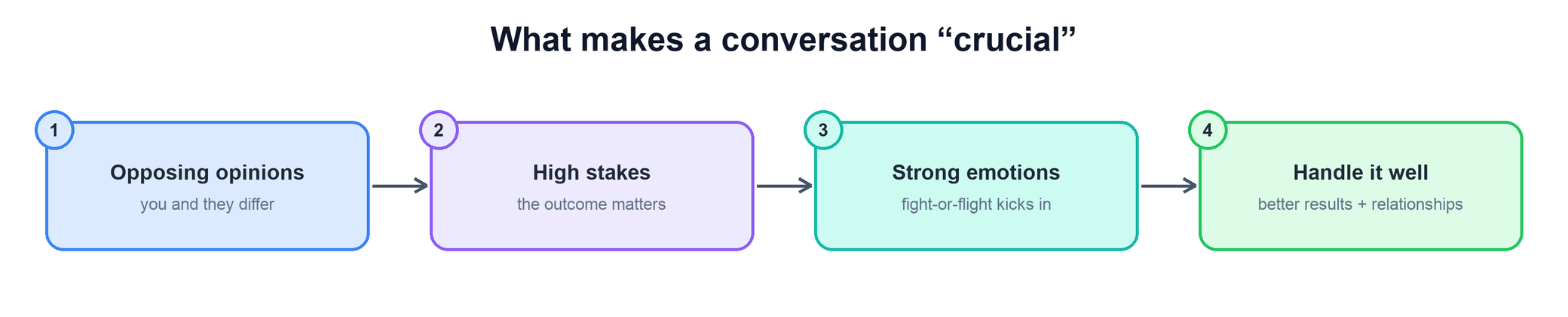
The book's core claim is that the people who get the best outcomes are not the ones who avoid these conversations or bulldoze through them — they are the ones who have learned to stay in dialogue under pressure. That skill is the subject of every chapter that follows.
2. The goal: a shared pool of meaning
The organizing metaphor is the pool of shared meaning. Each person enters a conversation with their own facts, stories, and feelings. Dialogue is simply the free flow of all that information into a common pool that everyone can see. The larger the shared pool, the smarter the decisions and the stronger the buy-in — because people commit to conclusions they helped shape, even ones they initially disagreed with.
When people hold back their real views (silence) or try to force yours out of the pool (violence), the pool shrinks, and both the decision and the commitment to it suffer. So the single most useful skill is not persuasion — it is making it safe enough that everyone is willing to add their meaning to the pool.
3. Start with heart
The first tool is internal: before you try to fix the other person, work on yourself. Start with heart means getting clear on what you really want — for yourself, for the other person, and for the relationship — and then refusing to lose that goal when things get tense.
Under pressure our motives quietly degrade: we start out wanting a good decision and end up wanting to win, to look right, to punish, or to keep the peace at any cost. Two habits keep you honest:
- Ask what you really want. Name the outcome you'd want if you were at your best — then let that steer your behavior, not the urge to score a point.
- Refuse the Fool's Choice. The Fool's Choice is the false either/or ("I can be honest or keep this relationship"). The skilled move is to look for the and — how do I say the hard thing and preserve respect? Believing an "and" exists is what makes you keep searching for it.
4. Learn to look
You cannot fix a conversation you don't notice going off the rails. Learn to look is the skill of watching two things at once: the content (what's being said) and the conditions (whether it is still safe). The moment safety drops, people stop contributing honestly — and they do it in one of two directions.
| Silence — withholding meaning | Violence — forcing meaning |
|---|---|
| Masking — sarcasm, sugar-coating, understating what you really think. | Controlling — cutting people off, dominating, forcing your view. |
| Avoiding — steering away from the real topic. | Labeling — putting people or ideas in a box ("that's just typical engineering"). |
| Withdrawing — going quiet, checking out, leaving the conversation. | Attacking — belittling or threatening to win. |
Learn your own "style under stress" — do you tend toward silence or violence when it gets hard? — because your first job in a crucial moment is to catch the shift early, before the pool drains.
5. Make it safe
When you notice safety has broken, step out of the content and rebuild safety first. You literally cannot make progress on the issue while the other person feels unsafe; nothing you say will land. Safety rests on two conditions, and each has a matching repair.
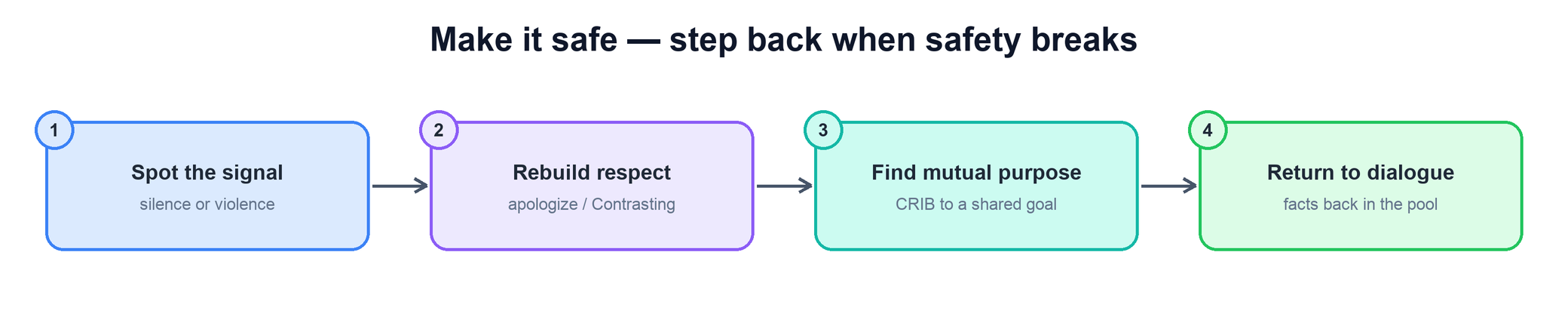
- Mutual Purpose — the other person needs to believe you are working toward a goal they care about too, not just your own agenda. When this is missing, people get defensive because they think you're playing a different game.
- Mutual Respect — the other person needs to feel you respect them. When this is missing, emotion takes over and the conversation becomes about defending dignity, not solving the problem.
Three tools restore these conditions:
- Apologize when you've genuinely done something that hurt safety — a sincere apology quickly rebuilds respect.
- Contrasting — a "don't/do" statement that fixes a misunderstanding: address what you don't mean ("I'm not saying your work is careless"), then affirm what you do ("I do want us to catch this class of bug before launch"). Contrasting is for repair, not softening — it puts the comment back in proportion.
- CRIB to a Mutual Purpose when you actually want different things:
| CRIB step | What it means |
|---|---|
| Commit to seek mutual purpose | Say out loud that you'll stay until you find a goal that works for both. |
| Recognize the purpose behind the strategy | Look past each side's demand to the why underneath it. |
| Invent a mutual purpose | If the whys still conflict, find a higher, shared goal you both serve. |
| Brainstorm new strategies | With a shared purpose set, generate options that meet everyone's real need. |
6. Master my stories
This is the psychological heart of the book. Between something happening and how you react, there is a hidden step: the story you tell yourself about what happened. The sequence is a loop the authors call the Path to Action: you see and hear something, you tell a story to explain it, that story creates a feeling, and the feeling drives how you act.
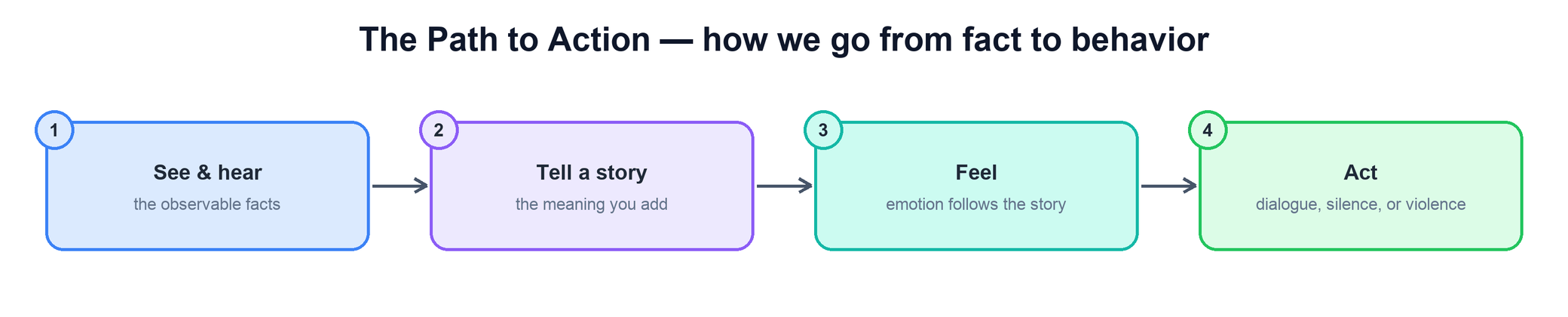
The powerful implication: you author your own emotions. Two people see the same terse code-review comment; one tells the story "they're helping me" and feels grateful, the other tells the story "they think I'm sloppy" and feels attacked. Because you wrote the story, you can rewrite it. The practical drill is to separate fact from story — strip your account back to what a camera would have recorded — and then watch out for three "clever stories" that let you off the hook:
| Clever story | The lie it tells | The question that breaks it |
|---|---|---|
| Victim — "It's not my fault" | Ignores your own role in the problem. | Am I pretending not to notice my part in this? |
| Villain — "It's all your fault" | Turns a reasonable person into a bad one. | Why would a reasonable, decent person do this? |
| Helpless — "There's nothing I can do" | Justifies giving up or going to silence/violence. | What should I do right now to move toward what I really want? |
Turning a clever story back into a useful one restores your agency — and usually softens the emotion enough to step back into dialogue.
7. STATE my path
Once you're clear-headed, you still have to say the hard thing. STATE is how to share a risky or unpopular view so it adds to the pool instead of triggering defensiveness. The first three letters are what you do; the last two are how.
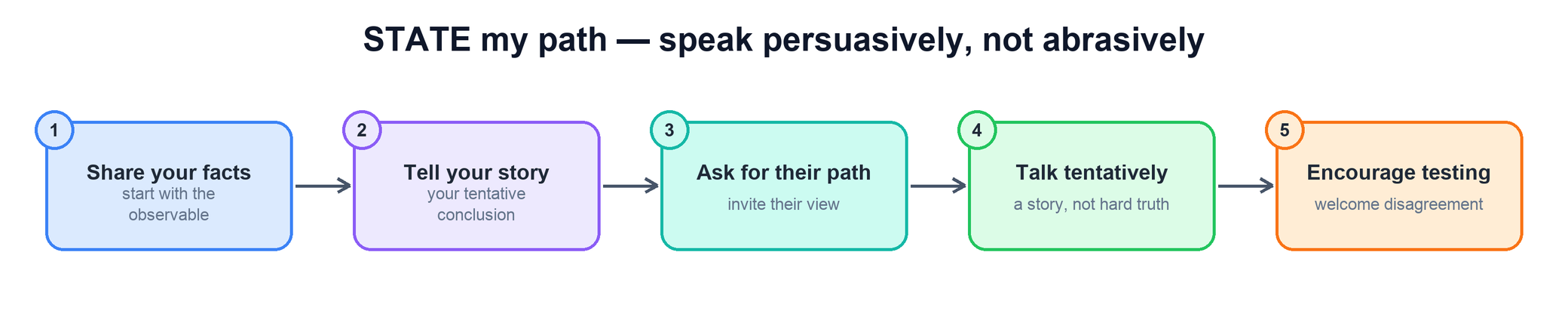
- Share your facts — start with the least controversial, most observable ground. Facts are the safest way to open.
- Tell your story — explain the conclusion you're starting to draw from those facts. This is where risk enters, so it follows the facts, not precedes them.
- Ask for others' paths — invite them to share their facts and stories, especially where they see it differently.
- Talk tentatively — state your story as a story, not as hard fact ("I'm starting to wonder if…"), so there's room for you to be wrong.
- Encourage testing — actively welcome disagreement; mean it when you ask someone to poke holes in your view.
8. Explore others' paths
Dialogue is two-way. When the other person is in silence or violence — holding back, or lashing out — your job is to make it safe for them to share the facts and story behind their behavior. The tool is AMPP, a ladder of increasingly active moves for drawing someone out.
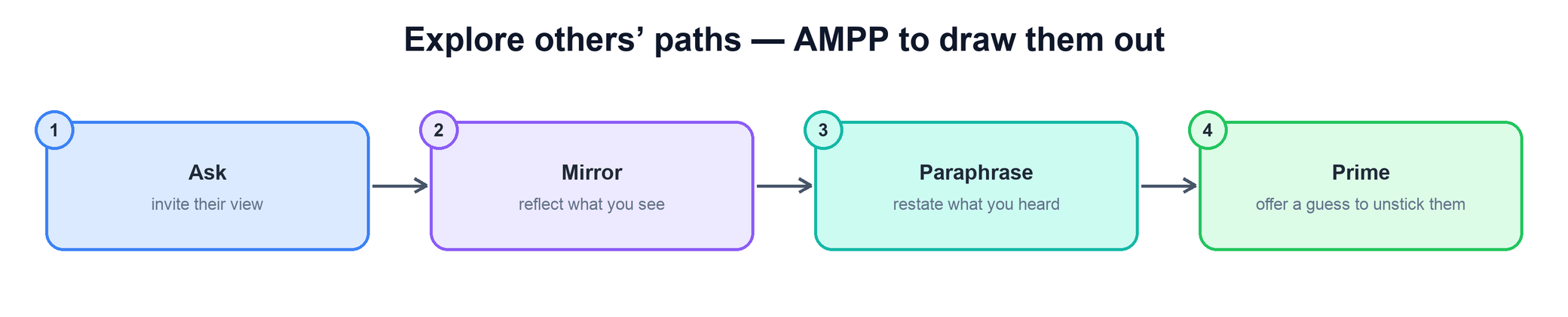
- Ask — simply invite their view: "What's going on for you here?"
- Mirror — reflect the mismatch you see between their words and their tone: "You say it's fine, but you don't sound fine."
- Paraphrase — restate what you heard in your own words to prove you were listening and to build safety.
- Prime — when they still won't open up, take a guess at what they might be feeling to prime the pump: "Are you worried this will fall on your team?"
When you disagree with what they share, respond with ABC: Agree where you genuinely agree (most disagreements are smaller than they feel), Build by adding what they left out rather than restarting, and Compare your differing view as a difference of paths — not "you're wrong," but "I see it differently, here's why."
9. Move to action
Filling the pool of shared meaning is not the finish line — a great conversation that produces no decision just breeds cynicism. Two things convert dialogue into results: deciding how to decide, and being precise about who does what.
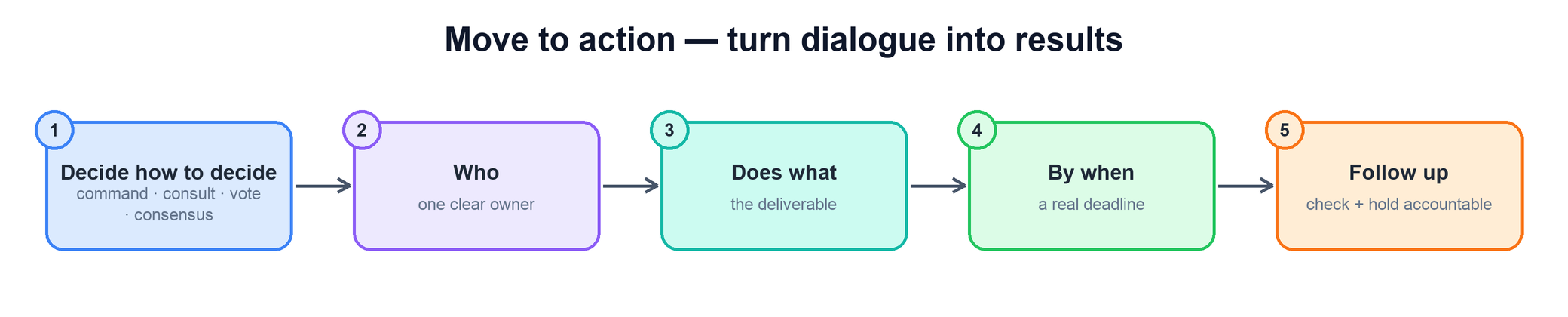
First, agree on the decision method — a lot of conflict comes from people assuming a different one:
| Method | Use it when |
|---|---|
| Command | The decision is made by someone else (a leader or external constraint); dialogue is about understanding, not choosing. |
| Consult | One person decides after gathering input from those affected. Efficient and common. |
| Vote | Speed matters more than full buy-in and everyone can live with the majority choice. |
| Consensus | Stakes and stakes-of-commitment are high enough to justify getting everyone genuinely on board. Powerful but expensive — reserve it. |
Then finish with the four details that make action real: Who (one owner, never "the team"), does What (a specific deliverable), by When (a real date), and how you'll follow up (a check-in that holds it accountable). Write it down — unrecorded decisions quietly evaporate.
10. Applying it at work
The frameworks map cleanly onto the hardest recurring conversations in engineering leadership. A few examples:
- Giving difficult feedback — Master My Stories before you walk in (are you telling a Villain story about them?), open with Contrasting to protect respect, then STATE the specific behavior and its impact.
- Incident and blameless postmortems — safety is the whole game; separate facts from stories so the review grades the system, not a person, and people actually tell you what happened.
- Code review disagreements — talk tentatively, ask for the author's path with AMPP, and use ABC to disagree without making it personal.
- Cross-functional conflict — CRIB straight to a mutual purpose when two teams want different things, then brainstorm strategies that serve the shared goal.
- Performance conversations — refuse the Fool's Choice ("honest or kind") and aim for both; make it safe, then be direct.
11. Summary
The whole book reduces to one loop: notice when a conversation turns crucial, make it safe, get your own story straight, share your view honestly and tentatively, draw out theirs, and convert the shared meaning into a clear decision.
| Skill | The one-line takeaway |
|---|---|
| Start with heart | Fix yourself first; know what you really want and refuse the Fool's Choice. |
| Learn to look | Watch for safety dropping into silence or violence — catch it early. |
| Make it safe | Rebuild Mutual Purpose and Mutual Respect with apology, Contrasting, and CRIB. |
| Master my stories | You author your emotions; separate fact from story and drop the clever stories. |
| STATE my path | Share facts, tell your story tentatively, and invite the other view. |
| Explore others' paths | Use AMPP to draw people out; use ABC to disagree without breaking safety. |
| Move to action | Decide how to decide, then nail who/what/when and follow up. |